
Popcorn box sizing affects portion control, customer satisfaction, profit margins, and operational efficiency more than most businesses realize. A movie theater selling 32-ounce boxes when customers expect 46-ounce servings creates disappointment and negative reviews, while oversized boxes at corporate events lead to excessive waste and inflated food costs.
Businesses ordering custom popcorn boxes for the first time often rely on vague size descriptions like “small,” “medium,” or “large” without understanding actual capacity, dimensions, or how sizing decisions affect customer perception and profitability.
This guide explains popcorn box sizing standards across different industries, how to calculate the right size for your specific application, dimensional specifications affecting display and storage, and practical considerations ensuring boxes match customer expectations while controlling costs.
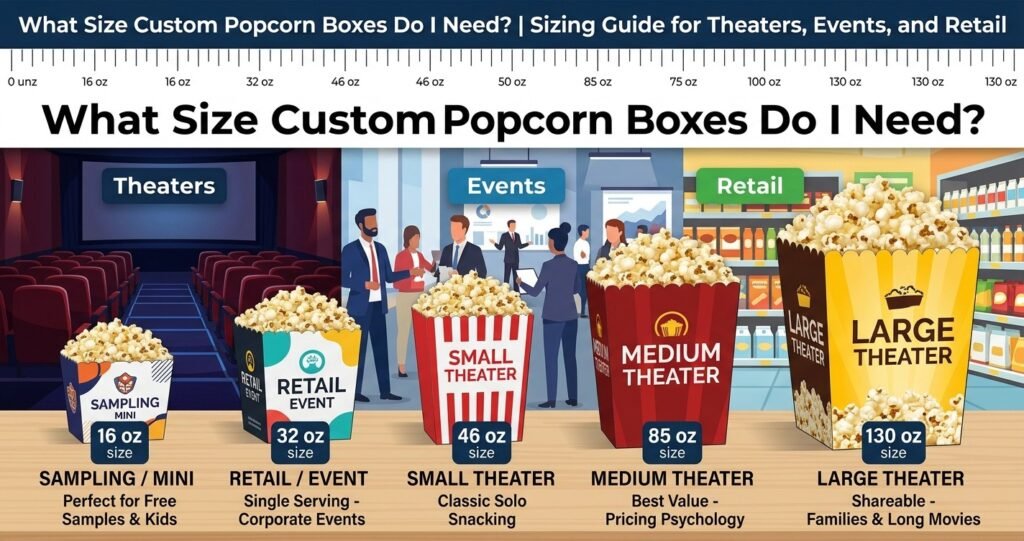
Quick Answer: Popcorn box sizes range from 16-ounce mini boxes for sampling to 170-ounce tubs for theater sharing. Standard movie theater sizes include 46-ounce small, 85-ounce medium, and 130-ounce large.
Retail and event applications typically use 32-ounce to 46-ounce boxes, balancing portion size with handling convenience. Choose sizes based on serving purpose, target customer demographics, price point positioning, and whether customers eat immediately or take portions home.
Why Does Popcorn Box Size Matter Beyond Just Capacity?
Customer Perception and Value
Box size directly influences perceived value even when actual popcorn quantity remains constant. Research in consumer psychology shows customers judge portion size partly by container dimensions, with taller, wider boxes appearing more generous than compact alternatives holding an identical volume.
The relationship between price and size must feel proportional to customers. A $6 popcorn serving needs visual heft justifying the cost, while $2 samples in oversized boxes make the pricing seem unreasonable relative to portion size.
Size affects eating experience and satisfaction ratings. Customers eating directly from boxes prefer sizes matching consumption speed since overly large boxes become cumbersome while too-small boxes require frequent refilling or feel stingy.
Theater popcorn sizing specifically creates tiered pricing psychology where medium sizes appear as the best value (anchoring effect). Many theaters intentionally price small boxes close to medium prices, steering customers toward higher-margin medium purchases.
Operational and Cost Considerations
Storage space in concession areas, storerooms, or event setups limits practical size ranges. Boxes stacking efficiently without excessive height or floor space requirements improve inventory management and reduce storage costs.
Staffing efficiency depends partly on box size affecting filling speed. Very large boxes require more filling time per customer, while extremely small boxes need more frequent preparation. Medium sizes (46-85 ounces) typically optimize staff productivity.
Food cost percentages vary by size, with larger boxes often showing higher profit margins despite lower per-ounce pricing. A 46-ounce box costing $0.35 plus $0.40 in popcorn kernels versus a 130-ounce box at $0.50 plus $0.85 in kernels demonstrates how larger sizes leverage fixed packaging costs.
Portion control becomes easier with standardized sizes, preventing staff from overfilling and cutting into profit margins. Clearly defined sizes with visual fill lines or volume markers ensure consistency.
Display and Branding Impact
Box height and width affect retail shelf presentation and visual impact at concession stands. Taller boxes create stronger shelf presence, drawing customer attention more effectively than squat, wide alternatives.
Brand visibility increases with larger surface areas providing more space for logos, graphics, and marketing messages. A 32-ounce box offers roughly 40 square inches of printable surface, while 85-ounce boxes provide 65+ square inches for branding.
Custom popcorn boxes in unique sizes create product differentiation distinguishing your offerings from competitors using standard dimensions. Specialty sizing becomes part of brand identity when consistently applied across locations or events.
What Size Works Best for Movie Theaters?
Traditional Cinema Sizing Standards
Movie theaters typically offer three sizes, creating pricing tiers and purchase options matching different customer needs. The classic small (46 oz), medium (85 oz), and large (130 oz) structure dominates mainstream cinema chains.
Small theater boxes serve solo moviegoers or customers wanting light snacking without committing to large portions. These boxes fit standard cup holders and don’t obstruct viewing when held, making them practical for confined seating.
Medium boxes represent value sweet spots where per-ounce pricing drops enough to feel economical while the total price remains moderate. Many theaters price mediums only $0.50-1.00 more than smalls, creating compelling upgrade incentives.
Large sizes target families, couples sharing, or customers planning to eat throughout long movies. These boxes often include free refill policies since popcorn costs represent small percentages of total pricing, turning large sizes into marketing tools building customer satisfaction.
Some premium theaters add extra-large or bucket options (150-170 oz) positioned as premium shareable experiences. These sizes command a $2-3 premium over large but cost minimally more in materials and popcorn, generating strong profit margins.
Luxury and Boutique Cinema Considerations
Luxury theaters with reclining seats and enhanced experiences often use smaller portion sizes (32-46 oz) emphasizing quality over quantity. Premium positioning justifies higher per-ounce pricing, while smaller portions prevent waste from customers unable to finish during movies.
Boutique cinemas serving alcohol and upscale snacks may eliminate traditional large sizes altogether, offering only individual portions (32-46 oz) fitting their refined dining approach. Size selection signals brand positioning as much as it serves functional purposes.
Dine-in theaters with table service sometimes use flat-bottom boxes or baskets (32-64 oz) instead of traditional tapered containers. These sizes sit stably on tables without tipping while maintaining appropriate portions for table-service dining contexts.
How Should Event Planners and Caterers Choose Sizes?
Corporate Events and Business Functions
Corporate events typically favor 32-46 ounce boxes, providing individual portions guests consume while networking or watching presentations. These sizes prevent waste since guests rarely finish larger portions at business functions.
Branding opportunities matter significantly at corporate events where custom popcorn boxes serve dual purposes as snacks and marketing materials. Medium-sized (46-64 oz) provide adequate branding space without excessive packaging costs.
Demographic considerations affect size selection, with professional audiences generally preferring conservative portions over oversized servings. Health-conscious corporate cultures may specifically request smaller portions (24-32 oz) as lighter snacking options.
Distribution logistics favor boxes guests can easily carry while holding drinks, programs, or event materials. Sizes exceeding 64 ounces become cumbersome at standing receptions or networking events.
Weddings and Private Celebrations
Wedding receptions often use smaller decorative boxes (16-32 oz) as favors or late-night snacks rather than main food items. These sizes work as take-home treats or light refreshments during dancing.
Children’s portions at family celebrations should use 16-24 ounce mini boxes, preventing waste while appropriately sizing servings for younger guests. Kid-friendly boxes with fun designs in smaller sizes create special touches.
Late-night snack stations at weddings typically offer 32-46 ounce boxes, allowing guests to grab popcorn during extended receptions without creating excessive waste from partially eaten large portions.
Aesthetic presentation matters at upscale events where box size must complement overall design themes. Custom sizes matching color schemes and decoration styles integrate popcorn service into cohesive event design.
Festivals and Outdoor Events
Festival environments favor durable 46-85 ounce boxes guests carry while walking, watching performances, or browsing vendors. These sizes balance portion generosity with practical mobility.
Value perception at festivals relates partly to visible portion size since customers compare offerings across multiple vendors. Boxes appearing generous even if moderately sized (64-85 oz) create competitive advantages.
Weather resistance matters at outdoor events where boxes must withstand humidity, light rain, or sun exposure without collapsing. Sizes using heavier board stock (46-85 oz range) maintain structural integrity better than very large or very small alternatives.
Waste management considerations at large festivals favor moderate sizes (46-64 oz), reducing trash volume compared to oversized boxes with substantial uneaten portions.
What Dimensions Should Retail Stores and Specialty Shops Consider?
Grocery Store and Retail Shelf Display
Retail shelf space constraints limit practical box heights and widths. Standard grocery shelving accommodates boxes up to 8-9 inches tall, making 46-85 ounce ranges most practical for shelf display.
Product visibility on crowded shelves favors taller boxes standing out among competing snacks. A 46-ounce box at 5.5 inches tall creates stronger shelf presence than wider, shorter alternatives with equal capacity.
Price point positioning in retail environments typically targets the $3-6 range for specialty popcorn, suggesting 24-46 ounce sizes providing perceived value without pricing products out of impulse-purchase territory.
Retail packaging serves take-home purposes, unlike immediate consumption at theaters or events. Sizes should consider multi-serving households or gift-giving, with 32-46 ounce boxes providing 4-6 servings for family snacking.
Specialty Gourmet Popcorn Shops
Gourmet popcorn retailers often use smaller premium boxes (16-32 oz), emphasizing quality and allowing customers to purchase multiple flavors. This approach encourages variety purchases and repeat visits.
Sampling and gift-sized options (8-16 oz) introduce customers to flavors without large commitments. These entry sizes support trial purchases converting to larger-size loyalty.
Medium sizes (32-46 oz) work as individual household purchases, balancing value with freshness since gourmet popcorn maintains quality for shorter periods than commercial varieties.
Large gift boxes (64-85 oz) serve special occasions and corporate gifts where presentation and perceived generosity matter more than everyday snacking practicality.
Window displays and visual merchandising favor varied sizes, creating interesting arrangements. Mixing 16-ounce, 32-ounce, and 64-ounce options generates visual interest while showcasing range.
How Do You Calculate the Right Size for Your Specific Needs?
Understanding Capacity Measurements
Ounces listed for popcorn boxes measure volume capacity, not weight. A 46-ounce box holds 46 fluid ounces of popped popcorn, approximately 5-6 cups, depending on popcorn size and packing density.
Popped popcorn weight varies significantly from volume, with roughly 1 cup of popped corn weighing 0.3-0.5 ounces. This means a 46-ounce box holds only 2-3 ounces by weight despite its 46-ounce volume capacity.
Kernel-to-popped expansion ratios affect how much unpopped kernels yield finished portions. Generally, 1 ounce of kernels produces 15-20 ounces of popped volume, helping calculate raw material needs for different box sizes.
Fill levels significantly impact perception, with boxes filled to 80-90% capacity appearing generous while 60-70% fill seems skimpy even if meeting stated capacity. Choose sizes allowing proper fill appearance.
Matching Size to Consumption Patterns
Individual immediate consumption suggests 32-46 ounce boxes, providing satisfying single servings without creating waste from unfinished portions. Most individuals consume 4-6 cups comfortably in one sitting.
Sharing between two people works well with 64-85 ounce boxes, offering enough for both without requiring very large containers. Couples or pairs generally consume 8-12 cups total when sharing.
Family groups (3-4 people) need 100-130 ounce boxes, providing adequate portions without constant refilling. Families with children typically consume 12-18 cups total.
Take-home or multi-serving purposes warrant 46-85 ounce boxes, providing 2-3 separate eating occasions for individuals or families consuming over multiple days.
Price Point and Profit Margin Calculations
Calculate the total cost including box cost plus popcorn kernels, oil, seasoning, and labor, to determine minimum viable pricing. A 46-ounce serving costing $0.75 total (packaging, kernels, labor) needs $2.50-3.00 pricing to maintain healthy margins.
Compare pricing across size tiers, ensuring logical progression where larger sizes offer per-ounce savings without cannibalizing smaller size sales. Medium boxes should cost 1.3-1.5x small prices, and large boxes 1.6-1.9x small prices.
Volume discounts on packaging affect size selection economics. Ordering 5,000 units of 46-ounce boxes versus splitting between three sizes impacts per-unit costs significantly.
Profit margins often improve with larger sizes since packaging costs increase slower than selling prices. A small box costing $0.35 and sold at $5.00 shows lower margin percentages than large boxes at $0.50 sold for $7.50.
What Box Styles and Shapes Affect Effective Sizing?
Traditional Tapered Scoop Boxes
Classic tapered boxes wider at the top than the bottom maximize capacity while maintaining stackability. These shapes fit 20-30% more popcorn than straight-sided alternatives with identical base dimensions.
Tapered designs make portion sizes appear larger due to wide top openings creating visual fullness. This perception allows slightly smaller capacities to achieve satisfaction equivalent to larger straight boxes.
Stacking efficiency of tapered boxes saves storage space, with nested stacking reducing warehouse and concession stand footprint by 40-50% compared to rigid containers.
Structural integrity of tapered designs prevents collapse when filled and handled. The shape naturally reinforces sidewalls, distributing weight and preventing box crushing during service.
Straight-Sided Boxes and Containers
Straight-sided boxes provide consistent branding visibility since vertical surfaces remain parallel, offering uninterrupted graphic display. This style suits retail shelf displays where side visibility matters.
Capacity calculations for straight boxes prove simpler since volume equals base area multiplied by height without complex taper calculations.
Straight designs sometimes feel more premium or modern compared to traditional tapered carnival-style boxes. Upscale venues and boutique operations prefer straight aesthetics.
Stacking of straight boxes requires more vertical space since they don’t nest efficiently. Storage planning must account for full-height stacking without space savings from nesting.
Tubs and Buckets for Large Formats
Large-capacity tubs (130+ ounces) use different construction than standard boxes with reinforced bases and integrated handles supporting substantial weight.
Reusable souvenir buckets popular at theme parks and special events use rigid plastic or heavy coated board, allowing customers to keep containers. These premium formats justify higher pricing through collectible appeal.
Base stability becomes critical for large tubs since top-heavy designs tip easily. Wide bases relative to height (width at least 70% of height) ensure stability on armrests and tables.
Should You Offer Multiple Custom Popcorn Box Sizes?
Benefits of Size Variety
Offering three sizes creates tiered pricing capturing different customer segments and spending levels. Budget-conscious customers buy small, value-seekers choose medium, and premium buyers or sharers select large.
Multiple sizes accommodate different usage occasions, with the same customers choosing small for solo visits and large for family outings. Size variety increases per-customer spending across multiple transactions.
Size differentiation allows creative pricing strategies where medium appears as the best value, steering customers toward the profitable middle tier. This anchoring effect increases average transaction values.
Menu flexibility through size variety prevents losing sales to customers whose needs don’t match single-size offerings. Size options reduce “too much” or “not enough” purchase barriers.
Challenges of Multiple Sizes
Inventory management complexity increases with each size variant, requiring separate stock, reorder planning, and storage allocation. Three sizes mean triple inventory tracking versus single-size operations.
Setup costs for custom printing multiply across sizes since each requires separate dies and printing plates. First-time orders with three sizes face 2.5-3x setup costs versus single sizes.
Staff training requirements increase when multiple sizes need different filling procedures, pricing, and portion control. Consistency challenges grow with size variety, especially during high-volume rushes.
Minimum order quantities affect multi-size strategies since splitting orders across three sizes may prevent reaching volume discounts on any single size.
Single-Size Strategy Considerations
Operating with one size simplifies operations, reduces inventory costs, and streamlines staff training. Fast-casual concepts and pop-up operations often succeed with single-size simplicity.
Single sizes work well when the customer base shows consistent preferences without wide demographic variation. College campus concessions serving similar-aged customers may successfully use only medium sizes.
Pricing flexibility decreases with single sizes since no comparison tiers exist, but a focus on quality and experience rather than size selection can compensate.
Premium positioning becomes easier with single optimal sizes where “one perfect size” messaging reinforces quality focus over quantity emphasis.
What Common Sizing Mistakes Should You Avoid?
Choosing Sizes Based Only on Competitor Observation
Competitors’ sizes may not suit your specific customer demographics, price points, or operational setup. Blindly copying theater sizes for retail applications or vice versa leads to poor fit.
Different business models require different sizing approaches. High-volume, low-margin operations favor different sizes than low-volume, high-margin premium concepts even in the same categories.
Ignoring Storage and Display Constraints
Ordering sizes too large for available storage creates operational problems, requiring off-site warehousing or limiting order quantities preventing volume discounts.
Retail shelf dimensions limit practical box heights and widths. Boxes exceeding shelf space requirements don’t display properly regardless of ideal capacity.
Underestimating Customer Expectations
New businesses entering established markets face size expectations set by industry standards. Theaters offering 32-ounce “large” sizes disappoint customers expecting 130-ounce portions based on industry norms.
Premium pricing requires proportionally sized servings. Charging $6 for 24-ounce boxes when competitors offer 46-ounce at the same price creates value perception problems.
Overlooking Practical Handling Concerns
Very large boxes exceeding 130 ounces become difficult for customers to carry while holding drinks or other items. Practical portability limits effective maximum sizes.
Small boxes under 24 ounces at events or theaters frustrate customers through frequent refilling needs or feeling shortchanged on servings.
Neglecting Branding and Marketing Needs
Choosing sizes too small for effective graphic display limits branding impact. Boxes should provide adequate surface area for logos, product names, and key marketing messages.
Seasonal or promotional custom popcorn boxes may warrant temporary size variations supporting specific campaigns. Overly rigid size standards prevent marketing flexibility.
Final Thoughts
Selecting the right popcorn box size requires balancing customer expectations, operational efficiency, and profit margin goals while considering your specific business context. Movie theaters typically benefit from three-tier sizing (46 oz, 85 oz, 130 oz) creating pricing psychology and accommodating diverse customer needs. Retail environments favor 32-46 ounce boxes fitting shelf dimensions and multi-serving household consumption, while events work best with 32-64 ounce individual portions guests easily carry.
Calculate size needs based on actual consumption patterns, target demographics, and whether customers eat immediately or take portions home. Consider dimensional specifications beyond just capacity, including height and width affecting display, storage, and handling. Test sizes through sampling before committing to large custom orders, gathering customer feedback on portion satisfaction and value perception.
Work with experienced packaging suppliers who understand popcorn-specific requirements, including grease resistance, structural integrity when filled, and dimensional specifications supporting your operational needs. Custom popcorn boxes properly sized for your application enhance customer satisfaction, support pricing strategies, and optimize operational efficiency while effectively representing your brand.