
A cinema chain ordering 10,000 custom popcorn boxes discovers after delivery that the manufacturer’s “grease-resistant” coating fails within five minutes of contact with buttered popcorn, forcing emergency reorders and temporary generic packaging during peak season.
An event planner receives boxes matching approved digital proofs perfectly except the custom Pantone red prints as orange under venue lighting, creating brand inconsistency across a high-profile corporate launch. A gourmet popcorn retailer learns too late the manufacturer cannot reproduce their order because the initial production used discontinued materials, making reorders impossible without complete redesign.
These disasters share a common cause: buyers failed to ask critical questions before placing orders with popcorn boxes manufacturer partners, making assumptions about capabilities, specifications, and processes that prove incorrect only after committing thousands of dollars to production runs.
This guide provides 25+ essential questions to ask any popcorn boxes manufacturer before placing your first order, organized by category to ensure you understand capabilities, limitations, quality standards, and terms preventing costly mistakes and establishing clear expectations for successful partnerships.
Quick Answer: Ask manufacturers these critical questions before ordering: material specifications and food-safety certifications, exact color-matching capabilities and Pantone limitations, minimum order quantities and volume pricing breakpoints, realistic lead times with buffer periods, sample availability and approval processes, design file requirements and revision policies, defect rates and replacement procedures, coating options and performance testing, size customization ranges and tooling costs, payment terms and deposit requirements, shipping methods and damage liability, reorder consistency guarantees, and production capacity during peak seasons. Document all answers in writing before committing to orders, and request physical samples demonstrating actual production quality rather than relying solely on digital proofs or sales representations.
Questions About Material Quality and Safety Standards
Understanding Food-Contact Compliance
“What specific FDA regulations do your materials comply with, and can you provide certification documentation?” Materials must meet 21 CFR standards for food-contact substances. Request written proof rather than verbal assurances, since non-compliant materials create liability exposure and potential health department violations.
“Are your coatings approved for direct food contact, or only for indirect contact?” Some industrial coatings resist grease but aren’t food-safe. Clarify whether coatings meet FDA requirements specifically for direct contact with oily, fatty foods like buttered popcorn.
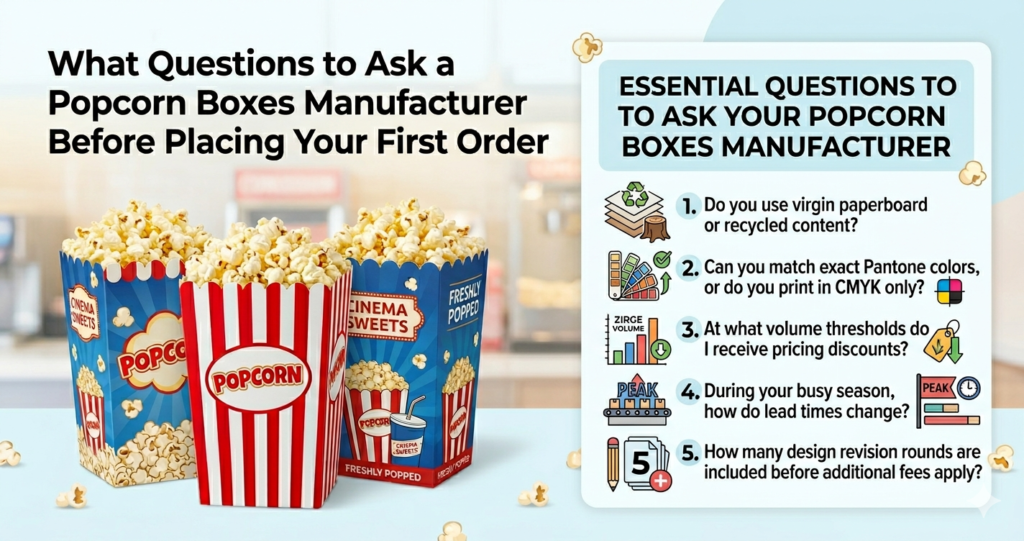
“Do you use virgin paperboard or recycled content?” Virgin materials ensure purity and consistent quality while recycled content may introduce contaminants or inconsistent performance. If using recycled materials, ask what percentage and how they ensure food safety.
Structural Integrity and Performance
“What is the board weight specification for the sizes I’m ordering?” Material thickness affects durability. Standard popcorn boxes use 14-18pt board for small to medium sizes, with heavier 20-24pt board for large formats. Confirm specifications match your handling requirements.
“How do you test grease resistance, and what performance standards do your boxes meet?” Ask about testing methodology—time until grease penetration, butter concentration used in tests, temperature conditions. Boxes should resist grease penetration for 30+ minutes under typical serving conditions.
“What happens to box strength in humid environments or when exposed to steam?” Outdoor events, humid climates, or freshly popped corn create moisture exposure. Understand how boxes perform when damp and whether additional coating provides protection.
Questions About Customization Capabilities and Limitations
Color Accuracy and Printing Constraints
“Can you match exact Pantone colors, or do you print in CMYK only?” Pantone spot colors provide exact brand color matching while CMYK approximates colors through process printing. If brand colors are critical, confirm Pantone capability and whether additional costs apply.
“How does your printing on kraft paper differ from white paper in terms of color vibrancy?” Natural kraft’s brown background dulls colors compared to white substrates. Request side-by-side samples showing identical designs on both materials understanding color shift implications.
“What is your achievable print resolution, and are there minimum text sizes?” Digital printing typically achieves 300+ DPI while offset provides superior detail. Ask about minimum readable text size (usually 6-8pt) and fine line thickness ensuring your design elements print clearly.
“Do you offer special finishes like spot UV, metallic inks, or embossing?” Premium finishes enhance visual impact but add costs and production time. Clarify availability, pricing increments, and whether special finishes affect minimum order quantities.
Size and Structural Customization
“What standard sizes do you offer, and can you create custom dimensions?” Standard sizes use existing dies avoiding tooling costs while custom sizes require new die creation adding $200-500 to order costs. Understand size options and associated expense implications.
“If I need custom sizing, what are die creation costs and ownership terms?” Clarify whether you own custom dies enabling reorders with any manufacturer, or whether manufacturer retains dies forcing ongoing relationship. Die ownership affects long-term flexibility.
“Can you modify box shapes—flared tops, curved edges, window cutouts, or unique bottom structures?” Structural modifications beyond standard tapered or straight designs require engineering assessment. Ask about feasibility, tooling costs, and whether modifications affect pricing or minimums.
Questions About Order Quantities and Pricing Structure
Minimum Order Requirements
“What is your absolute minimum order quantity, and does it vary by printing method?” Digital printing typically allows 250-1,000 unit minimums while offset printing requires 5,000-10,000 units. Confirm minimums for your specific size and customization needs.
“If I order multiple sizes or designs, can I combine quantities to meet minimums?” Some manufacturers allow splitting minimum quantities across variations while others require minimums per SKU. Combined minimums provide flexibility for diverse product lines.
“At what volume thresholds do I receive pricing discounts?” Volume pricing typically breaks at 1,000, 2,500, 5,000, and 10,000+ units. Understanding breakpoints helps optimize order quantities balancing unit costs against inventory carrying costs.
Understanding Complete Cost Breakdown
“Can you provide itemized pricing showing per-unit costs, setup fees, die charges, and shipping separately?” Hidden fees revealed after commitment create budget problems. Insist on transparent pricing breaking down all cost components before placing orders.
“Are setup fees one-time or recurring with each order?” One-time setup fees amortize across reorders while recurring fees increase per-order costs. Clarify fee structure and whether reorders using same specifications avoid setup charges.
“What triggers additional charges—design revisions, rush production, color changes, or special materials?” Understanding upcharge triggers prevents budget surprises. Ask for written policies specifying exactly what changes incur additional fees and typical cost ranges.
Questions About Production Process and Timelines
Realistic Lead Time Expectations
“What is your standard production lead time from approved artwork to shipment?” Standard timelines typically span 7-15 business days depending on printing method and complexity. Get specific commitments rather than vague estimates enabling accurate planning.
“How much additional time should I allow for design development and approval before production starts?” Design phase adds 5-10 business days to total timeline. Manufacturers should clarify whether quoted lead times include or exclude design and approval periods.
“During your busy season, how do lead times change?” Summer festivals and holiday seasons create capacity constraints extending timelines. Ask about seasonal variations and whether placing advance orders guarantees standard lead times.
“Do you offer rush production, and what are the costs and realistic timeframes?” Rush services typically cost 25-50% premiums and compress timelines by 3-5 days. Confirm actual rush capabilities rather than assuming expedited service availability.
Design Files and Technical Requirements
“What file formats do you require, and what are your technical specifications?” Most manufacturers require vector files (AI, PDF, EPS) with outlined fonts, CMYK colors, and proper bleed setup. Clarify exact requirements preventing file rejection delays.
“Do you provide dieline templates, and can your team assist with file preparation?” Templates ensure designs fit properly within printable areas. Ask whether design assistance is included or costs extra, and what level of support they provide.
“How many design revision rounds are included before additional fees apply?” Standard packages typically include 1-3 revision rounds. Understanding revision policies prevents unexpected charges during design refinement.
Questions About Quality Control and Defect Management
Quality Assurance Processes
“What quality control inspections do you perform during production?” Professional manufacturers inspect at multiple stages—substrate receipt, printing, die-cutting, and final packaging. Ask specifically what they check and at what production points.
“What is your typical defect rate, and how do you define defective units?” Industry-standard defect rates run 1-3%. Understand their historical performance and whether they have written standards defining what constitutes defective product.
“Can I inspect production runs or require hold-for-approval before shipping?” First-time orders with new manufacturers benefit from pre-shipment approval. Ask whether they accommodate inspection visits or can ship samples from production run before completing full order.
Handling Problems and Replacements
“What is your policy for replacing defective products?” Clear replacement policies protect your investment. Get written guarantees specifying acceptable defect thresholds, who pays shipping, and turnaround time for replacement production.
“If I’m unsatisfied with color accuracy or print quality, what recourse do I have?” Color disputes represent common complaints. Understand whether manufacturer will reprint for color variations and what tolerance ranges they consider acceptable.
“What happens if boxes arrive damaged from shipping?” Clarify liability for shipping damage and replacement procedures. Understand whether they file insurance claims or expect customers to handle damaged shipment issues.
Questions About Samples, Proofing, and Approval Processes
Physical Sample Availability
“Can you provide physical samples before I commit to a full order?” Physical samples reveal material quality, structural integrity, and print characteristics impossible to assess digitally. Sample costs of $50-100 represent essential insurance.
“Will samples be produced using the same materials and process as my production run?” Sample-specific materials or processes create misleading quality expectations. Confirm samples accurately represent production output rather than best-case showcase pieces.
“What is the turnaround time for sample production and delivery?” Sample timelines of 5-10 business days must factor into overall project schedules. Plan sampling phases preventing delays to final production deadlines.
Proof Approval Procedures
“Do you provide digital proofs, physical proofs, or both?” Digital proofs show layout and general appearance while physical proofs demonstrate actual print quality on real substrates. First orders benefit from physical proofing despite additional cost and time.
“Once I approve proofs, can I still make changes, or is approval final?” Understand whether proof approval locks specifications or allows minor adjustments. Post-approval changes may incur fees or restart production timelines.
“What approval documentation do you require—email confirmation, signed forms, or other?” Clear approval processes prevent miscommunication. Know what sign-off they need and keep approval documentation for your records protecting against disputes.
Questions About Payment Terms and Business Practices
Payment Structure and Timing
“What are your payment terms—deposit percentage, payment timing, and accepted methods?” Standard terms require 50% deposit with balance due on delivery. Unusual terms like 100% upfront payment may signal financial instability warranting caution.
“Do you offer net-30 or net-60 payment terms after establishing relationship?” Extended payment terms improve cash flow for ongoing partnerships. Ask about qualification requirements and whether minimum order histories enable credit terms.
“What forms of payment do you accept, and are there processing fees for credit cards?” Credit card convenience may carry 2-3% processing fees. Clarify whether wire transfer, ACH, or check payments avoid fees affecting total costs.
Long-Term Relationship Considerations
“How do you ensure consistency between reorders of the same design?” Consistent reproduction matters critically for brand recognition. Ask whether they archive specifications, maintain color formulas, and store dies between orders guaranteeing reorder accuracy.
“What happens if materials or processes used in my initial order become unavailable?” Discontinued materials prevent exact reproductions. Understand whether they notify customers about changes and how they handle necessary substitutions maintaining quality.
“Can you provide references from customers who have worked with you for multiple years?” Long-term customer references demonstrate consistent performance and relationship management. Ask references about reorder consistency, problem resolution, and overall satisfaction trajectory.
Questions About Shipping, Handling, and Delivery
Logistics and Delivery Details
“What shipping carriers do you use, and can I specify preferred carriers?” Carrier choice affects delivery speed, tracking capability, and damage rates. Some manufacturers mandate specific carriers while others accommodate customer preferences.
“Are shipping costs included in quoted prices, or billed separately?” Shipping represents significant expense requiring clear understanding. Confirm whether quotes include delivery or whether freight bills separately preventing budget surprises.
“Can you ship to multiple locations from one order, and what are the cost implications?” Multi-location businesses benefit from split shipments delivered directly to each venue. Ask about split shipment capabilities, minimum quantities per location, and additional handling fees.
“How are boxes packaged for shipment, and what protection prevents damage?” Proper packaging using pallets, stretch wrap, and protective layers prevents crushing or moisture damage. Understand packaging methods and whether you can specify special handling.
What Question Categories Do First-Time Buyers Often Neglect?
Overlooking Reorder Logistics
First-time buyers focus exclusively on initial order mechanics while ignoring reorder processes, storage of specifications, consistency guarantees, and price lock provisions affecting long-term costs. Ask reorder questions upfront even when placing only one order.
Die ownership and specification retention determine whether you can source reorders from alternative manufacturers or remain locked to initial supplier. Clarify ownership rights and whether you receive complete specifications for competitive bidding.
Assuming Standard Practices
Buyers assume industry-standard practices without confirmation discovering too late that specific manufacturers deviate significantly. Never assume standard payment terms, typical lead times, normal defect policies, or common quality standards, ask explicitly and document answers.
Regional variations, manufacturer size, and business model differences create substantial practice variations. International manufacturers operate under different norms than domestic suppliers; small operations differ from large manufacturers; wholesalers differ from direct manufacturers.
Failing to Document Answers
Verbal assurances during sales conversations prove worthless when problems arise months later with different personnel handling accounts. Request written confirmation of critical answers regarding specifications, timelines, prices, and policies creating enforceable records.
Follow-up emails summarizing phone discussions and requesting confirmation establish written documentation even when manufacturers don’t proactively provide written terms. Email records protect your interests if disputes arise.
Final Thoughts
Asking comprehensive questions before placing orders with popcorn boxes manufacturer partners prevents expensive mistakes from mismatched expectations, inadequate specifications, or unclear terms discovered only after committing to production. Thorough questioning during evaluation demonstrates professionalism, sets clear performance standards, and establishes accountability frameworks protecting your business interests.
Prioritize questions about food safety compliance, material specifications, and quality standards as non-negotiable fundamentals, then address customization capabilities, pricing structure, and timelines matching your operational requirements. Don’t hesitate to ask follow-up questions when initial answers lack specificity or create concerns-manufacturers should welcome detailed questions from serious buyers.
Document all answers in writing through email confirmations, quotes incorporating discussed terms, or formal agreements before placing orders. Written documentation prevents miscommunication and provides recourse if manufacturers fail to deliver promised specifications, timelines, or quality standards.
Work with popcorn boxes manufacturer partners who answer questions completely, transparently, and professionally without evasiveness or pressure tactics. Manufacturers confident in their capabilities and committed to customer success welcome thorough vetting and provide detailed, honest answers supporting informed decision-making.