
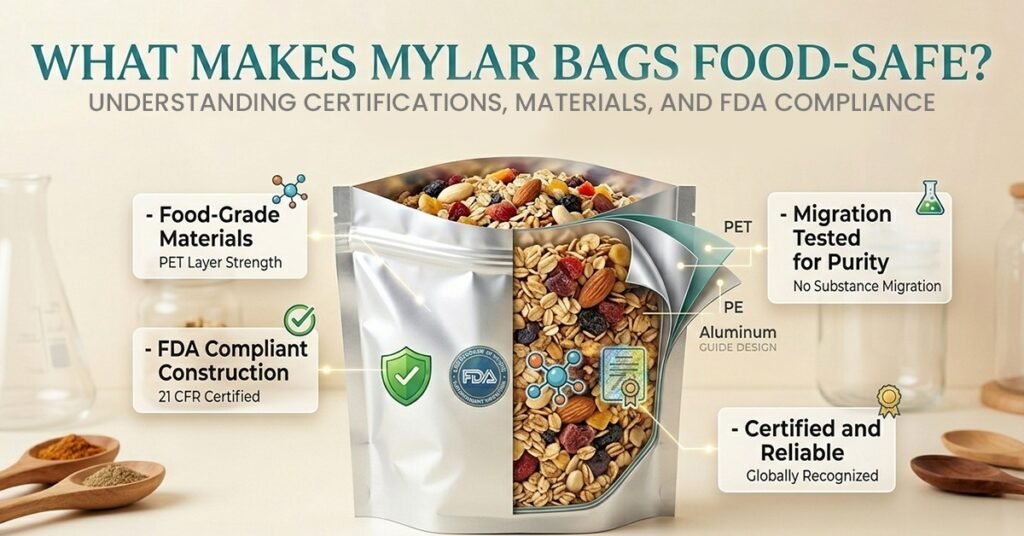
Food packaging safety determines whether materials touching edible products comply with regulatory standards preventing chemical migration, contamination, or health hazards. Businesses selling food, beverages, supplements, or pet food face legal liability and serious health risks when using packaging materials not certified for food contact. The FDA regulates food-contact substances under Title 21 of the Code of Federal Regulations, but enforcement relies partly on manufacturers and businesses choosing compliant materials rather than universal pre-market approval systems catching every violation.
This guide explains what food-safe certification actually means for custom mylar bags, which regulatory standards apply, material composition requirements, testing procedures verifying safety, and practical steps businesses should take ensuring packaging complies with FDA regulations.
Quick Answer: Food-safe mylar bags meet FDA regulations under 21 CFR 177.1520 for polyester film and related sections for aluminum foil and polyethylene coatings. True food-grade mylar uses virgin materials (not recycled content), passes migration testing showing chemicals don’t transfer to food, and includes food-safe printing inks meeting FDA indirect food contact standards. Look for supplier certifications, independent lab testing documentation, and specific FDA CFR citations rather than vague “food-safe” claims without supporting evidence.
What Does “Food-Safe” Actually Mean for Mylar Bags?
FDA Regulatory Framework
The FDA does not pre-approve food packaging materials before market use. Instead, manufacturers self-affirm compliance with FDA regulations or obtain generally recognized as safe (GRAS) status for novel substances. This regulatory structure places responsibility on businesses choosing packaging ensuring materials meet applicable standards.
Title 21 CFR (Code of Federal Regulations) establishes food-contact substance regulations including specifications for polymers, coatings, adhesives, and additives used in packaging materials. Mylar bags comply when all component materials meet relevant CFR sections and migration testing demonstrates no harmful substance transfer to food.
Food contact substances must use approved additives at specified concentration limits. The FDA maintains positive lists of permitted substances with maximum usage levels. Materials containing unlisted additives or exceeding permitted concentrations fail compliance regardless of migration test results.
Migration testing measures whether chemicals transfer from packaging into food simulants (liquids mimicking different food types) under specified time and temperature conditions. Testing protocols follow FDA guidelines in 21 CFR 175.300 establishing extraction procedures for different food categories.
Good manufacturing practices (GMPs) under 21 CFR Part 110 require food packaging manufacturers to maintain sanitary conditions, implement quality control systems, and document compliance procedures. Material suppliers should provide certificates of compliance or testing documentation verifying FDA conformity.
Material Composition Requirements
Food-safe mylar bags typically use virgin polyethylene terephthalate (PET) film as base material meeting 21 CFR 177.1520 specifications. Virgin resin ensures no contamination from recycled sources that may contain unknown substances or accumulated chemicals.
The aluminum layer in metallized mylar must meet purity standards under 21 CFR 175.380 preventing heavy metal contamination. Food-grade aluminum deposition uses high-purity aluminum preventing lead, cadmium, or other toxic metals from contacting food.
Interior food-contact surfaces use polyethylene coatings complying with 21 CFR 175.300 providing inert barrier between metallized layers and food products. This coating prevents direct aluminum contact with food while creating heat-sealable surface.
Lamination adhesives bonding material layers must comply with 21 CFR 176.170 or 176.180 depending on adhesive chemistry. Solvent-based, solvent-less, or water-based adhesives all require FDA compliance for food-contact applications.
Printing inks applied to exterior surfaces fall under indirect food contact regulations (21 CFR 175.105 and 175.380) since chemicals may migrate through substrate to food contact surface. Even exterior printing requires food-safe ink formulations.
Certifications and Documentation
Third-party testing laboratories conduct migration testing following FDA protocols and issue certificates of compliance documenting that materials meet regulatory standards. These certificates provide evidence of compliance if FDA inspections or customer audits question packaging safety.
Material Safety Data Sheets (MSDS) or Safety Data Sheets (SDS) disclose chemical composition and hazard information but do not constitute food-safety certification. MSDS documents safety handling requirements rather than confirming FDA food-contact compliance.
Supplier declarations of compliance state manufacturers affirm their materials meet FDA regulations. These declarations carry less weight than independent lab testing but serve as baseline documentation of compliance claims.
Certificates of analysis from material suppliers detail specific testing results including migration levels, heavy metal content, and extractables testing. These certificates provide detailed evidence beyond generic compliance claims.
ISO 22000 or FSSC 22000 certifications indicate manufacturers implement food safety management systems including proper handling, quality control, and contamination prevention. These certifications address manufacturing practices rather than specific material compliance but indicate professional quality systems.
BRC (Brand Reputation Compliance) or SQF (Safe Quality Food) certifications demonstrate manufacturers meet recognized food safety standards through third-party audits. These certifications increase confidence in supplier quality systems beyond self-declared compliance.
Why Do Material Composition and Purity Matter?
Virgin vs. Recycled Materials
Virgin materials manufactured from new resin eliminate contamination risks from unknown substances in recycled streams. Post-consumer recycled content may contain residues from previous uses including chemicals, medications, or industrial substances inappropriate for food contact.
The FDA prohibits post-consumer recycled content in direct food-contact surfaces unless material undergoes validated recycling processes removing contaminants. Most mylar bag manufacturers avoid recycled content in food-contact layers preventing compliance complications.
Industrial recycled content (pre-consumer scrap) from manufacturing processes poses lower contamination risks than post-consumer material but still requires validation ensuring no cross-contamination from non-food applications in manufacturing facilities.
Supply chain transparency matters for virgin material verification. Reputable suppliers provide documentation tracing materials to resin manufacturers confirming virgin content rather than accepting claims without verification.
Chemical Additives and Plasticizers
Plasticizers, stabilizers, and processing aids added to polymers during manufacturing must comply with FDA regulations. Some common plasticizers like certain phthalates face restrictions or prohibitions in food-contact applications due to health concerns.
Slip agents and anti-blocking agents preventing film layers from sticking together during manufacturing must come from FDA-approved substance lists. These additives migrate to surfaces where food contact occurs, requiring compliance verification.
UV stabilizers, antioxidants, and other performance additives require FDA approval for food-contact use. Materials formulated for industrial packaging may contain additives permitted for non-food applications but prohibited for food contact.
Migration testing determines whether additives transfer from packaging to food at levels exceeding FDA limits. Even approved additives must stay below specific migration limits measured through standardized testing protocols.
Heavy Metal Contamination
Lead, cadmium, mercury, and other heavy metals pose serious health risks even at low concentrations. Food-contact materials must demonstrate heavy metal content below FDA limits through compositional analysis and migration testing.
Aluminum metallization in mylar bags requires high-purity aluminum preventing toxic metal contamination. Industrial-grade aluminum may contain impurities acceptable for non-food applications but failing food-safety standards.
Printing inks historically contained lead and cadmium in pigments. Modern food-safe inks use alternative colorants meeting FDA standards, but older ink formulations or non-compliant inks from some manufacturers may still contain problematic metals.
Adhesives and sealants sometimes contain heavy metal catalysts or driers. Food-compliant adhesives use alternative chemistries avoiding toxic metals or keeping concentrations below regulatory limits.
What Testing Verifies Food-Safe Compliance?
Migration Testing Procedures
Migration testing exposes packaging materials to food simulants (water, acetic acid, ethanol, vegetable oil) representing different food types (aqueous, acidic, alcoholic, fatty) under time and temperature conditions matching intended use.
Testing protocols follow FDA guidelines in 21 CFR 175.300 establishing specific extraction conditions. Testing at 120°F for 2 hours simulates hot-fill applications, while room temperature testing for 10 days represents shelf storage conditions.
Analytical methods detect and quantify substances migrating from packaging into food simulants. Gas chromatography-mass spectrometry (GC-MS) or liquid chromatography-mass spectrometry (LC-MS) identify chemical compounds at parts-per-billion sensitivity.
Overall migration limits restrict total amount of substances transferring from packaging to food regardless of substance identity. The FDA generally accepts 50 ppm (parts per million) or 0.5 mg per square inch as overall migration limit for food-contact materials.
Specific migration testing measures individual substances of concern (plasticizers, monomers, additives) ensuring concentrations stay below FDA-specified limits. Some substances have very low specific migration limits (0.05 ppm) requiring sensitive analytical methods.
Testing must occur on finished packaging materials in final form including all layers, coatings, and printing. Testing component materials separately doesn’t verify finished package compliance since manufacturing processes may create interactions between layers.
Heavy Metal Testing
Heavy metal analysis measures lead, cadmium, mercury, arsenic, and chromium content through inductively coupled plasma mass spectrometry (ICP-MS) or atomic absorption spectroscopy. These methods detect metals at parts-per-billion levels.
Testing follows FDA protocols or recognized standards like California Proposition 65 establishing maximum allowable concentrations. Lead limits for food-contact materials typically fall below 100 ppm total content with lower migration limits.
Surface analysis using X-ray fluorescence (XRF) provides non-destructive screening for heavy metals in packaging materials. XRF offers quick preliminary assessment though confirmatory testing through ICP-MS provides more accurate quantification.
Testing should cover all material components including base films, aluminum layers, adhesives, inks, and coatings. Heavy metals may appear in unexpected locations like pigments in colored films or catalysts in adhesives.
Extractables and Leachables Studies
Extractables testing uses harsh solvents and extreme conditions identifying all potential substances that could migrate from packaging materials. This worst-case testing reveals chemical composition and potential contaminants.
Leachables testing uses realistic conditions matching actual product storage determining which extractables actually transfer under normal use. Leachables represent subset of extractables migrating at relevant temperatures and contact times.
These studies particularly matter for products with long shelf lives, hot-fill applications, or products containing oils, alcohols, or other aggressive substances increasing migration risk.
Pharmaceutical-grade testing protocols for extractables and leachables exceed basic FDA food-contact requirements but provide higher confidence in material safety for sensitive applications.
Which Certifications Should Businesses Look For?
FDA Compliance Statements
Suppliers should provide written statements declaring materials comply with relevant FDA regulations citing specific CFR sections. Generic “FDA approved” claims without citations lack specificity since FDA doesn’t approve packaging materials broadly.
Statements should identify all material components (base film, coatings, adhesives, inks) with corresponding CFR citations. Comprehensive compliance statements demonstrate supplier knowledge of applicable regulations.
Compliance statements should specify intended use conditions (temperature range, food types, contact duration) since FDA regulations vary based on application. Materials compliant for cold storage may not meet requirements for hot-fill applications.
Dated compliance statements with revision tracking ensure documentation reflects current material formulations. Materials change over time, requiring updated compliance verification when formulations change.
Third-Party Testing Certificates
Independent laboratories like SGS, Intertek, TÜV, or Bureau Veritas conduct migration testing and issue certificates documenting FDA compliance. Third-party testing provides greater credibility than supplier self-testing.
Certificates should detail testing protocols, food simulants used, temperature and time conditions, and analytical methods. Comprehensive certificates allow verification that testing followed appropriate procedures.
Testing certificates should show actual migration values compared to regulatory limits rather than just pass/fail results. Numerical data provides transparency about safety margins.
Recent testing (within 1-2 years) ensures certificates reflect current materials. Old certificates may not represent material changes or formulation updates occurring since original testing.
International Food Safety Standards
European Union regulations under 10/2011 framework establish food-contact material standards often exceeding FDA requirements. Materials meeting EU standards typically comply with FDA regulations though verification remains necessary.
German LFGB certification represents rigorous European food-contact testing. LFGB-compliant materials demonstrate high safety standards though US businesses still need FDA compliance verification.
China GB 4806 standards govern food-contact materials in Chinese markets. Businesses exporting to China need GB compliance alongside FDA requirements for US sales.
Multi-market compliance becomes important for businesses selling internationally. Packaging meeting FDA, EU 10/2011, and other major market standards simplifies global distribution.
What Questions Should Businesses Ask Mylar Bag Suppliers?
Material Composition Verification
Ask whether materials use virgin or recycled content. Verify that all food-contact surfaces use virgin materials meeting FDA standards. Recycled content in non-contact layers may be acceptable but requires documentation.
Request complete material composition including all layers, coatings, adhesives, and additives. Transparency about formulation demonstrates supplier knowledge and quality systems.
Inquire about material sourcing and supply chain traceability. Reputable suppliers track materials to original manufacturers ensuring quality consistency and compliance verification.
Ask whether formulations have changed recently requiring updated compliance testing. Material changes necessitate new migration testing validating continued FDA compliance.
Testing Documentation and Certifications
Request copies of migration testing certificates from independent laboratories. Review certificates verifying they cover relevant food types, temperatures, and contact times matching your product application.
Ask about heavy metal testing results. Review data confirming lead, cadmium, and other toxic metals stay well below FDA limits.
Request FDA compliance statements citing specific CFR sections applicable to mylar bag components. Generic “FDA approved” claims without citations indicate insufficient compliance knowledge.
Inquire about testing frequency. Regular testing (annually or after formulation changes) demonstrates ongoing quality commitment beyond one-time certification.
Ask whether supplier maintains HACCP, ISO 22000, or other food safety certifications. While not replacing material testing, these certifications indicate professional quality management systems.
Application-Specific Compliance
Verify that materials suit your specific application (hot-fill, fatty foods, acidic products, long shelf life). FDA compliance varies by food type and storage conditions.
Ask about recommended maximum storage temperatures and durations. Some materials compliant for ambient storage may not suit hot-fill or retort applications.
Inquire about compatibility with your specific products, especially if containing oils, acids, or alcohol. Migration increases with aggressive substances requiring application-specific testing.
Request information about seal integrity and barrier properties maintaining food protection throughout shelf life. Compliance includes maintaining protective barriers preventing contamination.
Manufacturing Quality Controls
Ask about manufacturing facility food safety certifications (BRC, SQF, FSSC 22000). These certifications demonstrate systematic quality management beyond basic material compliance.
Inquire about contamination prevention procedures in manufacturing facilities. Cross-contamination from non-food production runs compromises food-safety claims.
Request information about quality control testing during production. Ongoing monitoring ensures consistency meeting compliance standards established during initial testing.
Ask about traceability systems allowing lot tracking if safety issues arise. Proper traceability enables targeted recalls rather than broad market actions.
How Do Different Food Types Affect Mylar Bag Safety Requirements?
Dry Foods and Non-Perishables
Dry foods like coffee, tea, spices, nuts, and grains represent lower-risk applications since minimal moisture limits chemical migration. Standard food-grade mylar typically suits dry food packaging without specialized formulations.
Migration testing for dry foods uses vegetable oil or fatty food simulants since many dry foods contain oils. Nuts, coffee beans, and chocolate all contain fats potentially extracting chemicals from packaging.
Long shelf lives common with dry foods require testing simulating extended storage periods. Migration testing at room temperature for 10 days validates typical shelf storage though longer-term studies provide additional confidence.
Oxygen barrier properties matter significantly for dry foods sensitive to oxidation. Coffee, nuts, and whole grains go rancid with oxygen exposure, requiring mylar bags maintaining barrier integrity throughout shelf life.
Moist or Semi-Moist Foods
Moist foods like dried fruits, jerky, or pet treats contain enough moisture for aqueous migration testing. These applications require verification using water or acetic acid simulants.
pH affects migration rates, with acidic products increasing extraction of certain substances. Products like dried tomatoes or fruit preserves need testing with acidic simulants (3% acetic acid) validating safety for low-pH foods.
Moist foods may support microbial growth if packaging barriers fail. Material compliance must include maintaining protective barriers preventing moisture transmission and external contamination.
Modified atmosphere packaging (MAP) for moist foods requires verification that barrier properties maintain gas composition preventing spoilage. Mylar’s excellent oxygen and moisture barriers suit MAP applications when properly heat-sealed.
Fatty and Oily Foods
Fatty foods represent highest-risk category for chemical migration since oils effectively extract non-polar substances from packaging materials. Oils, nut butters, chocolate, and fatty snacks require rigorous testing with fatty food simulants.
Testing uses vegetable oil or alternative fatty simulants at elevated temperatures (120°F for 2 hours) simulating worst-case extraction conditions. Materials passing fatty food testing typically comply with other food categories.
Some plasticizers and additives migrate preferentially into fatty foods. Materials safe for aqueous or dry foods may fail fatty food testing due to increased migration into oils.
Fatty food contact often requires specialized barrier coatings preventing direct oil contact with adhesive layers or metallization. Interior polyethylene coatings provide effective fatty food barriers.
Hot-Fill and Retort Applications
Hot-fill applications (products filled above 160°F) require materials withstanding elevated temperatures without degrading or increasing migration. Standard mylar formulations may not suit hot-fill applications.
Retort processing (pressure-cooking packaged foods for sterilization) subjects packaging to 240-250°F with pressure. Only specialized retort-grade mylar bags meeting stringent requirements suit these applications.
Testing for hot-fill applications uses elevated temperatures (120-175°F) and extended contact times validating safety under actual processing conditions. Room-temperature testing data doesn’t verify hot-fill compliance.
Seal integrity under thermal stress becomes critical for hot-fill applications. Seals must maintain strength and barrier properties at elevated temperatures preventing contamination during and after filling.
Supplements and Vitamins
Dietary supplements fall under FDA dietary supplement regulations (21 CFR 111) including packaging requirements. Supplement packaging must prevent contamination and maintain product potency.
Some vitamins and nutraceuticals are chemically reactive, potentially interacting with packaging materials. Vitamin C’s acidity and antioxidant properties may increase migration requiring specialized testing.
Moisture-sensitive supplements (probiotics, some vitamins) require extremely low moisture transmission rates. Mylar bags provide excellent moisture barriers when properly heat-sealed though testing should verify adequate protection.
Supplement companies often apply pharmaceutical-grade standards exceeding basic FDA food-contact requirements. Enhanced testing including extractables/leachables studies provides additional safety assurance.
What Are Common Misconceptions About Food-Safe Mylar Bags?
“All Mylar Bags Are Food-Safe”
Generic mylar bags sold for crafts, electronics, or industrial applications may not meet FDA food-contact standards. Industrial mylar may use recycled content, non-compliant adhesives, or materials not tested for food contact.
Appearance alone cannot determine food-safety compliance. Industrial and food-grade mylar look identical requiring supplier documentation verifying FDA compliance.
Purchasing mylar bags without requesting compliance documentation risks using non-compliant materials exposing businesses to regulatory violations and potential liability.
“Exterior Printing Doesn’t Matter for Food Safety”
Exterior printing inks must meet FDA indirect food-contact standards since chemicals may migrate through substrate to food-contact surfaces. Non-compliant exterior inks create food-safety violations.
Heavy metals in printing inks (lead, cadmium in pigments) can migrate through packaging materials. Even exterior printing requires food-safe formulations preventing contamination.
Adhesive layers may allow ink component migration. Multi-layer mylar bags require verification that exterior printing doesn’t migrate through adhesive to interior food-contact surfaces.
“Clear Windows Mean Non-Compliant Materials”
Clear viewing windows in mylar bags can meet FDA standards when using compliant clear films properly laminated. Material compliance depends on specific materials and testing rather than transparency.
Some clear windows use PET or polypropylene films meeting FDA food-contact regulations. Documentation verifying window material compliance ensures total package safety.
Adhesives bonding clear windows require FDA compliance. Non-compliant adhesives compromise food safety even when base materials meet standards.
“One-Time Testing Ensures Permanent Compliance”
Material formulations change over time as suppliers modify additives, change resin sources, or adjust processing. Regular testing (annually or after formulation changes) maintains compliance verification.
Supplier changes affect compliance. New material suppliers require compliance verification even for ostensibly identical materials since manufacturing processes differ.
Regulatory standards evolve with new research identifying safety concerns. Periodic testing ensures materials continue meeting current standards rather than outdated requirements.
“Thicker Bags Are Safer”
Material thickness doesn’t determine food-safety compliance. Thin food-grade mylar meeting FDA standards provides safer packaging than thick non-compliant materials.
Barrier properties matter more than thickness alone. Properly formulated thin mylar offers excellent oxygen and moisture barriers protecting food effectively.
Thickness affects durability and puncture resistance but not chemical compliance. Both thin and thick bags require identical FDA compliance verification.
How Should Small Businesses Ensure Compliance?
Working With Reputable Suppliers
Choose mylar bag suppliers specifically serving food industry demonstrating knowledge of FDA regulations and food-safety requirements. Food-focused suppliers understand compliance better than general industrial packaging providers.
Request compliance documentation before ordering. Legitimate suppliers provide FDA compliance statements, testing certificates, and material composition details without hesitation.
Verify supplier claims through review of testing certificates from recognized laboratories. Look for specific migration values, test conditions, and analytical methods rather than generic pass/fail statements.
Start with small orders testing material quality and verifying compliance documentation accuracy before committing to large inventory. Sample orders enable due diligence without excessive financial risk.
Ask suppliers about notification procedures if material formulations change. Proactive communication about changes allows businesses to request updated compliance testing maintaining verification.
Documentation and Record-Keeping
Maintain compliance documentation files including supplier FDA statements, testing certificates, material composition sheets, and correspondence about food-safety compliance. These records demonstrate due diligence during inspections or if safety questions arise.
Keep documentation organized by material lot or order batch. Traceability connecting packaging to specific compliance testing enables targeted responses if safety concerns develop.
Update files when receiving new material lots requesting updated compliance documentation periodically ensuring current materials match testing performed months or years earlier.
Establish standard operating procedures for reviewing supplier compliance documentation before approving new materials or suppliers. Systematic review prevents non-compliant materials entering supply chain.
Testing When Necessary
Consider commissioning independent testing for high-volume or sensitive applications even when suppliers provide compliance certificates. Independent verification increases confidence in food-safety claims.
Businesses with unique or challenging applications (hot-fill, fatty foods, long shelf life) should conduct application-specific testing rather than relying on generic compliance statements.
Testing becomes essential when changing suppliers, even for ostensibly identical materials. Manufacturing differences between suppliers affect compliance requiring verification.
Budget $800-2,000 for comprehensive migration testing through accredited laboratories. This investment protects against regulatory violations and potential liability while demonstrating commitment to food safety.
Regulatory Awareness and Updates
Monitor FDA announcements about food-contact materials including new regulations, safety alerts, or enforcement actions. Regulatory changes may affect mylar bag compliance requiring material updates.
Join industry associations like the Flexible Packaging Association providing regulatory updates and compliance guidance. Association resources help small businesses understand complex regulations.
Consult food safety attorneys or consultants if questions arise about compliance obligations. Professional guidance prevents costly mistakes navigating complex regulations.
Establish relationships with material testing laboratories for consultation about testing protocols and regulatory requirements. Laboratory expertise clarifies compliance questions.
Final Thoughts
Food-safe mylar bags require compliance with specific FDA regulations governing material composition, allowable additives, and migration limits preventing chemical transfer from packaging to food. True food-grade mylar uses virgin materials, compliant adhesives and coatings, and food-safe printing inks, all verified through migration testing following FDA protocols.
Businesses must request detailed compliance documentation from suppliers including FDA compliance statements citing relevant CFR sections, third-party testing certificates showing migration values, and material composition details. Generic “food-safe” or “FDA approved” claims without supporting documentation provide insufficient verification.
Different food types require different testing approaches with fatty foods representing highest-risk applications requiring specialized migration testing. Application-specific compliance verification ensures materials suit actual intended use including temperature conditions, food characteristics, and storage duration.
Small businesses should work with reputable suppliers serving the food industry, maintain compliance documentation files demonstrating due diligence, and consider independent testing for high-volume or sensitive applications. The investment in proper food-safe materials and verification protects customers, prevents regulatory violations, and demonstrates commitment to product safety and quality.