
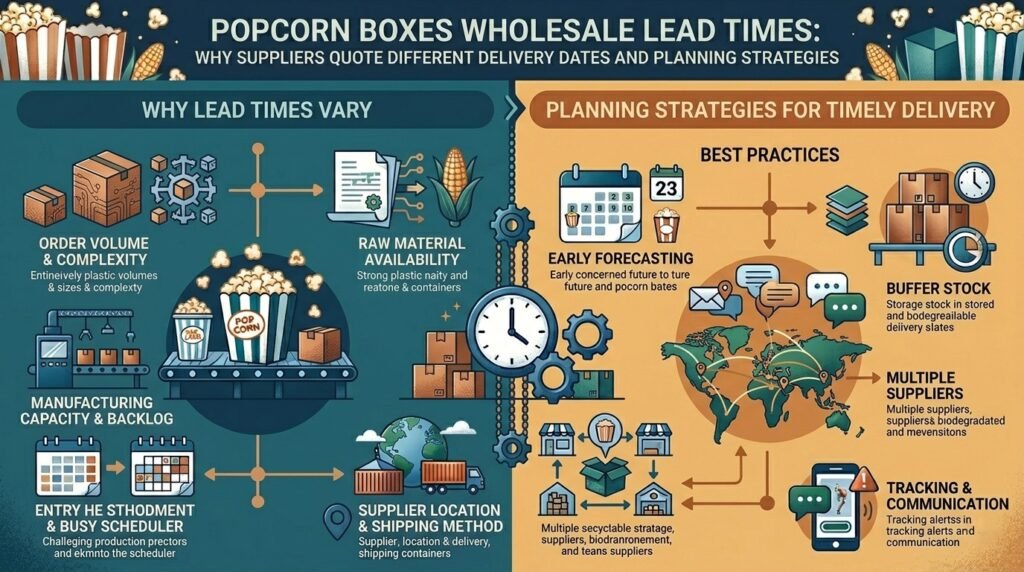
Popcorn boxes wholesale buyers receive conflicting lead time quotes from different suppliers for identical orders creating scheduling confusion. One supplier promises 2-week delivery while another quotes 4 weeks for the same wholesale popcorn boxes, leaving buyers uncertain which timeline to trust.
A concession operator planning seasonal inventory discovers their “2-week” quote for wholesale boxes actually means 2 weeks from artwork approval, not order placement, delaying delivery until two weeks past the promised date. Meanwhile, a gourmet popcorn retailer learns their “4-week standard” quote includes 1 week printing queue, 2 weeks production, and 1 week shipping, enabling accurate planning once components understood.
This guide explains what comprises lead times for popcorn boxes wholesale, why supplier quotes vary dramatically, how to plan backwards from needed dates, and preventing missed deadlines through realistic timeline understanding.
Why Do Different Suppliers Quote Different Lead Times?
Production Capacity and Queue Management
Suppliers operating near maximum capacity have extended lead times accommodating existing orders ahead of new business. Busy suppliers quote 4-6 weeks while underutilized facilities offer 2-3 weeks.
Seasonal capacity fluctuations create timeline variation among popcorn boxes wholesale providers. Peak seasons (fall for event planning, spring for retail launches) extend lead times 2-3 weeks versus off-season timelines.
Equipment configuration and line speed affect throughput. Suppliers with automated systems handle volumes faster than manual-intensive operations producing popcorn boxes for wholesale distribution.
Current workload determines when production can begin. A supplier with full capacity may quote starting production 2-3 weeks away while competitors begin immediately.
Staff availability including skilled operators, press technicians, and quality inspectors limits production speed. Understaffed facilities work slower than fully staffed operations.
Customization Complexity Impacts
Standard designs in regular rotation require minimal setup. Fully custom designs requiring new die-cutting ($800-2,500) extend timelines 5-10 days for tooling creation.
Multiple color printing requires press setup time. Single-color prints need 1 press setup while 4-color processes need 4 separate setups extending production 2-5 days.
Special coatings or finishes (grease-resistant, UV, matte) require additional drying and curing time adding 2-3 days.
Structural modifications from standard designs require engineering review and die approval extending timelines 3-7 days.
Artwork complexity affects printing preparation. Detailed graphics with precise color matching require more press setup and adjustment time.
Material Sourcing and Supply Chain
Board stock availability affects production start dates. Custom paperboard grades require sourcing adding 3-7 days lead time extension.
Ink color matching for custom Pantone specifications may require special formulation adding 2-5 days versus standard colors maintained in inventory.
Rush orders consuming supplier inventory accelerate timelines while out-of-stock situations force waiting for material replenishment (5-10 days typical).
Geographic location affects material sourcing timelines. Coastal suppliers with direct port access manage faster material arrival than inland locations.
Material supply chain disruptions (port delays, manufacturing issues) unpredictably extend lead times. Suppliers quoting timelines already account for typical supply variability.
Shipping Distance and Carrier Selection
Local/regional orders shipped by supplier truck (2-3 days) versus cross-country parcel carriers (5-7 days) create timeline variation.
Expedited shipping options (overnight, 2-day) available at premium cost enable shorter total timelines despite longer production.
Carrier capacity affects availability. During peak periods, specific carriers may be unavailable extending shipping timeline 2-3 days.
Consolidation for cost optimization adds 5-7 days waiting for full-container loads in wholesale popcorn box orders.
Rural or remote destinations require additional transit time adding 2-5 days versus major metro areas with direct service.
Understanding Lead Time Components Separately
The “2-Week Quote” Myth
When suppliers state “2-week lead time,” this typically means 2 weeks from design approval, not order date. Many buyers misunderstand this critical distinction.
Actual timeline from order placement to delivery may be 3-4 weeks after accounting for design revision (2-5 days) before the quoted 2-week production window begins.
Some suppliers intentionally quote only production time while others include all steps from order through delivery. Ask specifically what the quote encompasses.
“2-week lead time” without specifying start point creates confusion. Clarify whether this means from order date, artwork approval, or payment receipt.
Setup and Die-Cutting Timeline
Setup involves preparing production equipment, creating digital files, and performing initial setup tests. This typically requires 3-7 days.
Custom die-cutting for non-standard designs requires creating physical dies ($800-2,500) adding 5-10 days before production begins.
Standard designs already on file skip die-creation reducing setup to 2-3 days for equipment configuration only.
Rush setup (same-day or next-day) available from some suppliers but requires complete files and immediate payment authorization.
Design and Artwork Approval Cycle
Design review by supplier quality team checks files for production compatibility requiring 1-3 days.
Revision rounds add substantial time. Each requested change requires resubmission and re-review potentially adding 2-5 days per round.
Slow client approval causes major delays. Suppliers can’t proceed without artwork sign-off, so buyer delays directly extend overall timeline.
Setting clear approval processes and response expectations accelerates this often-neglected timeline component.
Production Run Duration
Production scheduling depends on order size and current queue. Small orders (1,000 units) may produce in single shift (8-16 hours) while 10,000-unit orders require multiple shifts or days.
Equipment downtime for maintenance, changeover, or technical issues can delay production 1-2 days unpredictably.
Quality issues discovered during production require rework extending timelines. Defective runs must be corrected adding 2-5 days.
Batch production runs simultaneously processing multiple orders may delay specific shipments awaiting production slot availability.
Printing and Finishing Timeline
Printing requires press setup time (configuration, ink mixing, test runs) adding 1-2 days before actual printing begins.
Press queue depends on current workload. Busy suppliers may queue multiple orders ahead of incoming business.
Ink drying time varies by ink type (standard oils, UV, water-based) and weather conditions. Humidity and temperature affect drying (8-24 hours typically).
Grease-resistant coating application and curing adds 2-3 days requiring temperature-controlled drying.
Quality Inspection and Approval
Sample inspection verifies printing quality, structural integrity, and specifications before full order release. This requires 1-2 days.
Failed inspection samples require correction or reprint adding 3-5 days for rework and re-inspection.
Final inventory verification confirming unit counts and checking for damage adds 1 day before shipment authorization.
Documentation preparation including packing lists, invoices, and certificates of compliance adds 1 day.
Packing, Staging, and Shipping
Packing individual boxes into cases and palletizing for shipment requires 1-2 days depending on volume and labor availability.
Freight coordination and pickup scheduling by carrier may add 1-2 days if LTL (less-than-truckload) consolidation needed.
Shipping carrier transit time varies 3-7 days depending on distance, carrier, and service level selected.
Expedited shipping (overnight, 2-day) available at premium cost ($500-2,500 typical) compresses shipping window to 1-2 days.
Why Do Seasonal Factors Affect Lead Times?
Peak Season Capacity Constraints
Fall season (August-September) experiences maximum demand from event planners, schools, and holiday promotions. Lead times extend 3-4 weeks beyond standard.
Spring retail launches (March-May) create peak demand as businesses refresh packaging. Supplier queues extend timelines 2-3 weeks.
Holiday production (September-October for November-December demand) experiences extreme congestion. Lead times reaching 6-8 weeks typical.
Summer periods show minimum demand. Lead times compress to 2-3 weeks reflecting available capacity.
Winter slow periods (December-January) see extended lead times from skeleton crews and holiday closures despite light workload.
Holiday Closures and Plant Maintenance
Supplier closures during major holidays (July 4, Thanksgiving, Christmas, New Year’s) disrupt timelines unpredictably. Production stops 1-2 weeks creating delays.
Scheduled maintenance windows (typically 1-2 weeks) occur during slower periods impacting timelines during those periods.
Planned maintenance notification enables advance planning while emergency maintenance causes timeline surprises.
Understanding supplier holiday schedules prevents ordering dates creating delivery conflicts with closures.
Seasonal Material Availability
Paperboard suppliers manage seasonal demand fluctuations. Peak season board stock shortages extend sourcing timelines 3-7 days.
Ink availability varies seasonally with popular colors subject to allocation during peak demand periods.
Coating materials particularly grease-resistant compounds experience seasonal shortages during peak seasons.
Advance communication with suppliers about material sourcing enables planning for potential constraints.
How to Plan Backwards From Your Needed Date
Timeline Planning Framework
Identify absolute needed delivery date (when boxes must arrive at your facility).
Subtract shipping time (3-7 days standard, 1-2 expedited) determining production release deadline.
Subtract quality inspection and packing time (2-3 days) determining production completion deadline.
Subtract printing and finishing time (5-10 days) determining production start deadline.
Subtract setup time (3-7 days) determining order placement deadline accounting for approval cycles.
Add buffer time (3-5 days minimum) for contingencies and delays.
The result is your actual order placement deadline to achieve needed delivery date for popcorn boxes wholesale.
Real-World Planning Example
Needed Delivery Date: May 1st (Event on May 5th)
Working backward:
- Subtract shipping (5 days): Production release by April 26th
- Subtract packing (2 days): Production completion by April 24th
- Subtract printing (5 days): Production start by April 19th
- Subtract setup (5 days): Order placement by April 14th
- Add buffer (5 days): Order by April 9th (actual date to commit)
Ordering April 14th instead of April 9th eliminates all buffer time creating risk. Any delay (approval revision, supply issue, unexpected queue) causes missed deadline.
Communication and Specification
Clearly state needed delivery date with supplier. Don’t assume they’ll meet arbitrary dates without explicit communication.
Specify all approvals, design variations, and special requirements upfront preventing revision rounds delaying timelines.
Confirm supplier understanding of timeline and their confidence in meeting dates. Ask specifically “Can you guarantee delivery by [date]?”
Get timeline commitments in writing. Verbal promises don’t protect against delays.
Buffer Time Allocation
Minimum 3-5 day buffer accommodates typical minor delays (approval revision, production queue, shipping variance).
Larger buffers (7-10 days) appropriate for complex custom designs, new suppliers, or peak season orders.
Critical deadlines warrant maximum buffers (10-14 days) preventing single-point failures.
Understand that buffer time consumed by delays becomes schedule pressure. Real contingency requires additional buffer beyond minimum.
What About Rush Production and Expedited Options?
Rush Production Availability and Costs
Rush production (1.5-2 week turnaround) available from most suppliers at 20-50% premium ($500-2,000 typical additional cost).
“Rush” typically compresses timelines 50% versus standard. 4-week standard becomes 2-3 week rush, not same-week delivery.
True expedited (1-week turnaround) available from select suppliers at 50-100% premium requiring immediate payment and limited customization.
Same-week delivery rarely available and costs 100-200% premium. Only feasible for stock items with minimal customization.
Rush Production Constraints
Rush orders require complete, approved artwork at time of order. Design revisions eliminate rush advantage consuming time.
Standard designs rush better than custom designs. New die-cutting and custom designs can’t be rushed as tooling creation can’t accelerate.
Volume limits apply to rush production. Very large orders (20,000+ units) can’t rush due to production capacity constraints.
Rush orders may require higher per-unit costs or minimum quantities. Expedited service comes with conditions limiting flexibility.
Availability varies by supplier workload. During peak season, rush capacity disappears entirely as all production slotted.
Strategic Use of Rush Options
Reserve rush production for genuine emergencies, not poor planning. Using rush regularly becomes expensive and stressful.
Budget rush premium into critical timeline scenarios planning for likely use. $500-2,000 emergency cost preventable through advance planning.
Establish relationships with rush-capable suppliers for planned emergencies. Build emergency protocol before needing it desperately.
Expedited Shipping vs. Rush Production
Expedited shipping (overnight, 2-day) costs $300-800 compressing only final 3-7 days. Useful when production on schedule but delivery needs acceleration.
Combining standard production with expedited shipping sometimes cheaper than rush production. Analyze both options.
Expedited shipping works for close-proximity buyers. Cross-country overnight shipment expensive ($800-1,200) versus coast-to-coast 2-day ($400-600).
Common Lead Time Planning Mistakes
Confusing Quote Start Point
Assuming “2-week lead time” means 2 weeks from order date when supplier means 2 weeks from artwork approval. Clarify explicitly.
Not accounting for design approval cycles which frequently take 2-5 days before production window begins.
Treating supplier’s stated timeline as absolute without understanding components and variability.
Underestimating Approval Time
Not budgeting time for design review, internal approvals, or revision rounds. Design cycles frequently add 5-10 days.
Slow response to approval requests by buyer delays entire timeline. Plan for your internal decision-making speed.
Assuming approval happens instantly when actual process takes 2-5 days minimum for quality review.
Ignoring Seasonal Constraints
Ordering during peak season expecting standard lead times. Capacity constraints exist, timelines extend, or rush becomes necessary.
Not understanding supplier holiday schedules and ordering dates that hit closures directly.
Failing to account for supplier maintenance windows and weather delays affecting production and shipping.
Not Communicating Timeline Requirements
Placing orders without stating needed delivery dates. Suppliers optimize for their schedule not your requirements.
Assuming supplier knowledge of event dates, seasonal needs, or critical deadlines without explicit communication.
Failing to ask for written timeline commitments. Verbal promises lack accountability when delays occur.
Insufficient Buffer Planning
Ordering exactly on deadline leaving zero buffer for contingencies. Single delay causes missed delivery.
Underestimating revision rounds. First-time customization frequently requires 2-3 approval rounds consuming 5-10 days.
Not accounting for carrier delays, weather, or supply chain disruptions affecting final delivery window.
Practical Strategies for Reliable Planning
Build Supplier Relationships
Work with proven suppliers understanding their capabilities and typical performance. Relationship trust enables better planning.
Maintain consistent order patterns enabling suppliers to anticipate your needs and manage capacity accordingly.
Communicate regularly about upcoming needs allowing suppliers planning inventory and capacity ahead of formal orders.
Establish Standard Lead Times
Work with regular suppliers establishing realistic standard lead times for typical orders. Document these formally.
Create separate timelines for standard designs versus custom designs. Know the difference for your typical orders.
Understand supplier minimums and capacity enabling better prediction of actual lead times.
Plan Multiple Months Ahead
For seasonal products, begin planning 4-6 months in advance before peak season capacity constraints emerge.
Establish annual production schedules with suppliers enabling smooth execution without emergency rush.
Use off-season periods for lower-priority orders utilizing available capacity at standard rates.
Request Timeline Confirmation
Ask suppliers explicitly: “Can you guarantee delivery by [specific date]?” Get affirmative confirmation in writing.
Request detailed timeline breaking down each component so you understand where time actually occurs.
Confirm understanding of what’s included in quoted timelines (does it include approval time, shipping, etc.).
Maintain Contingency Plans
Identify backup suppliers enabling rapid switching if primary supplier fails timeline. Relationships matter.
Build extra buffer for critical deadlines enabling alternative solutions if primary path delays.
Maintain small inventory buffer enabling flexibility if new production orders delay.
Final Thoughts
Lead times for popcorn boxes wholesale typically range 2-5 weeks from order to delivery, but this varies dramatically based on order complexity, supplier capacity, and planning clarity. Understanding lead time components separately—setup, design approval, production, printing, finishing, inspection, and shipping—enables accurate planning rather than treating timeline as black box.
Supplier quotes vary because they reflect different current capacity levels, customization complexity, and component definitions. One supplier’s “2-week lead time” may mean 2 weeks production only, while another means 2 weeks total from order to delivery. Clarifying exact scope prevents timeline surprises.
Plan backwards from needed delivery date accounting for each component, supplier approval cycles, and realistic buffer time. Ordering on deadline leaves zero contingency buffer. Build 5-10 day buffers into critical timelines preventing single-point failures from minor delays.
Seasonal capacity constraints dramatically extend lead times August-October. Plan orders during these peak periods expecting 4-6 week timelines, or order during off-season for shorter lead times and more flexibility. Off-season ordering provides shorter lead times and more flexibility.
Rush production for wholesale popcorn boxes available at 20-50% premium compresses timelines approximately 50% but requires complete artwork and encounters availability constraints during peak seasons. Reserve rush for genuine emergencies, not poor planning. Communicate timeline requirements clearly in writing with supplier confirmation rather than assuming generic timelines apply to your wholesale ordering situation.