
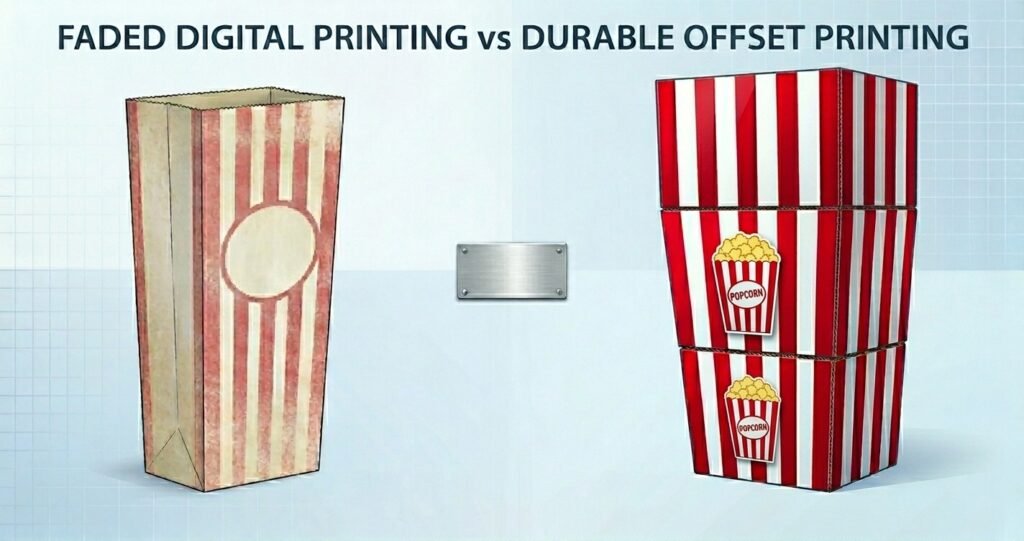
Businesses ordering custom popcorn boxes select printing methods based primarily on price, discovering months after launch that budget digital printing displays faded graphics while competitor boxes maintain vibrant colors. A movie theater orders 5,000 digitally printed branded boxes at attractive per-unit costs, then watches logos gradually blur and colors pale within weeks of exposure to warehouse heat and light. Meanwhile, a gourmet popcorn retailer invests premium pricing for offset printing discovering graphics remain crisp and vibrant throughout the entire shelf life and customer ownership period.
This guide explains fundamental differences between digital, offset, and flexographic printing methods affecting popcorn box durability, why cheap printing fades while quality printing persists, environmental factors accelerating degradation, and selecting printing methods matching intended use and shelf life expectations.
Why Does Digital Printing Fade Faster Than Offset?
Ink Chemistry and Substrate Interaction
Digital printing uses liquid inks deposited directly onto paperboard surface through inkjet technology. These water-based or solvent-based inks sit on substrate surface without deep penetration.
Offset printing transfers oil-based inks from printing plate to blanket cylinder to paperboard through pressure. This mechanical transfer embeds inks into substrate fibers creating permanent integration.
Substrate receptivity matters tremendously since porous corrugated board accepts liquid digital inks differently than smooth coated surfaces. Absorption rates affect final color saturation and durability.
Digital inks often contain lower pigment concentrations achieving budget pricing. Lower pigment load reduces color saturation and fade resistance compared to premium offset ink formulations.
Offset inks contain higher pigment percentages with specialized binders creating robust color that resists environmental degradation. Premium pigment load directly correlates with fade resistance.
Adhesion and Permanence
Digital inks rely on absorption and surface adhesion holding color to substrate. Without deep substrate penetration, inks remain vulnerable to surface wear and environmental exposure.
Offset inks mechanically embed into substrate fibers during pressure transfer. This integration creates permanent connection resisting surface wear, moisture penetration, and environmental stress.
Curing mechanism differs dramatically between methods. Digital inks cure through evaporation or absorption (incomplete process leaving some ink mobile). Offset inks cure through oxidation and polymerization (complete chemical transformation).
Incomplete digital curing leaves inks partially mobile susceptibcppole to environmental mobilization. Heat accelerates solvent evaporation from digital inks allowing pigment migration and fading.
Pigment Type and Quality
Digital printing often uses standard colorants optimized for cost rather than environmental resistance. These pigments fade readily under UV light and heat exposure.
Offset printing uses premium pigments specifically formulated for fade resistance, including lightfast ratings measuring UV resistance. Premium pigments cost 2-3x standard colorants explaining cost differences.
Organic versus inorganic pigments show different fade characteristics. Offset typically uses superior inorganic pigments while digital printing may substitute lower-cost organics.
Pigment particle size affects color intensity and durability. Finer particles in offset formulations create more vibrant colors with better fade resistance than coarser digital pigments.
What Environmental Factors Cause Digital Printing to Fade?
Heat Exposure and Thermal Stress
Temperature elevation accelerates ink degradation through multiple mechanisms. Solvent evaporation from digital inks increases with temperature, leaving lighter pigment deposits.
Paperboard thermal expansion and contraction stresses surface inks. Temperature cycling creates mechanical stress concentrating at ink boundaries.
Warehouse temperatures in summer months frequently exceed 90-100°F particularly in non-climate-controlled facilities. These temperatures dramatically accelerate digital ink fading.
Shipping containers in direct sunlight experience interior temperatures reaching 120-140°F. Digital inks fade visibly within days of this thermal exposure.
Light Exposure and UV Radiation
Ultraviolet light degrades both pigments and ink binders through photochemical reactions. Digital inks with lower UV-resistant pigments fade noticeably within weeks of light exposure.
Warehouse fluorescent lighting combined with heat exposure accelerates fading. Standard “cool white” fluorescents emit UV wavelengths affecting color stability.
Retail shelf placement under store lighting creates continuous light exposure. Digital printing may fade 50% within 4-6 weeks under typical retail lighting.
Outdoor storage or display creates extreme UV exposure. Digital printing becomes unacceptable for outdoor applications fading within days.
Moisture and Humidity Effects
Humidity variation causes paperboard dimensional changes. These dimensional movements stress surface inks creating micro-cracks and color separation.
High humidity environments (tropical climates, refrigerated displays) create condensation exposing inks to moisture penetration. Water-based digital inks prove particularly vulnerable.
Grease exposure from product contact or handling combines with humidity creating chemical mobilization of digital inks. Combined effects accelerate fading beyond either factor alone.
Humidity cycling (day-night, seasonal) stresses inks through repeated expansion and contraction. Digital inks lack the adhesion depth to withstand mechanical cycling.
Grease and Oil Exposure
Popcorn butter and oils contact box exteriors affecting printed surfaces. Grease penetration destabilizes digital inks more readily than offset formulations.
Oil-based solvents in grease mobilize digital inks chemically. Pigments suspended in aqueous or solvent-based digital inks migrate more readily than embedded offset inks.
Contact with greasy products, handling oils, or cleaning solvents causes visible color shift and fading in digital printing within hours of exposure.
Grease saturation of paperboard degrades ink adhesion fundamentally. Digitally printed boxes show visible degradation at grease saturation points.
Why Does Offset Printing Resist Fading?
Permanent Ink Integration and Chemical Bonding
Offset printing embeds inks into substrate creating permanent chemical bonds. Pigments integrated at fiber level resist surface wear, environmental exposure, and chemical mobilization.
Oxidation and polymerization during curing creates cross-linked ink polymer networks. These networks resist thermal stress, moisture, light exposure, and chemical degradation.
Premium pigments used in offset contain lightfast ratings (ASTM standards) measuring UV resistance. High lightfast ratings (8-9 on standard scale) ensure minimal fading over extended periods.
Ink film thickness from offset printing (typically 1-2 micrometers) creates protective barrier. This thickness provides substance resistant to surface wear and environmental stress.
Pigment Quality and Fade Resistance
Offset pigments formulated for printing applications undergo rigorous lightfastness testing. These pigments resist UV degradation maintaining color for years under normal conditions.
Inorganic pigments used in premium offset formulations chemically resist environmental attack. Organic pigments fade readily while inorganic pigments maintain color.
Pigment concentration in offset inks optimizes for color intensity and fade resistance rather than cost. Higher pigment loads directly improve durability.
Binder chemistry in offset inks protects pigments from environmental exposure. Complex binder systems shield pigments preventing photochemical degradation.
Environmental Resilience
Offset ink films tolerate temperature cycling without stress cracking. Chemical bonding prevents micro-crack formation from thermal expansion and contraction.
Moisture resistance of offset inks prevents water penetration mobilizing pigments. Complete curing creates hydrophobic ink layer repelling moisture.
Grease exposure causes minimal impact on offset printing since inks remain protected by substrate integration and robust polymerized films. Offset printed boxes maintain color despite grease contact.
Light exposure over extended periods shows minimal color shift in offset printing. Pigment lightfastness prevents visible fading under typical warehouse and retail lighting.
What About Flexographic Printing?
Flexographic Method and Performance
Flexographic printing uses flexible printing plates transferring fast-drying inks. This method combines aspects of digital speed with offset durability characteristics.
Flexographic inks polymerize quickly requiring less setup time than offset but providing superior durability compared to digital. Ink formulations intermediate between digital and offset.
Fade resistance from flexographic printing typically ranges 5-10 months approaching offset durability. Pigment quality varies by supplier with premium formulations closely matching offset.
Cost structure intermediate between digital ($0.18-0.35) and offset ($0.25-0.50) with setup costs ($600-1,800) between both methods.
Advantages and Trade-Offs
Flexographic suits high-volume production with moderate durability requirements. Volume discounts reduce per-unit costs while maintaining acceptable color persistence.
Grease resistance excellent from flexographic due to ink formulation and substrate integration. Popcorn box applications particularly benefit from grease-resistant flexographic inks.
Line-work capability superior to digital printing making flexographic ideal for detailed graphics and fine text. Resolution approaches offset quality.
Cost-benefit favorable for 10,000+ unit runs where flexographic economies outweigh offset setup costs without sacrificing significant durability.
How Do Storage Conditions Affect Printing Durability?
Temperature Control Impact
Climate-controlled storage (65-75°F) minimizes thermal stress on inks. Digitally printed boxes maintain appearance 2-3x longer in controlled conditions versus uncontrolled warehouses.
Uncontrolled warehouse conditions with summer temperatures 85-100°F+ accelerate fading dramatically. Digital printing shows visible degradation within 4-8 weeks.
Outdoor storage or shipping in direct sunlight creates extreme conditions destroying digital printing within days. Temperature swings 50°F+ daily stress inks mechanically.
Cold storage (refrigerated or frozen) generally favorable for ink durability though thermal cycling during product removal and return accelerates degradation.
Light Exposure Management
Warehouse location away from windows and direct light extends digital printing life 50-100% compared to exposed locations. Strategic placement provides inexpensive durability improvement.
Covered storage preventing direct sunlight dramatically extends color vibrancy. Uncovered storage in direct sun causes digital printing fading within weeks.
Retail shelf placement under fluorescent lighting degrades digital printing 2-4x faster than warehouse storage. Store environment provides harsh conditions.
Outdoor display or vending situations destroy digital printing essentially immediately. These applications require offset or flexographic printing.
Protective Coatings
Clear varnish or protective topcoat applied after printing shields digital inks from environmental exposure. Coating extends digital printing life from 2-4 months to 4-8 months.
Matte or gloss topcoatings cost $0.05-0.15 per box adding modestly to digital printing while dramatically improving durability. Cost-benefit favorable for extended shelf life applications.
UV-protective topcoatings specifically formulated for light resistance provide additional benefits. Premium coatings add $0.10-0.20 per box.
Coatings improve grease resistance and moisture resistance. Combined protective benefits justify coating investment for moderate-shelf-life applications.
When Does Each Printing Method Make Sense?
Digital Printing Appropriate For
Rush orders requiring fast turnaround (48-72 hours) where time constraints justify durability compromise. Digital printing fast production cycle enables rapid delivery.
Small quantity orders (500-2,500 units) where offset setup costs ($800-2,500) would overwhelm per-unit savings. Digital avoids expensive setup.
Prototype and testing applications validating designs before full production. Digital enables affordable experimentation.
Short-shelf-life applications (2-4 weeks) where boxes discarded before fading becomes visible. Seasonal promotions, events, limited-time offerings.
Interior display or warehouse use where environmental exposure minimal. Boxes protected from light, heat, and moisture.
Design iteration where frequent changes make setup-intensive methods impractical. Digital flexibility accommodates rapid modification.
Offset Printing Appropriate For
Permanent retail packaging with 6-12+ month shelf life requiring color persistence. Offset durability essential for established product lines.
Outdoor or high-light-exposure applications where color must survive severe environmental stress. Offset fade resistance becomes critical.
Premium brand positioning where color perfection demonstrates quality commitment. Offset vibrant colors reinforce premium perception.
Volume orders exceeding 10,000-15,000 units where offset economies justify setup investment. Large runs amortize setup costs favorably.
Product lines anticipated lasting years or seasonal recurring orders reusing plates. Offset plates justify investment when reused.
High-humidity or temperature-extreme storage environments requiring environmental resilience. Offset ink stability prevents degradation.
Hybrid Approaches
Digital printing with protective topcoat extends durability addressing digital weakness. Coating cost modest compared to offset setup.
Small-batch offset for premium SKUs while using digital for secondary products. Tiered approach optimizes cost and durability.
Digital for rapid market testing, offset for validated long-term SKUs. Production method aligns with product lifecycle stage.
Flexographic for high-volume seasonal products needing durability between digital and offset costs.
Common Mistakes Brands Make With Printing Method Selection
Choosing Digital Based on Price Without Considering Shelf Life
Saving $0.05-0.10 per unit through digital printing creates problems costing far more through customer complaints, returns, and brand damage.
Faded graphics after 2-3 months destroy brand perception and customer satisfaction. Cost savings eliminated by warranty replacement and reputation damage.
Assuming All Digital Printing Quality Is Equivalent
Budget digital printers using standard colorants fade dramatically faster than premium digital suppliers. Supplier selection matters as much as method choice.
Not all digital inks created equal with significant quality variations between providers. Requesting fade-resistant digital ink formulations improves durability.
Underestimating Environmental Stress
Warehouse conditions often harsher than anticipated. Uncontrolled temperature swings and sun exposure through windows create severe stress.
Retail environments under fluorescent lighting degrade digital printing faster than expected. Customer use and handling adds stress beyond initial stocking.
Ignoring Protective Coating Options
Topcoat application represents minor cost ($0.05-0.15) providing substantial durability improvements. Many brands skip this cost-effective enhancement.
Digital printing with protective coating often meets durability requirements at moderate cost. This hybrid approach provides better value than pure digital.
Not Discussing Storage Plans With Suppliers
Suppliers can recommend printing methods matched to intended storage conditions. Environmental factors should drive method selection.
Budget options acceptable for controlled environments become failures in uncontrolled warehouses. Storage environment should inform printing choice.
How to Select the Right Printing Method
Define Shelf Life Requirements
Establish how long boxes remain in storage before use. This timeline should drive printing method selection.
Consider entire lifecycle from production through customer possession. Premium products retained by customers may need longer durability.
Factor seasonal variations if applicable. Winter storage less harsh than summer heat exposure.
Evaluate Storage Conditions Realistically
Assess actual warehouse environment including temperature extremes, humidity levels, and light exposure. Don’t assume controlled conditions.
Consider shipping and retail environments. Boxes may experience harsher conditions than factory storage.
Plan for worst-case scenarios rather than best-case conditions.
Balance Cost and Durability
Calculate true cost including reprinting, replacement, and brand damage from faded graphics. Cheap printing creating failures costs more than premium printing.
Model costs across intended shelf life. Annual costs for repeated purchasing may favor offset despite higher per-unit costs.
Request Samples and Test
Request sample boxes from different suppliers evaluating color vibrancy and consistency. Visual inspection reveals quality differences.
Conduct basic durability testing exposing samples to heat, light, and moisture simulating storage conditions. Document color changes over time.
Request supplier recommendations on methods and materials. Experienced suppliers provide valuable guidance.
Specify Durability Requirements in RFQs
Clearly state shelf life requirements and storage conditions in supplier quotes. This enables tailored recommendations.
Request specific pigment types and ink formulations supporting stated durability requirements. Don’t accept vague “quality” claims.
Request lightfastness ratings or fade-resistance testing documentation.
Final Thoughts
Digital printing costs less upfront ($150-300 setup, $0.18-0.35 per box) but uses inks fading within 2-4 months from heat, light, and grease exposure making it suitable only for short-shelf-life applications and controlled storage environments. Offset printing costs more initially ($800-2,500 setup, $0.25-0.50 per box) but applies durable inks lasting 6-12+ months in retail and warehouse conditions through permanent substrate integration and superior pigment formulations.
Printing method selection should match intended shelf life and storage conditions rather than focusing exclusively on initial cost. Digitally printed boxes destined for 6-12 month retail shelf life create customer complaints and brand damage as graphics fade. Offset printing’s superior durability justifies premium investment for retail applications with extended shelf life.
Flexographic printing provides middle-ground option with costs between digital and offset while offering durability approaching offset for high-volume applications. Protective topcoatings on digital printing extend durability modestly at minimal cost providing compromise approach for moderate applications.
Environmental factors including warehouse temperature, humidity, light exposure, and product contact dramatically affect ink durability. Uncontrolled storage conditions and retail environments accelerate fading. Communicate storage conditions to suppliers enabling method recommendations matching actual requirements.
Test samples from different suppliers evaluating color vibrancy and resistance to environmental stress. Request fade-resistance documentation and lightfastness ratings rather than accepting generic quality claims. Patient supplier evaluation prevents expensive mistakes of selecting inadequate printing for intended applications.