
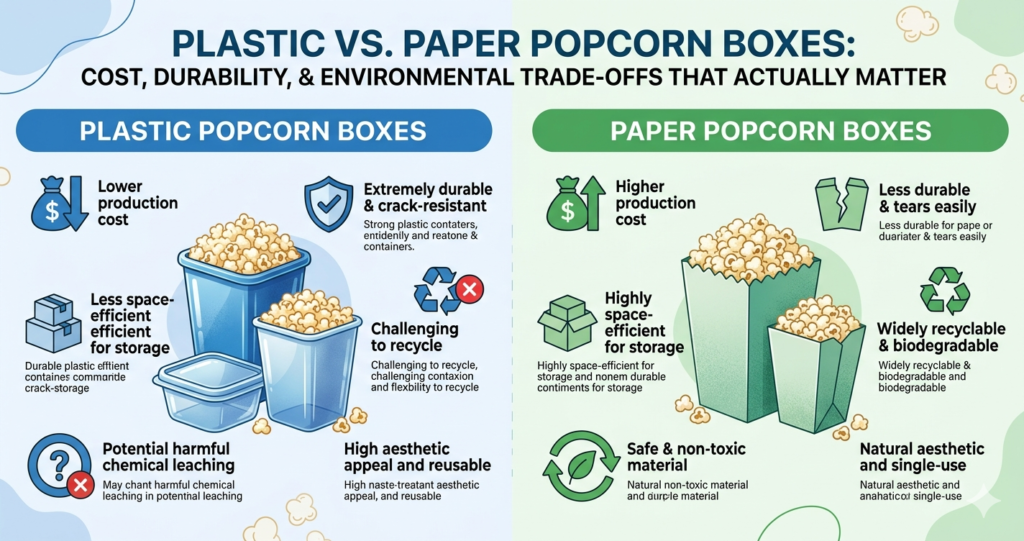
Businesses selecting between plastic and paper popcorn boxes base decisions on surface-level information. Plastic seems more durable while paper appears more environmentally responsible, missing critical trade-offs affecting operational costs and actual environmental impact. A concession vendor orders plastic boxes expecting superior durability only discovering brittleness in cold temperatures creates product damage during winter events, while a gourmet popcorn retailer switches to paper assuming environmental responsibility without realizing certain paper formulations carry larger carbon footprints than selected plastic alternatives. Neither material universally outperforms the other, with actual best choice depending on specific use conditions, storage environment, product type, and sustainability priorities.
This guide explains fundamental differences between plastic and paper popcorn boxes across cost, durability, environmental impact, and operational performance, clarifying which material suits different applications and preventing costly wrong choices.
Why Do Plastic Boxes Cost More Initially?
Material and Manufacturing Costs
Plastic material (polypropylene, PET, polystyrene) costs more per unit than paperboard. Resin pricing fluctuates with crude oil markets affecting plastic costs more dramatically than paper.
Manufacturing plastic boxes requires different equipment than paper production. Injection molding or thermoforming machinery more capital-intensive than corrugated converting.
Setup charges for plastic molds ($1,500-4,000) exceed paperboard die costs ($600-1,200) requiring larger order quantities justifying investment.
Plastic production speeds typically match or exceed paper production but labor costs per unit remain higher. Plastic manufacturing less automated than commodity paperboard.
Quality control for plastic proves more complex ensuring consistent wall thickness, clarity, and structural integrity. Testing requirements add costs.
Per-Unit Price Breakdown
Base plastic material: $0.25-0.60 per box Manufacturing and conversion: $0.20-0.40 per box Setup and tooling amortization: $0.10-0.25 per box (varies with quantity) Quality control and testing: $0.05-0.10 per box Packaging and shipping: $0.05-0.15 per box Total: $0.65-1.40 per box at 5,000-unit volumes
Paper equivalent breakdown: Base paperboard material: $0.15-0.35 per box Manufacturing and conversion: $0.15-0.30 per box Setup and tooling amortization: $0.05-0.15 per box Quality control: $0.02-0.08 per box Packaging and shipping: $0.05-0.10 per box Total: $0.45-0.95 per box at 5,000-unit volumes
What Makes Plastic Boxes More Durable?
Material Properties and Environmental Resilience
Plastic demonstrates superior dimensional stability across temperature ranges. Polypropylene tolerates -20°F to 120°F without brittleness or material degradation affecting paper.
Hydrophobic nature of plastic repels moisture preventing water absorption that causes paper warping and dimensional instability. Plastic maintains structural integrity in humid conditions.
Grease resistance excellent from plastic chemical composition. Butter, oil, and grease contact doesn’t degrade plastic or penetrate material like paper absorption.
UV resistance varies by plastic type but most formulations tolerate light exposure better than printed paper surfaces. Plastic colors fade minimally compared to paper printing degradation.
Plastic resists microbial growth and insect damage that can compromise paper. Moisture and warmth promote mold and pest issues on paper.
Real-World Durability Testing
Drop testing shows plastic boxes surviving 30-inch drops maintaining structural integrity while paper boxes burst or crush more readily. Impact resistance substantially superior.
Compression testing (stacking weight) shows plastic maintaining shape while paper deflects and crushes under extended loading. Plastic stacking strength superior.
Thermal cycling (temperature swings -10°F to 100°F) shows plastic stability while paper becomes brittle at cold temperatures and soft at heat extremes. Plastic tolerance wider.
Humidity cycling shows plastic dimensions stable while paper swells, warps, and loses shape. Plastic humidity resistance absolute advantage.
Grease saturation testing shows plastic resisting butter/oil contact for 3-6 months while paper saturates and fails within 2-4 weeks. Plastic dramatically outperforms.
Shelf Life in Various Conditions
Warehouse storage (65-75°F, controlled humidity): Paper 6-12 months, Plastic 12-24+ months Uncontrolled warehouse (85-100°F, variable humidity): Paper 2-6 months, Plastic 8-12+ months Retail shelf (fluorescent light, temperature swings): Paper 3-8 weeks, Plastic 6-12 months Outdoor/exposed storage: Paper failure within weeks, Plastic 3-6+ months Refrigerated display: Paper degradation rapid, Plastic stable and reliable Vehicle/transport storage: Paper inconsistent, Plastic reliable.
When Does Paper Actually Outperform Plastic?
Specific Product and Use Cases
Hot popcorn in immediate consumption (theater concessions): Paper adequate since product consumed before saturation point. Plastic unnecessary.
Dry popcorn products (microwave packets, shelf-stable): Paper sufficient if shelf life under 3 months. Plastic overkill for rapid turnover.
Premium gift packaging where appearance prioritized: Paper printing quality superior supporting premium positioning better than plastic clarity.
Environmentally conscious consumers prioritizing compostability: Paper compostable options available while plastic compostability extremely limited.
One-time events or limited-duration promotions: Paper lower cost for short shelf life acceptable applications.
Cost Advantage Scenarios
Small quantity orders (500-1,500 units): Paper lower costs without large mold charges. Plastic setup fees become prohibitive.
Rapid prototyping and design testing: Paper faster iteration without expensive mold revisions. Design flexibility favors paper.
Seasonal products with short production runs: Paper economics superior for non-recurring annual items. Plastic justifies only for recurring products.
Budget-conscious applications where durability less critical: Paper acceptable when conditions and shelf life limited.
What Are the Real Environmental Trade-Offs?
Paper Environmental Profile
Virgin fiber paper production requires forest resources, water usage, and chemical processing. Environmental impact substantial for virgin content.
Recycled paper reduces forest pressure but collection, sorting, and reprocessing create transportation and processing emissions offsetting some benefits.
Paperboard production emissions typically 1.5-2.5 kg CO2 per box depending on virgin versus recycled content and production location.
Paper inherent compostability at end-of-life provides environmental advantage if proper composting infrastructure exists. However, grease-saturated or printed boxes complicate composting.
Food contamination in paper collection streams reduces recyclability. Greasy boxes often contaminate paper recycling streams requiring landfill instead.
Corrugation process (virgin kraft pulp, chemical processing, energy-intensive converting) carries higher environmental impact than plastic for equivalent performance.
Plastic Environmental Profile
Plastic production from crude oil creates upstream emissions (1-2 kg CO2 per box) from extraction and refining. Ongoing carbon debt from fossil fuel origin.
Plastic persistence in environment creates long-term concern. Incomplete degradation means plastic persists centuries in landfills or natural environments.
Recycling capability exists but collection and processing infrastructure variable. Many regions lack adequate plastic box recycling programs.
Plastic incineration reduces landfill volume but creates emissions. Some facilities recover energy partially offsetting impact but not all regions.
Microplastic generation from degradation and processing affects marine and soil ecosystems. Long-term environmental persistence creates ongoing concern.
Plastic production manufacturing consistency enables longer product life reducing replacement frequency. Durability may offset production emissions through reduced frequency.
Lifecycle Analysis Reality
Lifecycle analysis (LCA) comparing paper and plastic shows surprising results. Material choice depends on:
- Recycling infrastructure availability (matters enormously)
- Transportation distances (affects both materials)
- End-of-life processing method (landfill vs. recycling vs. incineration)
- Product durability (longer-lasting plastic may offset production impact)
- Manufacturing location (electricity grid carbon intensity)
Generic “paper is greener” or “plastic is worse” claims oversimplify complex environmental systems. Actual impact varies significantly based on these factors.
Many regions show plastic superior LCA when properly recycled due to durability reducing replacement frequency. Other regions with poor plastic infrastructure show paper superior.
Transportation impact substantial for both materials. Local paper may carry lower impact than imported plastic, or vice versa depending on sources.
Greenwashing and Marketing Claims
“Eco-friendly” claims on both materials often lack substance. Verify with lifecycle analysis or third-party certifications (FSC, Cradle-to-Cradle, etc.).
Paper compostability claims require certified compostable facilities which many regions lack. Home composting won’t properly process commercial food-contact paper.
Plastic “biodegradable” claims often misleading. Truly degradable plastics rare and expensive. Standard plastics persist centuries despite marketing.
Recycled content claims require verification. Percentage recycled matters (20% vs. 100% completely different environmental impact).
Carbon-neutral claims increasingly common but require specific measurement methodology verification. Different studies reach different conclusions.
How Do Storage and Use Conditions Drive Material Selection?
Temperature Sensitivity
Cold storage environments (freezers, outdoor winter events): Plastic essential. Paper becomes brittle at -10°F failing structurally.
Hot storage (uncontrolled summer warehouses): Plastic superior. Paper softens and loses shape at 90°F+.
Temperature cycling (day-night swings, seasonal): Plastic maintains stability. Paper dimensional changes stress joints and structure.
Refrigerated display (ice cream shop style): Plastic reliable and clear for product visibility. Paper condenses moisture and warps.
Vehicle storage (delivery trucks with no climate control): Plastic essential. Paper degrades rapidly with temperature swings.
Moisture Environments
Humid retail environments (coastal regions, tropical climates): Plastic clearly superior. Paper absorbs moisture warping dimensions.
Outdoor or partially exposed storage: Plastic resistant. Paper saturates becoming unusable.
Condensation environments (moving from cold to warm): Plastic hydrophobic. Paper absorbs surface moisture.
High-altitude dry storage: Both acceptable. Moisture minimal reducing humidity advantage.
Refrigerated + humid combinations: Plastic non-negotiable. Paper degradation rapid and complete failure likely.
Product Type Impact
Heavily buttered popcorn (theater, commercial): Plastic essential. Paper saturates within days.
Dry popcorn (microwave, shelf-stable): Paper acceptable. Minimal grease contact.
Gourmet flavored popcorn (chocolate, caramel, oil-based): Plastic superior. Rich coatings saturate paper rapidly.
Specialty popcorn (spiced, seasoned): Paper acceptable if dry. Oil-based seasonings require plastic.
Promotional/seasonal products (short shelf life): Paper often adequate if storage conditions controlled.
What About Hybrid or Alternative Materials?
Plastic-Lined Paper Boxes
Paper exterior with plastic lining combines paper aesthetics/printability with plastic moisture resistance. Costs $0.70-1.20 per box.
Durability approaching plastic (6-10 months) while maintaining paper sustainability credentials. Greener than pure plastic for many applications.
Recycling challenging since mixed materials complicate processing. Neither pure paper nor pure plastic recycling stream accepts hybrids.
Compostability eliminated by plastic lining. Environmental advantage of paper compostability lost.
Cost premium over pure paper ($0.20-0.30 per box increase) provides substantial benefit improvement.
Molded Fiber (Plant-Based Plastic Alternative)
Molded fiber uses recycled paper and cardboard formed into rigid structures. Compostable and biodegradable unlike standard plastic.
Cost comparable to plastic ($0.70-1.30 per box) with durability approaching plastic in many conditions.
Moisture resistance inferior to plastic but superior to paper. Temperature tolerance reasonable though not matching plastic.
Grease resistance moderate (2-3 months) better than paper but less than plastic. Food contact coatings available.
Environmental profile substantially superior to plastic with compostability and renewable origin. True environmental advantage over both alternatives.
Limited supplier availability and customization options compared to mature plastic and paper markets.
How to Make the Right Material Choice
Define Your Requirements
Document actual storage conditions not assumed conditions. Measure temperatures, humidity, light exposure, product contact.
Specify shelf life requirement. How long must boxes maintain integrity and appearance? This drives material selection fundamentally.
Identify product type and contact with grease, oils, moisture. This affects durability profile.
Clarify environmental priorities. Is compostability, recyclability, carbon footprint critical to brand or customer base?
Evaluate True Cost Over Lifecycle
Calculate not just per-box cost but total cost including replacement frequency if material fails prematurely.
Model costs across intended shelf life. $0.30 cheaper paper boxes costing $5,000 in replacements costs more than $0.50 plastic preventing failures.
Factor operational costs of failed packaging (customer complaints, replacement fulfillment, brand damage).
Compare total cost of ownership not just unit cost.
Request Samples and Test
Obtain sample boxes from each material option. Store samples in conditions matching actual usage (temperature, humidity, light, grease exposure).
Document appearance and structural integrity changes over 4-8 weeks. Real performance trumps theoretical advantages.
Test with actual products if possible. Popcorn type and preparation method affect material performance.
Request supplier recommendations. Experienced suppliers provide valuable guidance on material fitness.
Verify Environmental Claims
Request documentation for sustainability claims. Lifecycle analysis, certifications, recycled content percentages.
Verify compostability claims against local composting facility requirements. Certified compostable ≠ home compostable.
Understand carbon footprint methodology. Different calculation approaches yield different results.
Research recycling infrastructure for your region. Local recycling capability affects material sustainability.
Start With Smaller Orders
Initial orders 1,000-2,500 units enable testing before committing to 10,000+ unit purchases. Testing prevents expensive mistakes.
Collect customer feedback on durability, appearance, and environmental perception. Real user experience reveals problems.
Scale to larger volumes once material performance validated under actual conditions.
Final Thoughts
Paper and plastic popcorn boxes involve genuine trade-offs rather than clear winner. Paper costs 30-50% less per unit ($0.45-0.95 vs. $0.65-1.40) but provides 2-6 months durability dependent on storage conditions, coating quality, and grease exposure. Plastic costs more initially but delivers 6-12+ months consistent durability across temperature extremes and moisture exposure.
Environmental superiority isn’t obvious or universal. Paper offers compostability advantage assuming proper infrastructure exists, but food contamination and lack of compostability facilities limit practical benefit. Plastic persistence creates long-term environmental concern but superior durability may reduce replacement frequency offsetting production impact. Actual environmental profiles require lifecycle analysis, not marketing claims.
Material selection should match specific conditions rather than assumptions. Cold storage, outdoor exposure, high-humidity environments, or heavily greased products require plastic’s superior durability. Short-shelf-life applications, controlled temperature storage, or budget-conscious scenarios favor paper. Hybrid molded-fiber options provide alternative balancing environmental and performance benefits.
Test both materials under actual storage and use conditions before committing to large orders. Sample boxes stored in real conditions for 4-8 weeks reveal performance differences marketing claims conceal. Request supplier guidance and environmental documentation rather than accepting generic sustainability assertions.
True environmental responsibility requires verifying claims through lifecycle analysis and recycling infrastructure research specific to your region. Generic “paper is greener” or “plastic is sustainable” oversimplify complex decisions. Select material matching your specific requirements, storage conditions, product type, and documented environmental priorities.