
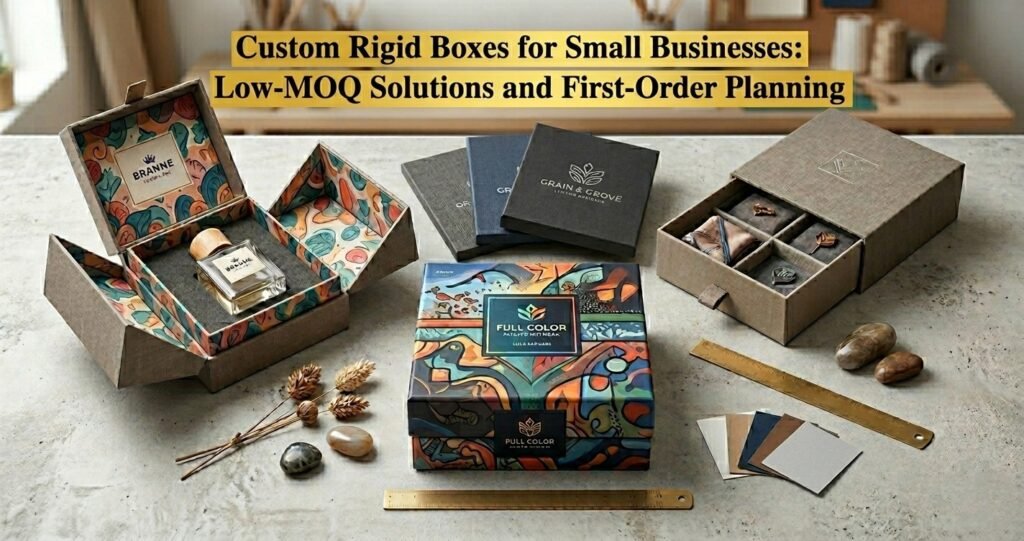
Small businesses launching premium products face challenges balancing luxury packaging expectations with limited budgets and uncertain sales volumes. Custom rigid boxes cost 2-4 times more than folding cartons, require higher minimum order quantities, and involve longer production timelines that complicate inventory planning for startups testing markets.
First-time buyers ordering rigid packaging often discover that impressive supplier portfolios showing luxury cosmetics and high-end electronics translate to $3,000-5,000 minimum orders exceeding startup budgets or creating excessive inventory risk.
This guide explains low-MOQ options for businesses needing rigid boxes without massive inventory commitments, realistic budget expectations for first orders, when rigid packaging investment makes strategic sense, and practical planning steps ensuring packaging arrives on time without depleting working capital.
Quick Answer: Small businesses can order custom rigid boxes starting at 500-1,000 unit minimums with digital printing or simple designs, though per-unit costs ($2.50-4.00) remain significantly higher than folding cartons. Budget $2,500-4,000 total for first orders including setup costs ($600-1,200), per-unit pricing, and design services.
Plan 5-6 weeks from design approval to delivery. Start with rigid boxes only when product positioning, profit margins, and customer expectations justify premium packaging investment.
Why Do Custom Rigid Boxes Cost More Than Folding Cartons?
Construction Complexity and Labor Requirements
Rigid box construction involves multiple manufacturing steps that folding cartons accomplish in single automated processes. Workers manually wrap printed paper around rigid chipboard bases, apply adhesives, create perfectly aligned corners, and assemble separate lids and bases.
Hand assembly requirements mean labor costs significantly impact pricing. A folding carton production line outputs 8,000-12,000 units per shift through automated die-cutting and folding. Rigid box assembly produces 800-1,500 units per shift due to manual processes, directly affecting per-unit costs.
The chipboard core material costs 2-3 times more than paperboard used in folding cartons. Rigid boxes use 1200-1800 gsm (grams per square meter) chipboard providing structural rigidity, while folding cartons use 300-400 gsm paperboard adequate for lighter-duty applications.
Wrapping paper covering chipboard adds material costs beyond base structure. Premium rigid boxes use specialty papers (textured, metallic, or coated stocks) further increasing material expenses compared to printed-only folding cartons.
Quality control requirements increase with hand assembly since each box undergoes individual crafting where minor variations affect luxury perception. Automated folding carton production maintains consistency through mechanical precision, reducing quality control labor.
Setup and Tooling Investments
Die creation for rigid boxes requires separate cutting dies for chipboard, wrapping paper, and interior components. A complete setup involves 3-5 different dies versus single dies for folding cartons, tripling tooling costs.
Printing plates or screens for wrapping paper add setup expenses similar to folding carton printing but apply to fewer square inches of visible surface. Setup costs spreading across smaller production runs increase per-unit impact.
Interior fittings (foam inserts, cardboard dividers, velvet trays) require additional dies and setup when included. Each component adds $150-400 in tooling costs multiplying complexity beyond simple boxes.
Why MOQs Run Higher for Rigid Boxes
Setup time and changeover between jobs incentivizes manufacturers to run longer production batches. The labor-intensive setup process makes short runs economically unattractive, pushing minimums higher than folding cartons.
Skilled craftspeople required for rigid box assembly represent limited production capacity. Manufacturers balance small-run requests against larger orders from established brands, often prioritizing volume customers.
Material purchasing minimums from suppliers affect finished goods minimums. Specialty chipboard, wrapping papers, and closure components come in bulk quantities that manufacturers spread across multiple customer orders.
What Budget Should Small Businesses Allocate for First Orders?
Complete Cost Breakdown
Setup costs for rigid boxes include dies for chipboard and wrapping paper ($300-600), printing plates or digital setup ($300-500), and any specialty component tooling ($200-400). Total setup ranges $800-1,500 for straightforward designs without complex features.
Per-unit manufacturing costs at 500-1,000 quantities typically run $2.00-3.50 depending on size, materials, and finishing. This includes chipboard, wrapping paper, adhesives, assembly labor, and basic printing.
Design services add $400-1,000 when working with professional designers creating dielines, graphics, and print-ready files. Some suppliers include basic design support for orders over certain quantities though complex work incurs charges.
Sampling before production costs $75-150 per physical sample including production and shipping. Order 2-3 samples testing different materials or finishes before committing to full production runs.
Shipping adds $150-350 depending on quantity, destination, and urgency. Rigid boxes ship less efficiently than flat folding cartons due to pre-assembled structure consuming more freight volume.
Sample Budget Scenarios
Minimum Viable Order (500 units, simple design):
- Setup costs: $800
- Per-unit cost: $3.00 x 500 = $1,500
- Design services: $400
- Samples: $100
- Shipping: $175
- Total: $2,975 ($5.95 per box including setup)
Small Business Standard (1,000 units, moderate complexity):
- Setup costs: $1,100
- Per-unit cost: $2.40 x 1,000 = $2,400
- Design services: $500
- Samples: $125
- Shipping: $275
- Total: $4,400 ($4.40 per box including setup)
Growing Brand (2,500 units, professional finish):
- Setup costs: $1,400
- Per-unit cost: $1.95 x 2,500 = $4,875
- Design services: $600
- Samples: $150
- Shipping: $425
- Total: $7,450 ($2.98 per box including setup)
Reorders eliminate setup costs reducing per-unit expenses to base manufacturing prices. Second orders of 1,000 units cost approximately $2,400-2,700 total versus $4,400 initial investment.
When Rigid Box Investment Makes Financial Sense
Product retail prices above $30-40 justify rigid packaging costs when positioning emphasizes luxury, gift-giving, or premium quality. Lower-priced products struggle absorbing $3-5 packaging costs maintaining healthy margins.
Profit margin analysis should show packaging representing 8-15% of product retail price. A $50 product can support $4-7.50 packaging while $20 products cannot absorb rigid box costs without pricing competitively.
Customer lifetime value calculations matter when rigid packaging drives repeat purchases or referrals. Premium unboxing experiences increasing retention by 25-30% justify higher initial packaging investment through improved customer economics.
Gift market positioning strongly favors rigid boxes since purchasers evaluate packaging quality heavily. Products marketed as gifts, corporate presents, or special occasions warrant packaging investment that everyday consumables cannot justify.
What Low-MOQ Strategies Work for Small Businesses?
Domestic Specialty Suppliers
US-based packaging suppliers serving small businesses and startups offer 500-1,000 unit minimums understanding that emerging brands cannot commit to 5,000-unit orders. These suppliers price higher per-unit but provide accessible entry points.
Expect $2.50-4.00 per box at 500 quantities including setup cost amortization. While expensive compared to volume pricing, these rates enable market testing without excessive inventory investment.
Search for suppliers specifically marketing to small businesses, Etsy sellers, or boutique brands. These companies structure operations around shorter runs and frequent design changes common with growing businesses.
Shorter lead times (3-4 weeks versus 5-6 weeks) often accompany domestic small-batch suppliers since proximity eliminates international shipping and customs clearance delays.
Simplified Design Approaches
Single-color or two-color designs reduce printing costs by $0.30-0.60 per box compared to full-color printing. Strategic color selection creates elegant appearance without full-color complexity.
Stock materials (standard white, kraft, or black chipboard with basic wrapping papers) eliminate custom material sourcing reducing minimums and costs. Suppliers maintain inventory of common materials shipping quickly.
Standard rectangular shapes avoid custom die creation for unusual structures. Simple lift-off lids cost less than hinged designs, magnetic closures, or complex opening mechanisms.
Eliminate interior components initially, adding foam inserts or compartments only after validating product-market fit. Starting with basic boxes lowers first-order costs while maintaining premium exterior presentation.
Phased Packaging Approach
Launch products in premium folding cartons (1,000 units at $0.65-1.10 each) validating demand before investing in rigid boxes. This strategy tests markets with professional packaging at lower investment.
Transition to rigid boxes after proving sales volume justifies premium packaging investment. Initial sales data informs quantity decisions for rigid box orders reducing inventory risk.
Some businesses maintain dual inventory offering products in folding cartons for standard sales and rigid boxes for gift occasions or premium tiers. This flexibility serves different customer segments.
Reserve rigid packaging for limited editions, seasonal releases, or special collaborations where premium positioning justifies temporary investment without committing to permanent rigid inventory.
Partnering and Shared Orders
Collaborate with complementary brands splitting custom orders reaching higher quantities while each business receives moderate inventory. A skincare brand and candle company might share 2,000-unit orders receiving 1,000 boxes each.
Industry groups or maker collectives sometimes coordinate bulk orders from members pooling resources. Craft show vendors or boutique retail groups accessing group pricing individually unattainable.
Co-packing arrangements where established brands with existing rigid box contracts share excess capacity or minimum quantities with smaller businesses entering markets.
How Should Small Businesses Plan First Rigid Box Orders?
Timeline and Milestone Planning
Weeks 6-7 Before Launch:
- Research suppliers requesting quotes and MOQ information
- Establish budget and quantity decisions
- Select preferred suppliers based on pricing, minimums, and capabilities
Weeks 5-6 Before Launch:
- Finalize design concept and create artwork files
- Submit designs for technical review catching issues early
- Request design modifications if needed based on supplier feedback
Week 4 Before Launch:
- Order physical samples reviewing materials and construction quality
- Approve samples or request adjustments to specifications
- Submit final artwork and confirm production schedule
Weeks 2-3 Before Launch:
- Production occurs (typically 2-3 weeks for rigid boxes)
- Monitor progress receiving updates from supplier
- Prepare receiving and storage for delivery
Week 1 Before Launch:
- Receive shipment inspecting quality and quantity
- Identify any damage or errors requiring resolution
- Stage packaging for product filling and launch
Buffer additional weeks for international suppliers (8-10 week total timeline) or when expecting multiple revision rounds during design phase.
Design Considerations for Cost Control
Keep designs within standard size ranges (4x4x2, 5x5x3, 6x6x3 inches) where suppliers maintain existing dies. Custom dimensions require new tooling adding $300-500 to setup costs.
Use digital printing when ordering under 2,000 units. Digital setup costs less than offset plates ($300-500 vs $600-900) though per-unit printing costs run slightly higher.
Limit specialty finishes on first orders. Foil stamping, embossing, or soft-touch coatings add $0.40-0.80 per box plus setup fees. Test markets with clean designs before adding expensive embellishments.
Design for reusability allowing artwork updates for new products or seasons while maintaining core brand elements. Modular designs reduce future setup costs when launching line extensions.
Sampling and Quality Verification
Order 2-3 samples in different material or finish options comparing quality and appearance. Samples cost $75-150 total but prevent expensive production mistakes.
Test samples with actual products ensuring proper fit, adequate protection, and desired presentation. Products fitting too tightly or loosely signal dimension adjustments needed before production.
Photograph samples professionally documenting approved materials, colors, and construction for future reference. These photos serve as quality benchmarks when production units arrive.
Share samples with potential customers or trusted advisors gathering feedback before committing to production. Outside perspectives reveal issues internal teams overlook.
Quantity Decision Framework
Calculate 3-6 month inventory needs based on realistic sales projections. Ordering 6-12 months inventory risks obsolescence if designs change or sales underperform.
Consider seasonal factors and product lifecycle. Holiday products or limited collections warrant tighter quantity planning than evergreen products selling year-round.
Balance minimum quantity requirements against per-unit cost savings. Sometimes ordering 1,000 units instead of 500 (despite needing only 500) makes sense when per-unit savings justify investment.
Account for photography, samples, and damaged units when calculating saleable inventory. Order 10-15% over planned sales quantities covering these non-revenue uses.
When Should Small Businesses Choose Folding Cartons Instead?
Product Categories Better Suited to Folding Cartons
Food products, supplements, and consumables benefit from folding cartons providing adequate protection at lower costs. Customers repurchase these items regularly making expensive rigid packaging economically questionable.
Retail products under $25 retail price struggle justifying rigid packaging costs. Folding cartons maintain professional appearance at price points supporting healthy margins.
Products requiring frequent packaging design updates (seasonal variations, rotating flavors) favor folding cartons with lower setup costs and shorter lead times enabling agile iteration.
Lightweight items under 8 ounces rarely need rigid box structural protection. Folding cartons provide sufficient safeguarding at fraction of rigid costs.
When Folding Cartons Provide Adequate Luxury
Premium folding cartons with quality materials (24pt cardstock), excellent printing, and specialty finishes (soft-touch coating, spot UV) create upscale presentation at $0.85-1.50 per box.
Innovative structural designs (drawer boxes, sleeve boxes) in folding carton format provide differentiation and premium feel without rigid box costs.
Strong branding and graphic design elevate folding carton perception. Exceptional creative execution makes substantial packaging impressive regardless of construction method.
What Questions Should Small Businesses Ask Rigid Box Suppliers?
About Minimums and Pricing
Request detailed quotes breaking down setup costs, per-unit pricing at multiple quantities (500, 1,000, 2,500), and any additional fees. Itemized quotes enable accurate cost comparisons.
Ask about reorder pricing and whether dies remain on file. Reorder economics significantly impact total packaging investment across multiple orders.
Inquire about design assistance included versus charged separately. Understanding what design support comes standard prevents surprise costs.
Confirm shipping costs, transit times, and whether freight estimates include delivery to your location. Some quotes show ex-factory prices excluding freight.
About Capabilities and Customization
Ask which standard sizes the supplier maintains existing dies for, avoiding custom tooling costs when possible. Standard sizes typically ship faster and cost less.
Inquire about material options (chipboard thickness, wrapping paper choices) and associated costs. Understanding material flexibility helps optimize designs within budget.
Confirm available finishing options (lamination, foil, embossing) with minimums and pricing. Some finishes require higher quantities than base box minimums.
Ask about interior component options (inserts, trays, compartments) and whether these require separate minimums or can include in base order quantities.
About Timeline and Process
Confirm realistic production timelines from approval to delivery. Suppliers sometimes quote optimistic timelines not accounting for potential delays.
Ask about rush production availability and associated costs. Understanding expedited options helps when facing tight deadlines.
Clarify revision and approval processes. Know how many design rounds include and what additional revisions cost.
Understand quality control and defect policies. Ask about remedies if boxes arrive damaged or not meeting specifications.
Common Mistakes Small Businesses Should Avoid
Ordering Too Many Units Initially
Overcommitting to 2,500-5,000 units for better pricing risks obsolete inventory if designs need updates or sales underperform projections. Start conservatively increasing orders as demand validates.
Large initial orders strain working capital that growing businesses need for marketing, inventory, or operations. Packaging investment shouldn’t consume disproportionate resources.
Choosing Rigid Boxes When Folding Cartons Suffice
Some businesses order rigid boxes for perceived prestige when their customers don’t value or expect luxury packaging. Premium packaging doesn’t automatically increase sales if positioning doesn’t support it.
Testing with folding cartons first reveals whether customers respond to product or whether rigid packaging actually drives purchase decisions. Data-driven decisions prevent expensive assumptions.
Cutting Corners on Materials or Design
Cheap rigid boxes undermine premium positioning they’re meant to create. Thin chipboard, poor-quality wrapping paper, or sloppy assembly damage brand perception worse than quality folding cartons.
Inadequate design investment produces amateur appearance negating rigid box benefits. Professional design services justify costs through results.
Ignoring Reorder Economics
Not planning for reorders and future needs leads to constantly paying setup costs. Consider whether first designs accommodate product line growth without complete redesigns.
Suppliers sometimes discard dies after certain periods. Clarify die storage policies ensuring reorder capability without repeating setup costs.
Skipping Sample Review
Proceeding to production without physical samples creates expensive surprises when materials, colors, or construction don’t meet expectations. Sample costs represent insurance against production mistakes.
Final Thoughts
Custom rigid boxes elevate product presentation and create premium unboxing experiences but require careful budget planning and strategic thinking for small businesses. Start with minimum viable quantities (500-1,000 units) from domestic suppliers serving small businesses, expecting total first-order investment of $2,500-4,000 including setup costs, per-unit pricing, and design services.
Rigid packaging makes strategic sense when product positioning emphasizes luxury, gift-giving, or premium quality with retail prices above $30-40 supporting packaging costs of $3-5 per unit. Products under $25, consumables requiring frequent replenishment, or categories where customers don’t value premium packaging work better with quality folding cartons at fraction of rigid costs.
Plan 5-6 weeks from design approval to delivery, order physical samples before production, and calculate realistic inventory needs for 3-6 months preventing overcommitment. Work with suppliers experienced serving small businesses who understand limited budgets and uncertain sales volumes, offering accessible minimums and flexible ordering.
Test markets with conservative quantities, gather customer feedback about packaging importance, and scale investment as sales validate demand. Rigid boxes create strong competitive advantages for right products and positioning, but success requires matching packaging investment to actual customer expectations and business economics rather than aspirational brand visions alone.