
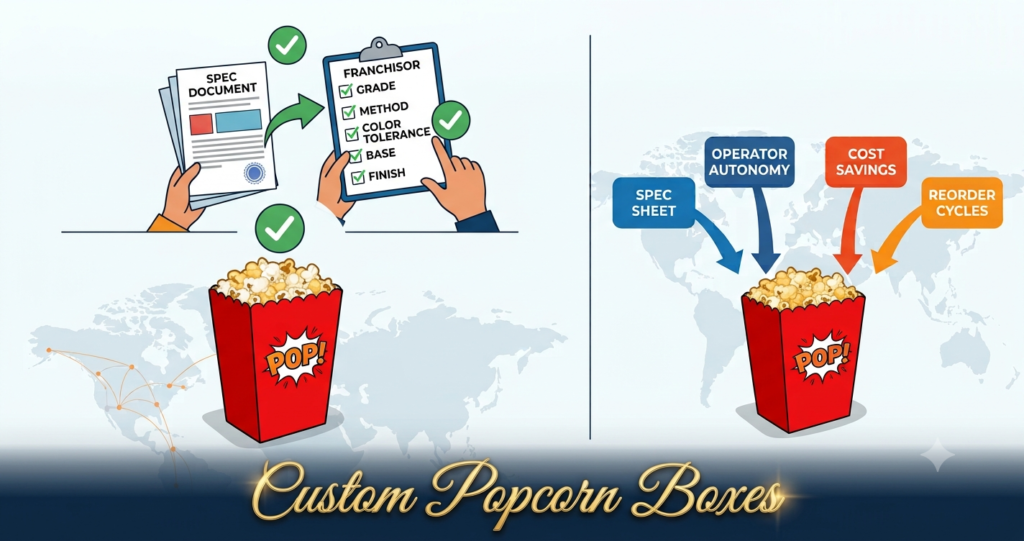
Franchise systems built around consistent customer experience discover their packaging supply chain is one of the hardest elements to standardise across independently operated locations. A regional popcorn franchise with fourteen locations finds that six operators ordered boxes from the approved supplier, four sourced cheaper alternatives locally, and four placed offshore orders to reduce costs, producing four visibly different shades of the same brand red across a single metropolitan market. Customers moving between locations notice. Regional franchise inspectors flag it. The franchisor’s brand team escalates. Nobody intended the inconsistency. It emerged because the system governing how individual operators purchase packaging wasn’t designed to prevent it.
This isn’t a design problem or a printing problem. It’s a supply chain governance problem specific to franchise models, and it requires solutions that operate at the system level rather than at the individual operator level. Solving it means understanding where franchise packaging consistency breaks down, what procurement structures prevent drift before it becomes visible to customers, and how custom popcorn boxes specifications need to be written to survive the reality of independent operators making purchasing decisions under cost pressure across distributed locations.
Where Does Packaging Consistency Actually Break Down in Franchise Systems?
The failure points in franchise packaging consistency cluster around three distinct moments in the procurement cycle, and recognising which moment is causing the problem determines what kind of solution actually addresses it.
The first failure point is specification ambiguity at the franchisor level. Brand guidelines that specify logo placement and colour codes without specifying board grade, print method, approved substrate, lamination type, and supplier selection criteria give individual operators enough freedom to make genuinely different decisions that all technically comply with the written guidelines. An operator ordering boxes from a local print shop who colour-matches to the Pantone reference and places the logo in the correct position has followed the brand guidelines as written. The resulting boxes may still look noticeably different from the approved supplier’s output because the substrate is different, the print method is different, and the lamination is different in ways the brand guidelines never addressed.
The second failure point is cost pressure at the operator level. Independent franchise operators running tight margins seek every available cost reduction, and packaging is one of the few variable costs they have genuine discretion over. An approved supplier quoting $0.85 per box competes against a local printer quoting $0.55 or an offshore supplier quoting $0.38. The $0.47 difference represents meaningful money across a high-volume concession operation, and operators facing that differential need a governance structure that makes compliance easier than deviation rather than simply requiring it without supporting it.
The third failure point is reorder timing decentralization. When individual operators manage their own reorder cycles independently, packaging arrives from different production batches, different seasons, and sometimes different suppliers depending on which approved vendor has stock available when the operator needs it. Even within a single approved supplier relationship, batch-to-batch colour variation that a centralized procurement team would catch and manage passes unnoticed when fifteen operators are each managing their own relationships with the same supplier independently.
What Procurement Structures Actually Maintain Consistency?
Franchise systems that successfully maintain custom popcorn box consistency across distributed locations share a common structural feature: they remove individual operators from the specification decision while preserving their ability to control timing and quantity within the approved framework.
Centralized procurement with operator ordering access represents the most effective consistency model for franchise networks with sufficient scale to justify the administrative infrastructure. Under this model, the franchisor negotiates a master supply agreement with one or two approved suppliers, locks the full specification including board grade, print method, substrate, lamination and colour tolerances, and then provides individual operators with direct ordering access to the pre-specified product. Operators choose when to reorder and how many units to order. They don’t choose what they’re ordering because the specification is fixed at the franchisor level.
This model works because it separates the decision where consistency is required (what the box is) from the decision where operator autonomy is reasonable (when to order and how much). It also concentrates purchasing volume with fewer suppliers, which improves negotiating leverage, supports better pricing than individual operators achieve independently, and creates a supplier relationship where the franchisor rather than individual operators holds accountability for quality performance.
Group buying arrangements suit smaller franchise networks whose combined volume doesn’t justify the administrative overhead of full centralized procurement. Under this model, the franchisor negotiates preferred pricing and locks specifications with one or two approved suppliers, but operators place orders individually rather than through a central purchasing function. The specification lock prevents the substitution problem while the preferred pricing arrangement reduces the cost differential that motivates operators to seek cheaper alternatives.
Approved supplier lists with mandatory specification sheets represent the minimum viable consistency structure for franchise systems that choose to preserve full operator procurement autonomy. Under this approach, the franchisor publishes a list of approved suppliers alongside a mandatory specification document that operators must provide to whichever approved supplier they use. The specification document covers every parameter affecting visual output including exact board grade, print method, Pantone references, substrate, lamination type, and approved finishing options. Operators retain freedom to negotiate their own pricing and timing with approved suppliers but cannot deviate from the specification document.
How Do Custom Popcorn Box Specifications Need to Be Written for Franchise Systems?
A franchise packaging specification document needs to be written to a different standard than a standard packaging brief prepared for a single-location brand. Standard briefs can leave certain decisions to supplier judgment because a single procurement team reviews output and catches problems before they reach customers. Franchise specifications need to anticipate every decision point where supplier judgment could diverge from brand intent and resolve each one explicitly within the document.
Board grade specification needs to go beyond general descriptions like “premium corrugated” or “heavy duty cardboard” to specify exact board weight in points or grams per square metre, wall construction, and minimum edge crush test or burst test ratings where structural performance matters. An operator providing this specification to any approved supplier in any state should receive structurally equivalent boxes regardless of which regional converter fills the order.
Print method specification matters more in franchise contexts than in single-location procurement because different operators may have access to suppliers using different printing technologies, and the same design prints differently across digital, offset and flexographic methods in ways that create visible differences at the brand colour level. Specifying the approved print method prevents the scenario where an operator’s local approved supplier uses digital printing while the master specification was developed around offset colour output.
Colour specification needs to combine Pantone references with Delta E tolerance limits that define the acceptable range of variation from the target colour. Specifying Pantone 485 C without a Delta E tolerance gives suppliers a target without a measurable pass/fail criterion. Adding a Delta E maximum of 2.0 creates an objective measurement standard that quality inspectors, operators and suppliers all reference from the same definition of acceptable rather than from subjective visual assessment that varies between observers.
Substrate specification including board brightness, coating type and recycled content percentage affects how printed colours appear at the point of contact with light. Two boxes printed to identical Pantone specifications on substrates with different brightness ratings look visibly different in natural light. Franchise specifications that lock substrate parameters alongside print specifications prevent this source of inter-location variation that operators never identify as a packaging problem because the boxes all technically meet the stated colour specification.
Lamination and finishing specifications complete the visual output definition by addressing the surface treatment layer that customers see and touch. Matte lamination from one supplier doesn’t always match matte lamination from another, with meaningful variation in sheen level and tactile quality between different lamination products. Specifying lamination by performance characteristic rather than generic type, for example specifying 60 degree gloss measurement targets for matte lamination, provides a measurable criterion that prevents the variation in “matte” that different suppliers produce from becoming a visible inconsistency across locations.
What Does Quality Control Look Like Across Distributed Franchise Locations?
Quality control in franchise packaging is a fundamentally different problem from quality control in centralised production because the inspection function that normally sits between production and customer contact needs to operate across dozens of independently managed locations rather than at a single point in a unified supply chain.
Incoming inspection protocols that individual operators can perform without specialised equipment provide the most practical quality control mechanism for distributed franchise networks. A protocol requiring operators to compare each new delivery against a retained approved sample using natural light, measuring the longest box dimension against a specified tolerance, and checking lamination type by tactile assessment takes under two minutes per delivery and catches the majority of obvious specification deviations before boxes enter service.
Physical approved samples distributed to every franchise location serve as the reference standard that incoming inspections compare against. These samples need to come from an approved production run that the franchisor has verified against full specification, and they need to be replaced on a schedule that prevents sample fading from degrading their accuracy as colour references. Twelve to eighteen months represents a reasonable replacement cycle for most printing and lamination combinations under normal storage conditions.
Photographic documentation requirements for new orders from new suppliers create an accountability mechanism that doesn’t require centralised inspection resources. Requiring operators to photograph the first delivery from any new approved supplier alongside an approved sample and submit the photograph to the franchisor’s brand team for review before the boxes enter service catches specification deviations before they reach customers while distributing the inspection workload across operators rather than concentrating it centrally.
Periodic mystery shopping specifically assessing packaging consistency across locations provides franchisor-level visibility into consistency performance without depending on operator self-reporting. Including a packaging assessment in routine franchise inspection programmes creates the same accountability structure that drives consistency in other operational areas where franchise standards are enforced through documented inspection rather than operator voluntary compliance.
How Should Franchisors Handle Operators Who Deviate?
Deviation management is the element of franchise packaging consistency programmes that most franchisors handle least effectively, either through enforcement that damages operator relationships or through leniency that signals the consistency standard isn’t genuinely mandatory.
The most effective deviation management approach treats specification deviations as operational problems requiring support rather than as compliance failures requiring punishment when they occur for the first time. An operator who sourced non-approved packaging because the approved supplier was out of stock, quoted an uncompetitive price, or had an extended lead time during a peak period faced a genuine operational problem that the consistency programme didn’t support adequately. Responding with remediation rather than penalty, and using the deviation as intelligence about where the approved supplier programme has gaps, produces better long-term compliance than punitive responses that push operators toward concealing future deviations rather than reporting them.
Repeat deviations from operators who deviated once and received support to return to compliance represent a different situation warranting escalation through the franchise agreement’s compliance provisions. The distinction between the first deviation as an operational failure and subsequent deviations as deliberate non-compliance creates a management structure that’s firm enough to maintain standards while reasonable enough to maintain operator trust.
Financial structures that make compliance easier than deviation represent the most durable consistency mechanism available to franchise systems. When the approved supplier’s pricing, supported by the franchisor’s centralised volume negotiation, is competitive with or better than what individual operators could source independently, the economic motivation for deviation disappears. When approved supplier pricing is significantly higher than alternatives operators can access, the consistency programme is fighting economic incentives rather than aligning with them, and enforcement becomes the primary mechanism holding consistency together rather than the backstop it should be.
What Does a Franchise Popcorn Box Specification Document Actually Need to Contain?
A complete franchise custom popcorn box specification document needs to resolve every decision point that could produce variation between boxes ordered by different operators from different suppliers at different times. In practice this means the document covers considerably more than most brand guidelines address.
The specification should open with the business rationale for the standard, explaining to operators why packaging consistency matters commercially rather than simply asserting that it’s required. Operators who understand that visible packaging variation between locations signals to customers that the franchise doesn’t control its own standards, and that this perception affects the premium price position the brand supports, are more likely to treat the specification as a commercial priority than operators who experience it purely as a compliance obligation.
Technical specifications within the document need to cover box dimensions with acceptable tolerances on each measurement, board grade by specific weight and wall construction, print method designation, Pantone references for every colour element with Delta E tolerance limits, substrate specification including brightness rating and coating type, lamination specification with measurable performance criteria, finishing options approved and prohibited, and packaging and labelling requirements for delivered product.
Supplier approval criteria and the approved supplier list with current contact information should appear in the same document as the technical specification, so operators have a single reference point for all packaging procurement decisions rather than navigating multiple documents that may not be consistently updated.
Quality inspection instructions written for operators without packaging expertise need to describe the incoming inspection process in terms of observable characteristics rather than technical measurements. An instruction telling operators to hold the new delivery box and the approved sample under natural light and compare the brand colour on the front panel is actionable without equipment. An instruction telling operators to measure Delta E using a spectrophotometer is technically correct but operationally impractical across most franchise networks.
Aly Packaging USA works with franchise networks and multi-location operators developing custom popcorn box specifications built for consistency across distributed ordering. Orders start from 25 units per location with 8 to 10 business day standard turnaround. Call +1 (844) 259-7225 or email sales@alypackaging.com to discuss franchise programme requirements and approved supplier arrangements.