
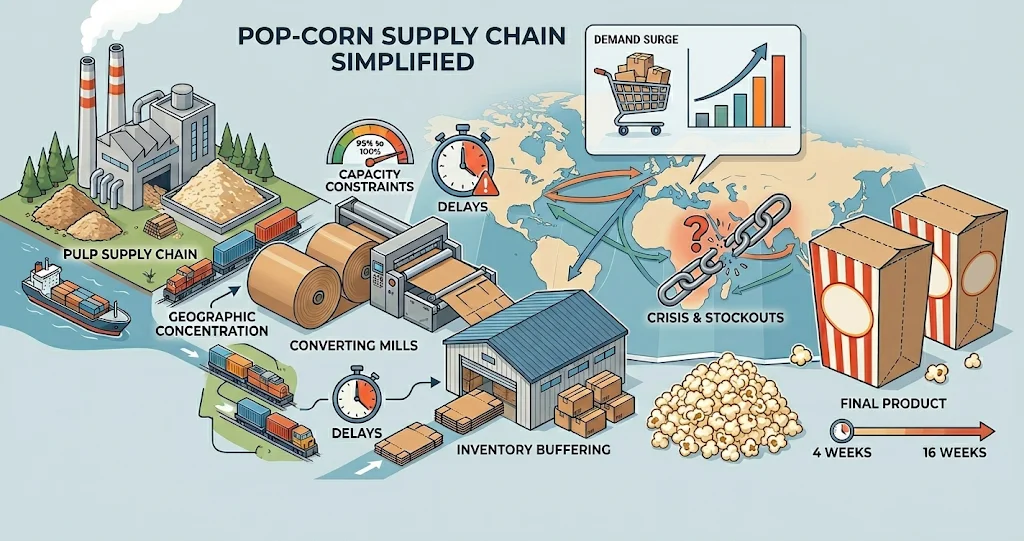
Popcorn box manufacturers and retailers faced unprecedented supply chain chaos 2021-2023 when cardboard capacity ran out, extending lead times from standard 3-4 weeks to 12-16 weeks creating stockouts and missed sales opportunities. Businesses that planned ahead ordering six months in advance maintained inventory while competitors discovered their suppliers ran out of capacity entirely.
A concession operator learned the hard way that calling suppliers during peak shortage found facilities completely booked with waiting lists months long, forcing emergency orders at 100-150% price premiums. Meanwhile, a prepared gourmet popcorn retailer maintained customer fulfillment through established backup supplier relationships enabling rapid switching when primary vendor capacity disappeared.
This guide explains cardboard popcorn boxes supply chain vulnerabilities, historical shortage patterns, strategic planning preventing disruption, and backup supplier strategies enabling operational resilience when capacity constraints emerge.
What Caused the 2021-2023 Cardboard Shortage?
Demand Surge from E-Commerce Growth
E-commerce accelerated dramatically post-pandemic increasing cardboard demand for shipping boxes exponentially. Consumer preference for delivered products rather than retail shopping persisted creating sustained demand.
Cardboard demand for corrugated shipping boxes surged 40-60% year-over-year through shortage period. Food and beverage sectors particularly impacted with increased online ordering and direct-to-consumer sales.
Popcorn subscription boxes and specialty food e-commerce particularly saw demand spikes during period. Emerging direct-to-consumer brands competing for cardboard allocation faced capacity constraints.
Simultaneous demand surge across multiple industries (e-commerce, food, consumer goods) created unprecedented total demand exceeding industry capacity.
Pulp Supply Chain Disruption
Pulp mill shutdowns and production curtailment in North America and Europe reduced virgin fiber supply 15-25%. Environmental regulations and facility upgrades temporarily idled capacity.
Shipping delays from overseas pulp suppliers extended sourcing timelines 4-8 weeks. Port congestion and container shortages compounded import challenges.
Pulp pricing volatility creating economic incentive for production curtailment. Mills withheld production when prices low awaiting better market conditions.
Recycled fiber sourcing increased but couldn’t offset virgin fiber shortages creating fiber supply gap across industry.
Converting Mill Capacity Constraints
Corrugated converting mills operating at 95-100% capacity with no availability for new or increased orders. Supplier booking windows extended from 2-3 weeks to 12-16 weeks standard.
Equipment maintenance backlogs prevented capacity additions. New equipment on order faced 12-18 month lead times for delivery.
Labor shortages at converting facilities reduced effective production capacity. Inability to staff second and third shifts limited output.
Converting mill consolidation and closures reduced total industry capacity. Smaller regional mills shutdown or merged reducing geographic options.
Allocation and Rationing by Suppliers
Large customers with existing volume commitments prioritized for available capacity. Small and new customers faced allocation restrictions or complete inability to obtain orders.
Suppliers prioritized existing long-term contracts over new or spot market orders. Loyalty to established customers meant startups and new entrants couldn’t access supply.
Minimum order quantities increased to higher levels. Suppliers less willing to accommodate small orders preferring to consolidate business with fewer customers.
Spot market pricing reached 200%+ of standard rates for available capacity. Emergency orders at extreme premiums became only option for unprepared businesses.
Geographic Supply Concentration
North American shortage created obvious reliance on limited supplier base. West Coast shortages particularly severe limiting regional suppliers.
International sourcing (Asia, Europe) became alternative but faced extended lead times and freight costs offsetting savings. Import delays 8-12 weeks typical.
Regional supplier consolidation meant fewer geographic options. Competition for limited capacity intense within specific regions.
How Can Businesses Prevent Supply Disruption?
Strategic Inventory Buffering
Maintaining 3-6 months inventory provides substantial buffer against disruption. At 5,000 boxes monthly consumption, carrying 15,000-30,000 boxes creates 3-6 month cushion.
Inventory investment modest ($2,000-5,000 for typical orders) compared to operational disruption costs from stockouts. Safety stock represents insurance against supply failure.
Inventory rotation (FIFO – first in, first out) prevents obsolescence. Older stock used before newer shipments ensuring continuous movement.
Storage space requirements manageable for most businesses. Climate-controlled warehouse space costs $1-3 per box monthly making 6-month buffer economically viable.
Seasonal inventory planning anticipates demand variations. Building inventory during off-season low demand enables sufficient supply during peak periods.
Long-Term Supply Contracts
Securing multi-year contracts with fixed pricing and guaranteed capacity provides certainty preventing allocation during shortages. Advance commitment enables supplier planning and capacity reservation.
Annual volume commitments (estimated consumption × 12 months) demonstrate stability enabling supplier relationship investment.
Contract terms specifying lead time guarantees, pricing stability, and allocation priority create mutual commitment.
Quarterly or semi-annual forecasting updates enable supplier planning without complete rigidity. Flexibility within committed minimums accommodates business changes.
Price escalation clauses in contracts moderate but enable cost adjustments for material inflation. Fixed pricing preventing escalation protection valuable during volatile periods.
Multi-Supplier Relationship Development
Establishing relationships with 2-3 cardboard suppliers prevents single-supplier dependency. Backup suppliers enable rapid switching if primary vendor fails.
Distributor relationships with multiple mills provide alternative sourcing options. Larger distributors often maintain inventory and broader mill relationships.
Primary/secondary/tertiary supplier hierarchy creates clear escalation path. Primary supplier normal sourcing, secondary activated if primary fails, tertiary as final backup.
Placing regular orders with backup suppliers even if not needed maintains relationships and understanding. Regular communication enables faster order processing if activated.
Cross-regional supplier relationships provide geographic diversification. West Coast, Midwest, and East Coast suppliers reduce geographic concentration risk.
Demand Forecasting and Early Ordering
Forecasting future demand enables advance ordering securing capacity before shortage peaks. 6-month forward planning allows ordering during available capacity windows.
Historical demand analysis and seasonal pattern understanding inform forecasting accuracy. Tracking growth rates enables anticipating future needs.
Communicating forecasts with suppliers enables capacity planning. Suppliers can reserve capacity when customers demonstrate commitment to volume.
Flexible ordering windows (allowing ±10% quantity variation) enable customer responsiveness while maintaining supplier planning certainty.
Peak season early ordering (spring for fall demand, summer for winter demand) secures capacity before availability tightens.
Industry Intelligence and Early Warning Systems
Monitoring pulp commodity prices, mill announcements, and industry publications provides early warning of emerging constraints. Price spikes and allocation announcements signal tightening conditions.
Supplier communication about capacity utilization, booking windows, and lead times reveals stress signals. Extending lead times often precede actual shortages.
Peer business communication within industry networks reveals shared supply challenges. Informal networking reveals early signals of emerging problems.
Industry association updates and supply chain publications provide macro trend information. Broader market understanding enables anticipating problems.
Consultant and third-party logistics provider insights offer professional perspectives. External advisors often see patterns individual businesses miss.
What Are Backup Supplier Activation Strategies?
Pre-Crisis Relationship Building
Establishing backup supplier relationships before crisis enables rapid activation. Regular communication and occasional orders maintain relationship quality.
Understanding backup supplier lead times, minimum quantities, and pricing enables quick activation knowing operational implications.
Sharing long-term plans and forecasts with backup suppliers demonstrates serious relationship despite not primary vendor. Suppliers appreciate understanding of intent.
Occasional small orders (quarterly or semi-annual) to backup suppliers maintain production familiarity and relationship quality. Regular work preferred over sudden large orders.
Crisis Activation Procedures
Clear decision criteria specifying when to activate backup suppliers prevents delayed response. Defined trigger points (primary supplier leads times exceeding threshold) automate escalation.
Pre-established emergency contacts with backup suppliers enable rapid communication. Known decision-makers and contact procedures accelerate response.
Documented activation procedures specifying quantity, urgency level, and timeline enable rapid deployment. Written procedures prevent confusion during crisis.
Immediate communication with primary supplier about backup activation often accelerates primary supplier resolution. Competitive pressure motivates rapid problem-solving.
Pricing and Premium Cost Management
Backup suppliers during crisis situations command premium pricing (30-100% above standard rates). Advance understanding of backup pricing prevents sticker shock.
Emergency ordering budget provisions accommodate premium costs. Setting aside contingency budget enables crisis purchasing without operational disruption.
Cost-benefit analysis comparing premium costs to stockout costs justifies activation decision. Emergency box purchases at 100% premium often cheaper than customer service failures.
Negotiating pricing tiers with backup suppliers in advance (e.g., 20% premium for rush orders, 50% for emergency allocation) provides cost certainty.
Volume and Timeline Flexibility
Backup suppliers often require minimum quantities or lead time commitments different from primary suppliers. Understanding these constraints in advance enables realistic expectations.
Accepting lower specification options (standard designs vs. custom, simpler printing vs. complex) from backup suppliers enables faster fulfillment.
Flexible timeline acceptance (accepting longer lead times than crisis timing if needed) increases backup supplier options. Unrealistic expectations limit alternatives.
Partial fulfillment options (receiving portion of needed order sooner) better than nothing. Staged delivery from backup supply manages shortage.
How to Structure Supplier Relationships for Resilience
Transparency and Communication Cadence
Monthly communication with suppliers about forecasts, capacity needs, and market conditions maintains strong relationships. Regular contact prevents suppliers feeling neglected.
Sharing business plans and growth projections with suppliers demonstrates seriousness. Suppliers more willing to reserve capacity for customers with clear visibility.
Supplier plant visits enabling relationship building and understanding operations create stronger bonds. Personal relationships transcend transactional interactions.
Feedback on service, quality, and lead time accuracy helps suppliers understand your priorities. Constructive feedback improves performance.
Volume Commitment vs. Flexibility Balance
Committing to baseline annual volumes provides supplier certainty while retaining flexibility within reasonable bounds. Balance prevents both parties feeling constrained.
Seasonal demand variation accommodation (lower winter orders, higher peak orders) anticipated in annual planning. Seasonal patterns understood not as failure but normal variation.
Growth accommodation in contracts enables scaling without renegotiating terms. Explicit growth clause (e.g., volume increase up to 25% annually) prevents disputes.
Explicit reduction clauses (allowing decline up to 20% if market changes) prevent penalty for natural business fluctuations.
Payment Terms and Financial Stability
Prompt payment maintaining good standing with suppliers creates goodwill and priority treatment. Slow-pay customers lower in allocation during shortages.
Discussing payment terms openly and being transparent about financial situation builds trust. Suppliers appreciate honesty enabling realistic planning.
Early payment discounts if cash flow permits strengthen supplier relationships. 2-3% discounts often justify accelerated payments.
Communicating financial changes (growth, challenges) maintains relationship continuity. Surprises about financial stability damage supplier trust.
Collaborative Problem-Solving
Viewing supplier as partner not vendor creates alignment during challenges. Partners work together solving problems, vendors may prioritize other customers.
Discussing supply challenges and brainstorming solutions together (volume adjustments, specification changes, timing flexibility) demonstrates partnership.
Being willing to accommodate supplier constraints (accepting longer lead times during peak, ordering during slow periods) shows mutual support.
Celebrating supplier successes and acknowledging good service reinforces positive relationships. Recognition motivates continued effort.
What Supply Chain Planning Looks Like in Practice?
Annual Planning Cycle
Q4 previous year: Forecast next year demand based on current trends, growth expectations, and seasonal patterns. Communicate forecast to suppliers.
Q1: Finalize annual volume commitments with primary suppliers. Place bulk orders securing capacity during off-peak demand.
Q2: Monitor forecast against actual demand adjusting if needed. Communicate adjustments to suppliers.
Q3: Peak season demand management. Monitor inventory levels relative to lead times. Activate backup suppliers if needed.
Q4: Evaluate supplier performance and plan next year relationship structure. Build inventory for Q1 peak demand.
Inventory Level Management
Target inventory = (peak monthly demand × 3-6 months) + safety stock for unexpected growth.
Example: 5,000 boxes monthly average, peak months 8,000 boxes = target inventory 15,000-30,000 boxes.
Monthly review compares current inventory to target. Approaching low levels triggers reordering (don’t wait for stockout).
Growth trajectory adjustment increases target inventory accordingly. Scaling inventory as business grows prevents shortage.
Demand Forecasting Methods
Historical analysis: Previous 12-24 months demand pattern identifies trends and seasonality.
Growth projection: Year-over-year growth percentage applied to historical baseline anticipates future needs.
Customer pipeline: Upcoming orders/commitments beyond historical average incorporated into forecast.
Market intelligence: Industry trends, competitor activity, and economic indicators inform demand assumptions.
Conservative adjustment: Forecasting slightly higher than expected data accommodates upside surprise and prevents stockout risk.
Lead Time Monitoring and Early Ordering
Track primary supplier lead times monthly. Increasing lead times signal tightening market conditions.
Order timing = lead time + buffer time + consumption time between orders.
Example: 4-week standard lead time + 2-week buffer + 2-week consumption = order 8 weeks before needed.
Extend order timing during peak season to 12-14 weeks in advance enabling secure capacity before crunch.
Activate secondary suppliers if primary supplier lead times exceed 8 weeks (threshold indicating market stress).
Common Supply Chain Disruption Mistakes
Ignoring Early Warning Signals
Not monitoring supplier lead time extensions and industry capacity signals. Early warning enables proactive response before crisis.
Assuming “shortage won’t happen again” after 2021-2023 period passes. Supply chain fragility persists requiring ongoing vigilance.
Not communicating with suppliers until crisis. Delayed communication prevents suppliers helping with solutions.
Inadequate Inventory Buffers
Carrying only 2-4 weeks inventory insufficient for disruption protection. Minimum 6-8 weeks buffer needed for real protection.
Treating inventory as waste rather than insurance. $2,000-5,000 inventory investment minimal compared to $50,000+ stockout costs.
Not adjusting inventory for business growth. Growing business needs proportionally larger buffer inventory.
Single Supplier Dependency
Relying exclusively on one cardboard supplier creates vulnerability to that supplier’s problems. No alternatives when problems emerge.
Not investing in backup supplier relationships until crisis. Developing relationships too late to enable rapid activation.
Assuming supplier loyalty prevents allocation during shortage. Suppliers prioritize their biggest customers regardless of previous relationship.
Inflexible Long-Term Contracts
Overly rigid contracts without escalation flexibility prevent adjustment during market changes. Fixed pricing can trap unfavorable economics.
Contracts without growth accommodation prevent scaling. Inability to increase orders stalls business growth.
Not including force majeure or disruption provisions addressing supply failure scenarios. Lack of contingency causes disputes during crisis.
Poor Demand Forecasting
Underestimating growth trajectory creates inventory shortage. Too-conservative projections leave insufficient buffer.
Not communicating forecasts with suppliers preventing capacity planning. Suppliers can’t reserve capacity without visibility.
Failing to adjust forecasts as conditions change. Outdated projections create misalignment.
Inadequate Crisis Communication
Not having established escalation procedures delaying response when problems emerge. Crisis procedures required before crisis.
Poor communication with suppliers during stress. Transparency enables collaborative problem-solving.
Not communicating with customers about potential delays proactively. Early notice prevents surprise and enables customer adjustment.
Final Thoughts
Cardboard popcorn box supply chain disruptions stem from pulp sourcing bottlenecks, mill capacity constraints, and demand spikes overwhelming production capacity. Historical shortages 2021-2023 extended lead times 12-16 weeks and increased prices 50-100% demonstrating vulnerability of unprepared businesses. Prevention requires proactive strategic planning rather than reactive crisis response.
Maintain 3-6 months inventory buffer providing cushion against disruption. Safety stock investment modest ($2,000-5,000) compared to operational disruption costs from stockouts. Secure long-term contracts with fixed pricing and guaranteed capacity preventing allocation during shortages. Develop 2-3 supplier relationships reducing single-supplier dependency and enabling rapid switching if primary vendor capacity disappears.
Forecast demand 6 months in advance enabling ordering during available capacity windows before shortage peaks. Monitor supplier lead times and industry capacity signals providing early warning of emerging constraints. Communicate forecasts with suppliers enabling their capacity planning and relationship investment.
Establish backup suppliers before crisis with pre-determined activation procedures, pricing tier agreements, and volume/timeline understanding. Regular communication and occasional orders maintain backup supplier relationships without constant volume requirements. Clear crisis trigger points enable rapid activation preventing delayed response.
Strategic supply chain planning costs modest amounts preventing catastrophic operational disruption and emergency premium costs reaching 100-200% above standard pricing. Businesses that planned ahead 2021-2023 maintained customer fulfillment while unprepared competitors faced stockouts and operational failure. Learning from historical shortage patterns and implementing resilience strategies prevents future disruption damaging operations and reputation.