
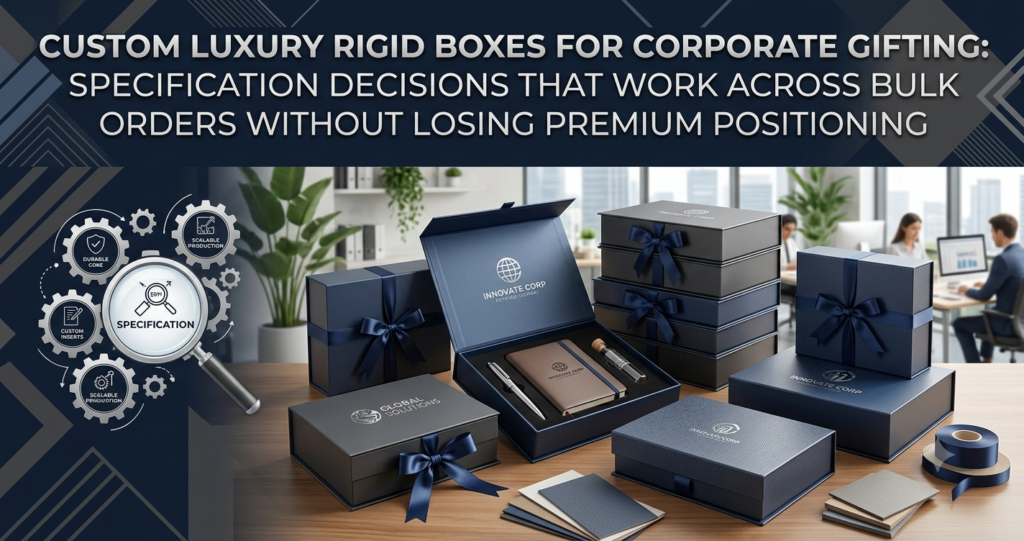
Corporate gifting programmes run on a contradiction that procurement teams and brand managers navigate differently and rarely resolve cleanly. The procurement team sees a bulk order of 500 custom luxury rigid boxes and immediately begins optimizing for unit cost, lead time, and supplier consolidation. The brand manager sees 500 individual interactions between the company’s identity and 500 recipients whose perception of the brand is being shaped by what they hold in their hands. Both perspectives are legitimate. The tension between them determines whether a corporate gifting programme lands as a genuine brand investment or as an expensive commodity purchase that achieves neither cost efficiency nor premium impact.
Specification decisions made early in a corporate gifting rigid box development cycle determine which outcome materializes. The choices that preserve premium positioning across bulk production, and the choices that quietly erode it while appearing to maintain it, aren’t always obvious from a quote sheet or a sample approval. This guide works through those decisions specifically, so procurement teams and brand managers can align on what actually matters before production begins rather than discovering the misalignment when 500 boxes arrive.
Why Bulk Volume Creates Premium Positioning Risk That Single Orders Don’t
A company ordering 10 custom luxury rigid boxes for a high-value client relationship manages quality control simply. Ten boxes can be inspected individually. Variations between units are immediately visible. The supplier relationship is close enough that problems surface and resolve quickly. Premium positioning holds because the production volume is small enough that quality consistency is relatively straightforward to maintain.
The same company ordering 500 boxes for an annual gifting programme introduces variables that single-unit and small-batch production never encounters. Five hundred boxes require genuine production scale, which typically means longer press runs, larger board stock orders drawn from multiple mill lots, more assembly line time across multiple shifts, and quality control sampling rather than individual unit inspection. Each of these production realities creates opportunities for consistency drift that erodes premium positioning in ways the quote sheet never reflects.
Board stock sourced from multiple mill lots within the same production run can carry measurable brightness and stiffness variation between lots, producing boxes whose surface appearance differs subtly but visibly when recipients compare their box against a colleague’s. Lamination applied across a long production run may show slight variation in sheen level between early and late production units as the lamination machine’s temperature and pressure parameters drift within tolerance. Magnetic closure installation across 500 units requires consistent magnet strength calibration that single-shift small-batch production manages more reliably than multi-shift extended runs.
These aren’t hypothetical risks. They’re the normal production realities of scale, and they affect premium rigid box production more than commodity packaging because the quality signals that make rigid boxes premium, tactile consistency, colour precision, closure feel, and structural uniformity, are exactly the elements most sensitive to the variation that bulk production introduces.
What Specification Decisions Actually Preserve Premium Positioning at Scale
The specification decisions that matter most for maintaining premium positioning across bulk corporate gifting orders fall into three categories: material consistency controls, structural precision requirements, and finish durability standards. Each requires explicit specification in the production brief rather than being left to supplier quality management defaults.
Material consistency controls start with board grade specification written tightly enough to prevent mill lot substitution within the same production run. Specifying 2mm grey chipboard covered with 128gsm art paper without further qualification leaves the supplier free to source board stock from whichever mills have inventory available at the time of production. A brief that adds specific brightness rating requirements for the covering paper, minimum stiffness targets for the greyboard, and a requirement that all board stock within a single production run come from the same mill lot eliminates the variable that creates visible inconsistency between units in the same order.
Colour specification for corporate gifting rigid boxes needs to be written with Delta E tolerance limits rather than Pantone references alone, for the same reason franchise packaging specifications require tolerances. Corporate gifting boxes go to recipients across an organisation simultaneously. A CFO and their direct reports receiving the same gift in boxes whose brand colour reads slightly differently because different units came from different points in the production run creates an impression of inconsistency that undermines the premium positioning the boxes were intended to communicate. Delta E tolerances below 1.5 for primary brand colours applied to corporate gifting production are tighter than general commercial packaging standards but appropriate for an application where direct unit-to-unit comparison by recipients is certain.
Structural precision requirements for magnetic closures deserve explicit specification because magnetic closure performance is one of the most immediately perceptible quality signals recipients evaluate when handling a premium rigid box for the first time. A magnetic closure that snaps shut with satisfying authority communicates quality before the box is even opened. A magnetic closure that closes loosely, or requires repositioning to align properly, communicates the opposite regardless of how well every other element of the box is executed. Specifying magnet grade, pull strength in grams, and acceptable closure gap tolerance gives the supplier measurable targets rather than subjective quality aspirations.
Finish durability standards matter specifically for corporate gifting because recipients handle premium gift boxes more than once. A box received as a corporate gift gets opened at the point of receipt, potentially reopened to show colleagues, and often retained rather than discarded. Lamination that scuffs from minimal handling, foil stamping that lifts at edges within days of receipt, or soft-touch coatings that show fingerprint marks immediately after handling create a degraded appearance at the point of maximum recipient attention. Specifying minimum lamination adhesion requirements, foil stamping temperature and pressure standards, and surface coating durability expectations provides quality targets that supplier defaults don’t automatically meet.
How Corporate Gifting Scale Affects Personalisation Without Destroying Unit Economics
Corporate gifting programmes increasingly incorporate recipient personalisation as a differentiator between programmes that feel considered and programmes that feel transactional. A rigid box with the recipient’s name foil-stamped on the lid communicates individual recognition at a scale that transforms a bulk procurement exercise into a collection of individual gestures. The challenge is incorporating this personalisation without creating unit economics that the programme budget can’t support.
Variable data foil stamping, which applies individualised foil elements to each unit during production, is technically possible but carries cost structures that most corporate gifting budgets can’t absorb at meaningful quantities. Setup costs for variable foil systems are substantial, and per-unit processing times extend production timelines significantly when each unit requires individual handling. For programmes above 100 units, variable foil stamping typically creates unit costs that collapse the economic case for the programme.
Digital variable printing on rigid box interior surfaces offers a more accessible personalisation pathway. The exterior of the box carries the consistent brand specification developed for premium positioning. The interior lid panel, printed digitally with recipient name and personalised message, delivers individual recognition without the cost structure of variable exterior foil application. Interior digital printing on premium stock adds $0.35 to $0.85 per unit at typical corporate gifting quantities, a cost increment that most programmes can absorb while maintaining overall budget parameters.
Personalised ribbon colours or ribbon printing represent another accessible personalisation option. A programme where each recipient receives a box with their department’s colour-coded ribbon, or a ribbon printed with their team’s name, creates differentiation within the programme that feels considered without requiring individual unit production handling. Ribbon colour variants add minimal cost at bulk quantities since ribbon stock is inexpensive and colour sorting at packing requires minimal additional labour.
Sleeve wrapping with personalised sleeves over a consistent base box offers the most cost-effective personalisation structure for large corporate gifting programmes. The rigid box itself is produced in full bulk with complete premium specification, preserving every economy of scale. A digitally printed paper sleeve specific to each recipient wraps the exterior, carrying name, department, personalised message, and any programme-specific content. Sleeve production costs are low relative to rigid box production, and sleeve application during packing adds predictable labour cost without disrupting box production economics. Recipients receive a visually personalised exterior presentation while the programme maintains the cost discipline that bulk box production enables.
What Quality Control Systems Work Across Bulk Corporate Gifting Production
Quality control for 500-unit corporate gifting orders requires a different structure than quality control for ongoing retail production, because corporate gifting has a defined delivery event rather than a continuous shelf life, and the consequences of quality failures reaching recipients simultaneously are substantially more damaging than failures distributed across a retail supply chain where individual incidents occur and resolve separately.
Pre-production sample approval for corporate gifting needs to evaluate every element that will appear in the final production run, not simply confirm that the design looks correct and the structure is sound. A complete pre-production sample for corporate gifting approval should include the exact board specification from the intended production lot, the lamination applied under production conditions rather than sample conditions, the magnetic closure installed with production-grade magnets rather than prototype hardware, the foil stamping executed at production press settings, and any personalisation elements included to confirm they integrate correctly with the premium specification rather than disrupting it.
Mid-production inspection at the 25 percent completion point, conducted before the full run is finished, catches systematic errors that would otherwise affect the remaining 75 percent of production. Colour drift developing across a long press run, lamination adhesion issues appearing as coating chemistry changes with temperature during extended production, and assembly errors that become habitual on extended production lines are all more efficiently caught and corrected at 25 percent completion than discovered during final inspection of a complete production run.
Packing inspection before shipment needs to confirm that personalisation elements match recipient lists accurately before boxes are sealed and shipped. A corporate gifting programme where names are transposed between recipients, where incorrect personalisation appears on any unit, or where units are shipped without personalisation elements that were ordered creates recipient-facing problems that damage the programme’s impact regardless of how well the boxes themselves are produced. A packing manifest confirming each unit’s contents against the recipient list, with supervisor sign-off before cartonisation, adds minimal time to the packing process while preventing the specific failure mode most damaging to corporate gifting programme outcomes.
Photography documentation of completed production before shipment creates a quality record that resolves disputes efficiently when recipients report problems after delivery. A documented record showing production quality at the point of shipment establishes whether reported damage occurred during production, during shipping, or during recipient handling, which determines responsibility and resolution pathway without requiring subjective post-delivery assessment.
How Lead Times for Corporate Gifting Differ From Standard Rigid Box Production
Corporate gifting has calendar-driven deadlines that don’t move the way commercial retail deadlines can. A product launching two weeks late loses revenue but remains commercially viable. A corporate gifting programme delivering after the event it was designed to accompany has failed its entire purpose regardless of production quality. Planning lead times correctly for corporate gifting rigid box production requires understanding the actual timeline components rather than accepting quoted production windows at face value.
Design approval cycles for corporate gifting take longer than standard packaging approvals because more stakeholders are typically involved in sign-off. Brand managers, procurement leads, executive sponsors, and legal teams reviewing brand usage all need to approve before production begins, and each stakeholder adds review and revision time that doesn’t compress simply because the production deadline is fixed. Planning four to six weeks for the design approval cycle rather than the one to two weeks adequate for standard packaging briefs prevents the situation where a compressed approval cycle pushes into production time and forces a choice between rushing production and missing the event.
Personalisation data collection creates a timeline dependency that standard packaging production never faces. Recipient lists, name spellings, department assignments, and any other variable data that drives personalisation need to be finalised and delivered to the production facility in time to integrate into the production schedule. Lists that arrive late compress personalisation production time, creating quality risks that pre-production planning cannot fully mitigate. Building a data delivery deadline into the programme timeline, typically two weeks before production begins, creates the buffer that protects personalisation quality.
International shipping timelines affect corporate gifting programmes differently than retail supply chains because gift delivery needs to be synchronised across all recipients rather than distributed across time. A retail product arriving over a two-week delivery window is a standard supply chain outcome. A corporate gifting programme where some recipients receive their gift three days before others creates a perception of prioritisation that undermines the programme’s intent. Planning shipping to arrive within a two to three day window across all domestic recipients requires tighter carrier selection and shipping schedule management than standard retail delivery planning.
Production capacity during peak corporate gifting periods, specifically the weeks preceding Thanksgiving through New Year’s and the months preceding major trade events and fiscal year-end dates, runs at constraints that extend standard production timelines by two to four weeks. Programmes that don’t account for seasonal capacity pressure when setting event delivery targets discover lead times extending beyond what the calendar allows. Confirming current production capacity directly with suppliers rather than assuming standard lead times applies regardless of season is the single most important lead time management step for corporate gifting programmes with fixed event dates.
What Budget Allocation Actually Produces Premium Outcomes
Corporate gifting budget allocation conversations typically begin with a target per-unit cost that works backward from programme budget divided by recipient count, producing a figure that procurement treats as the primary specification constraint. This starting point produces predictably mediocre outcomes because it positions cost as the design brief rather than as one parameter within a broader quality framework.
Premium positioning in corporate gifting rigid boxes comes from three elements that don’t contribute equally to perceived quality per dollar spent. The exterior covering material and its finish, specifically the tactile quality of the surface the recipient touches first, contributes disproportionately to initial quality perception relative to its cost. The magnetic closure feel contributes disproportionately to the second-impression quality assessment that happens in the three seconds between picking up the box and opening it. The interior presentation, including any tissue, ribbon, insert card, or product presentation structure, contributes most to the memory the recipient retains after the gift is opened.
Budget allocation that concentrates investment in these three elements rather than distributing it evenly across all specification categories produces stronger premium outcomes per dollar than balanced investment across all parameters. A programme that applies soft-touch lamination to the exterior while using standard magnetic closure hardware and basic interior tissue creates a strong first impression that weakens immediately upon opening. A programme with standard exterior lamination but precision-calibrated magnetic closure and thoughtfully designed interior presentation creates a building quality impression that peaks at the moment of gift discovery.
The specification decisions that most commonly waste corporate gifting budget without contributing meaningfully to premium positioning include structural complexity in the box construction that recipients never see, premium board grades that exceed what’s perceptible through the covering material, and finishing effects on panels that aren’t in the recipient’s sightline during the primary handling experience. Redirecting budget from these invisible premiums toward the three high-impact elements consistently produces better programme outcomes without increasing total spend.
Aly Packaging USA works with corporate gifting programmes across order sizes from 50 to 50,000 units, developing custom luxury rigid box specifications that maintain premium positioning across full production runs. Orders include pre-production sample approval, mid-production inspection coordination, and packing verification support for personalised programmes. Call +1 (844) 259-7225 or email sales@alypackaging.com to discuss your corporate gifting programme timeline and specification requirements.