
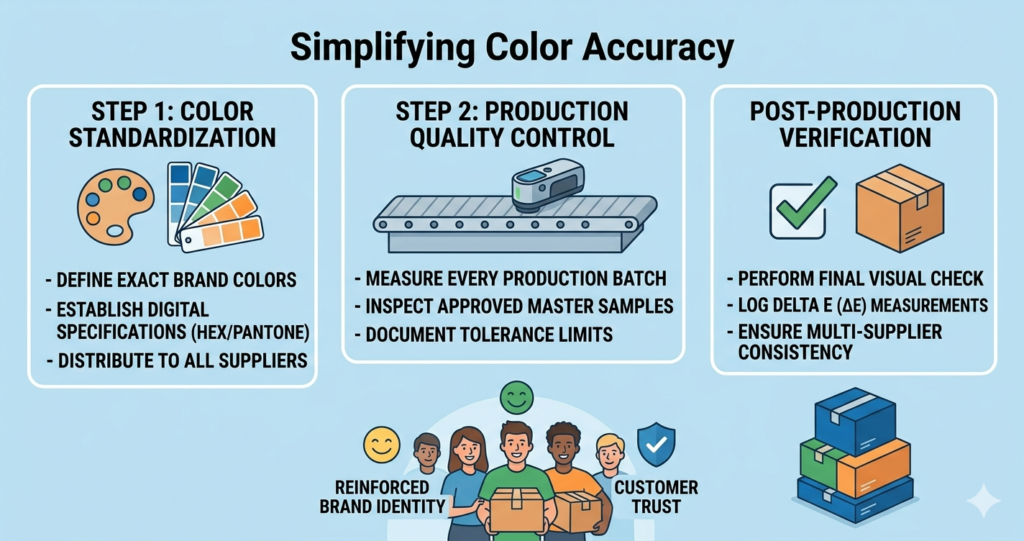
Brand managers ordering printed mailer boxes discover color drift between production runs after investing in premium packaging design. A skincare brand receives their third production run of printed mailer boxes and finds the signature teal appearing noticeably greener than the first two runs, creating visible inconsistency when customers photograph boxes side-by-side on social media. A subscription service switching to a backup supplier during a shortage finds their coral brand color reproduced as salmon pink, generating customer complaints about packaging quality despite identical product inside. Neither problem results from supplier negligence. Both result from the absence of color management systems that professional packaging programs require.
This guide explains why color drift occurs across printed mailer box production runs, the technical standards preventing batch-to-batch variation, supplier management practices maintaining consistency when multiple vendors are involved, and verification systems catching color problems before full production runs.
Why Does Color Drift Happen Between Production Runs?
Ink Lot Variation and Pigment Concentration
Printing inks arrive at production facilities in batches from ink manufacturers. Each batch contains pigments, binders, and solvents combined to specification, but natural raw material variation creates concentration differences of 2-5% between lots. This variation produces visible color shifts when comparing boxes from different production runs using different ink lots.
Pantone ink systems address this through standardized formulations, but even Pantone inks show batch-to-batch variation within allowable tolerances. A supplier using Pantone 3125 C for a brand’s teal specification in March may use a different ink lot in September with measurably different pigment concentration.
CMYK process printing amplifies this problem since four separate ink channels (cyan, magenta, yellow, black) each carry independent lot variation. Color accuracy in CMYK depends on the precise combination of all four channels hitting target density simultaneously. Variation in any single channel shifts the final mixed color.
Water-based inks and UV-curable inks show different lot variation profiles. UV-curable inks used in digital printing generally show tighter lot consistency (1-2% variation) than solvent-based offset inks (2-5% variation) because UV formulations have less volatile component variation during curing.
Press Calibration and ICC Profile Differences
Every printing press develops its own color response characteristics through use, maintenance, and environmental conditions. Press calibration profiles (ICC profiles) map the press’s actual color reproduction against target values, compensating for press-specific tendencies.
A press running 50,000 mailer box impressions monthly develops different wear patterns than a press running 10,000 impressions monthly. Roller wear, blanket compression changes, and ink fountain calibration drift all affect color density between production runs on the same equipment.
When suppliers run your printed mailer boxes across different presses within the same facility, each press requires its own calibration verification. Production scheduling decisions may route your job to whichever press has available capacity, creating color variation if presses aren’t calibrated to identical standards.
Multi-supplier scenarios amplify press calibration differences. Two suppliers with identical equipment but different calibration maintenance schedules produce measurably different color output for the same Pantone specification. Neither press is wrong. Both are operating within their individual calibration parameters, which may not align with each other.
Substrate Variation and Reflectance Impact
Paperboard reflectance directly affects how printed colors appear to the eye and to measurement instruments. Whiter, higher-brightness substrates reflect more light creating more vibrant color appearance. Lower-brightness substrates absorb more light making identical ink deposits appear darker and less saturated.
SBS board brightness varies between manufacturers and even between production batches from the same mill. A brand specifying 18pt SBS without brightness specification receives boards varying from 88 to 94 GE brightness across different suppliers and batches. This 6-point brightness range creates visible color appearance differences with identical ink deposits.
Kraft board creates the most significant substrate-driven color challenge. The natural brown substrate absorbs lighter colors completely, shifts warm colors toward earth tones, and requires substantially higher ink density to achieve any color vibrancy. Brands printing on kraft must account for substrate influence when specifying colors rather than transferring white-stock specifications directly.
Coated versus uncoated board surfaces affect ink absorption differently. Coated board prevents ink penetrating paper fibers, keeping pigment at the surface for maximum color density. Uncoated board allows ink absorption creating softer, less dense color appearance even with identical ink deposits.
What Color Standards Prevent Drift Between Runs?
Pantone Specification vs. CMYK-Only Briefing
Providing suppliers with only CMYK values creates the most common source of inter-run color inconsistency. CMYK values specify the percentage of each ink channel but don’t specify the target color appearance. Two suppliers interpreting identical CMYK values on different press configurations produce different color outcomes.
Pantone color references provide an absolute color target independent of printing method. Pantone 485 C specifies a precise red regardless of which press, which supplier, or which ink lot produces it. Every supplier with Pantone ink systems can reference the same physical color standard.
Converting brand colors to Pantone references requires identifying the Pantone match closest to your intended color. This process costs nothing and takes minutes using Pantone’s color matching tools or supplier assistance. The investment pays back immediately through improved inter-run consistency.
Pantone spot color printing uses premixed inks manufactured to exact formulations, providing tighter color accuracy (90-95%) than CMYK process printing (75-85%). For brands where one or two specific colors define their visual identity, spot color printing for those critical colors justifies the modest cost premium.
Physical Color Standards and Approved Samples
Retaining physical approved samples from each production run creates reference standards for future run comparison. A printed mailer box from the first approved production run represents the color target for all subsequent runs, providing physical reference that digital proofs cannot replicate.
Physical standard storage requires climate control preventing color shift in stored samples. Samples exposed to UV light, high humidity, or temperature extremes fade and yellow, becoming unreliable references. Sealed packaging in dark, temperature-controlled storage maintains sample integrity for 12-18 months.
Multiple copies of approved samples (minimum three per design) support multi-supplier programs. The primary supplier retains one copy for press make-ready comparison. A backup supplier retains one copy for their production reference. The brand retains one master copy for dispute resolution and new supplier onboarding.
Sample replacement schedules prevent color drift in the reference standard itself. Approved samples older than 12-18 months should be refreshed from current production before fading compromises their accuracy as color targets.
Delta E Tolerance Agreements
Delta E measures the mathematical difference between a target color and a reproduced color. A Delta E value of 0 indicates perfect match. A Delta E of 1.0 represents the threshold of human visual perception under controlled conditions. Industry standards for packaging color consistency accept Delta E below 2.0 as commercially acceptable.
Establishing Delta E tolerance agreements with suppliers before production creates measurable, enforceable color standards replacing subjective judgments. A tolerance agreement specifying Delta E below 2.0 for all brand colors gives both parties a clear, measurable pass/fail criterion.
Without Delta E agreements, color acceptance disputes become subjective disagreements between brand managers and suppliers about what “close enough” means. Suppliers defending their production and brand managers requesting reruns both lack objective criteria for resolution. Delta E agreements eliminate this ambiguity.
Critical brand colors with high recognition value warrant tighter tolerances. A brand where specific green is a trademark asset might specify Delta E below 1.5 for that color while accepting Delta E below 2.5 for secondary colors. Tiered tolerances apply appropriate standards without requiring maximum precision across all printed elements.
How to Manage Consistency Across Multiple Suppliers?
Supplier Qualification and Color Profiling
Before approving a new supplier for printed mailer box production, requesting color profiling samples demonstrates their color capability across your brand’s specific color range. Send three to five candidate designs representing your full color palette for print sampling. Evaluate samples against your approved standards using Delta E measurement.
Supplier qualification samples cost $150-400 in production time. This investment prevents the alternative scenario of discovering color capability gaps after committing to production volumes. Suppliers whose samples fall outside Delta E tolerances on qualification rounds rarely perform better in production pressure conditions.
Color capability varies by supplier’s equipment, ink system, and calibration maintenance practices. A supplier excelling at saturated CMYK process colors may struggle with specific Pantone spot colors. Understanding each supplier’s specific color strengths before assigning production prevents known weaknesses creating problems.
Multi-supplier color profiling creates a capability matrix identifying which supplier handles which color ranges most accurately. This matrix guides production assignment decisions. Complex designs requiring precise Pantone matching go to your highest-capability supplier. Simpler designs with more tolerance go to lower-cost alternatives.
Shared Color Reference Distribution
Distributing identical physical color standards to every approved supplier creates a common reference system reducing inter-supplier variation. When all suppliers press-match against the same physical standard, their outputs converge toward a shared target rather than diverging toward individual press defaults.
Shared reference distribution requires producing sufficient copies of approved standards during first-run production. Ordering slightly more printed mailer boxes than needed during the initial production run creates surplus approved samples available for supplier distribution without additional cost.
Digital color profiles (ICC profiles and spectrophotometer measurement files) complement physical standards by providing machine-readable color targets. Suppliers with spectrophotometer-based press control systems can import your brand’s color data and automatically monitor press performance against your specifications throughout production runs.
Updating distributed standards when brand colors evolve prevents suppliers working from outdated references. Color updates require recalling and replacing all distributed standards with new approved versions. A tracking system logging which suppliers hold which standard versions prevents the scenario of one supplier working from a discontinued color version.
Supplier Communication Protocols
Establishing communication protocols specifying how color concerns are flagged and resolved prevents problems discovered late in production runs. Protocols should specify: when suppliers should pause production to seek brand approval (Delta E exceeds tolerance on press check), how quickly brand managers respond to production holds, and what documentation accompanies color concern reports.
Production hold response time directly affects supplier behavior. If brand managers consistently take 24-48 hours responding to press check approvals, suppliers facing production scheduling pressure may proceed without approval rather than holding expensive press time. Committing to 2-4 hour response windows for production holds maintains the approval process integrity.
Documenting every color deviation and resolution creates a record of supplier performance over time. Suppliers with recurring color issues identified through documentation warrant capability reviews. Suppliers consistently delivering within tolerance deserve recognition through preferred vendor status and increased production allocation.
What Verification Systems Catch Problems Before Full Production?
Press Proof Approval Process
Press proofs represent the clearest opportunity to catch color problems before committing to full production runs. A press proof runs 25-50 sheets on the actual production press under production conditions, providing physical samples matching what full production will produce.
Approval criteria for press proofs should specify both subjective evaluation (does this match the approved standard) and objective measurement (Delta E within tolerance for all critical brand colors). Both criteria prevent the scenario where proofs pass visual approval but fail measurement standards or vice versa.
Press proof turnaround typically requires 1-2 additional business days beyond production quoting. Brands treating this as optional cost savings eliminate the single most effective color quality checkpoint. The cost of a rerun from production color failure ($800-3,500 typical for printed mailer boxes) far exceeds the press proof time investment.
Remote digital proofs (PDF or soft proofs) serve design layout verification but cannot confirm color accuracy for print production. Screen display technologies and printer color gamuts differ enough from offset press output that digital proofs appearing identical on screen frequently differ measurably in production. Treating digital proofs as color approval substitutes for press proofs creates false confidence.
Spectrophotometer Measurement Standards
Spectrophotometer measure reflected light from printed surfaces producing objective color data independent of human visual perception. This measurement capability enables consistent color evaluation across different observers, different lighting conditions, and different geographic locations.
Handheld spectrophotometers (X-Rite i1Pro, Barbieri LFP series) cost $800-2,500 and provide the measurement standard professional print quality programs use. Brands managing multi-supplier printed mailer box programs justify this investment through consistency value and dispute resolution capability.
Including spectrophotometer measurement in supplier contracts requires suppliers to measure and document color values for each production run, providing data alongside physical shipments. This documentation creates a color quality record enabling trend analysis identifying systematic drift before it becomes visible.
Brands without spectrophotometer capability can specify that suppliers provide color measurement data with each shipment. Most professional printing operations have measurement capability. Requiring data delivery as a contract condition adds no supplier cost while creating accountability.
Incoming Quality Inspection
Inspecting printed mailer box shipments upon arrival rather than at point of use catches color problems before inventory enters fulfillment workflows. Discovery at use point creates fulfillment disruption, customer complaints, and difficult replacement decisions when inventory is partially consumed.
Incoming inspection protocols specify sampling rates (100% inspection for first runs from new suppliers, 10-15% sampling for established suppliers with consistent quality history), measurement criteria (Delta E evaluation for critical brand colors), and disposition decisions (accept, conditionally accept pending brand review, reject).
Photographic documentation of incoming inspection findings creates shipment-level quality records. Photos comparing incoming boxes against approved standards provide visual evidence for supplier disputes and trend tracking across shipments.
Rejection and replacement protocols specify timelines and responsibilities when incoming inspection fails. Suppliers whose shipments fail inspection should replace within 5-7 business days at their cost. Brand managers should respond to rejection notifications within 24 hours confirming rejection decision and replacement specifications.
What Practical Steps Improve Consistency Starting Today?
Immediate Actions Requiring No Investment
Convert all printed mailer box briefs from CMYK-only to Pantone references immediately. Identifying Pantone matches for existing brand colors requires only access to a Pantone color guide or supplier assistance. This single change reduces the most common source of inter-run color variation with zero cost.
Retain one complete set of approved samples from your current or next production run. Label samples with production date, supplier, print method, and board specification. Store in sealed packaging away from light and heat. This creates the physical reference standard preventing future disputes.
Request Delta E measurement data from your current supplier for your next production run. Most professional printing operations measure color during production already. Asking for this data costs nothing and establishes the baseline measurement record enabling trend analysis.
Document all brand color specifications in a single reference document distributed to all approved suppliers. Include Pantone references, approved CMYK equivalents, substrate specification, and Delta E tolerances. This document becomes the color authority preventing individual supplier interpretation divergence.
Medium-Term Process Improvements
Commission press proof approval for all new designs and any design reprinting after 6+ months gap. The additional 1-2 business days in production timeline pays back through consistent color preventing reprint costs and customer complaints.
Develop a formal supplier qualification process requiring color profiling samples before approving new vendors. A one-page qualification checklist including color sample submission, Delta E measurement, and approval criteria ensures new suppliers meet standards before receiving production assignments.
Establish annual color standard refresh cycles retiring samples older than 12-18 months and replacing with current production references. Calendar this refresh during off-peak production periods when supplier capacity allows careful attention to color standards work.
Build color performance history into supplier evaluation criteria. Suppliers consistently delivering within Delta E tolerances receive preferred vendor status and production priority. Suppliers with recurring color issues receive performance improvement discussions before production assignment decisions.
Final Thoughts
Color consistency across printed mailer box production runs and multiple suppliers requires moving from informal expectation to documented system. Pantone color references replacing CMYK-only briefs, physical approved samples providing run-to-run comparison standards, Delta E tolerance agreements creating measurable acceptance criteria, and press proof approval protocols catching problems before full production commitment form the four pillars of a reliable color management program.
These systems don’t require significant investment. Converting briefs to Pantone references costs nothing. Retaining approved samples costs nothing. Requesting Delta E measurement data from suppliers costs nothing. Press proof approval adds 1-2 business days to production timeline. The total investment is small compared to a single rerun from color failure or the ongoing brand erosion from inconsistent packaging appearing in customer social media.
Brands managing two or more suppliers for printed mailer boxes need shared physical standards distributed to each approved vendor. Common reference points allow independent suppliers to converge toward the same color target rather than diverging toward their individual press defaults. Multi-supplier color management requires more coordination but enables supply chain resilience without sacrificing the brand consistency that premium packaging programs require.
For printed mailer box orders with specific color accuracy requirements, Aly Packaging USA provides Pantone-matched production, press proofs before full run commitment, and Delta E measurement documentation with shipments. Orders start from 500 units with 8-10 business day turnaround. Call 1-844-259-7225 or email sales@alypackaging.com to discuss color specifications.