
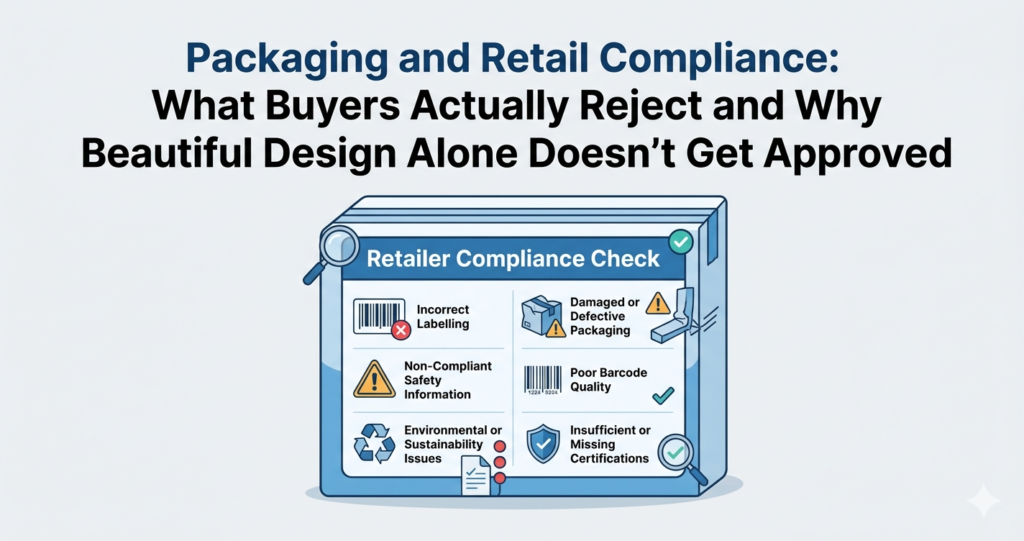
Brands spending $15,000-40,000 developing premium packaging discover during retailer submission that beautiful design doesn’t guarantee retail approval. A specialty food company receives Target rejection despite winning packaging design awards because case pack configurations didn’t match planogram requirements.
A beauty brand loses Whole Foods placement after six months of negotiation when packaging fails sustainability documentation requirements despite carrying recyclable messaging. Meanwhile, a household goods company receives Walmart approval within three weeks by submitting complete compliance documentation alongside design files, understanding that retail buyers evaluate operational compatibility before aesthetic appeal.
This guide explains what retail buyers actually check during packaging and retail compliance review, specific rejection reasons brands consistently encounter, documentation requirements preventing automatic disqualification, and building packaging systems passing retailer approval without expensive redesign cycles.
What Retail Buyers Actually Evaluate First
Operational Compatibility Precedes Aesthetics
Retail buyers separate compliance evaluation from design review in most organizations. Compliance teams review technical specifications while separate merchant teams evaluate design and brand positioning.
Compliance review occurs before merchant design presentation in most major retailers. Packaging failing compliance review never reaches merchant evaluation regardless of design quality.
Understanding this sequence prevents brands investing in expensive design refinement before ensuring operational compatibility. Compliance gaps create rejection regardless of brand positioning strength.
Buyer prioritization reflects retailer operational reality. Distribution centers, store teams, and supply chain systems can’t accommodate non-compliant packaging regardless of consumer appeal. Operational failure costs retailers far more than declining attractive packaging.
Retailer compliance portals require specific documentation before human review begins. Incomplete submissions trigger automatic rejection or hold status preventing advancement through review pipeline.
Buyer Pain Points Driving Rejection Decisions
Distribution center inefficiency from non-standard packaging creates retailer cost beyond product value. Packages requiring manual handling, special storage, or irregular processing add labor costs retailers pass back through chargebacks or rejections.
Store-level stocking complexity from non-standard packaging creates employee time waste. Packages not fitting standard shelf configurations require additional merchandising time retailers factor into acceptance decisions.
Return processing costs from inadequate packaging failing supply chain drive rejection decisions. High damage rates create hidden costs retailers attribute to packaging compliance failures.
Consumer complaints from inadequate labeling, misleading claims, or functional failures create customer service costs and brand liability. Retailers protect themselves by requiring labeling compliance before placement.
Category management requires planogram compliance enabling efficient shelf space management. Non-compliant dimensions create merchandising problems affecting entire category performance.
What Are UPC Barcode Compliance Requirements?
Barcode Placement and Sizing Standards
GS1 standards specify barcode placement ensuring reliable scanning throughout supply chain. Most retailers require barcodes on bottom panel or back panel within specific zones enabling consistent scanner access.
Quiet zone requirements specify minimum white space surrounding barcode preventing interference. Standard quiet zones require 11 module widths on left and right and 2.75 module heights top and bottom. Printing decorative elements within quiet zones causes scan failures.
Barcode sizing must fall within acceptable magnification range (80-200% of nominal size). Below-minimum sizing reduces scan reliability while oversized barcodes waste package real estate. Specific retailer requirements may narrow acceptable range.
X-dimension (width of narrowest bar) must meet minimum specifications ensuring physical print quality. Inadequate print resolution creating X-dimension below minimum causes scan failures during supply chain verification.
Color contrast between bars and background must meet minimum reflectance differential. Dark bars on light background required. Printing barcodes on dark backgrounds or using colors with insufficient contrast creates scan failures.
Scan Rate Testing and Verification
Retailers require minimum scan rate performance (typically 90-95% first-scan success across all packaging surfaces). Brands submitting packaging without scan rate verification discover failures during distribution center receiving.
GS1 scan testing services ($150-400 per barcode) verify compliance before retailer submission. Test reports demonstrating acceptable scan rates accompany submission documentation.
Multiple barcode placement sometimes required. Club stores and warehouse retailers often require barcodes on multiple package faces enabling scanning without reorientation. Single barcode placement acceptable for most channels but restricts club store opportunities.
Barcode verification equipment (verification grade readers) provides standardized grade reports retailers accept. Consumer-grade scanners cannot verify barcode quality to required standards.
Retailer-Specific Barcode Requirements
Target requires specific barcode placement on primary display panel with specific dimensions. Their vendor portal specifies exact requirements varying by product category.
Walmart requires barcode placement enabling scan from specific orientations aligned with their distribution center conveyors. Placement incompatible with conveyor scanning creates distribution center processing failures.
Amazon requires barcode compliance for both retail and FBA fulfillment. FNSKU labels for FBA and EAN/UPC for retail create dual barcode requirements some sellers overlook.
Club stores (Costco, Sam’s) require barcode on multiple surfaces enabling warehouse-scale scanning without individual handling.
What Case Pack and Master Carton Requirements Apply?
Standard Case Pack Configurations
Retailers specify acceptable case pack quantities (units per case) ensuring efficient replenishment and inventory management. Submitting non-standard case packs creates replenishment system incompatibility.
Target typically requires case pack quantities matching their replenishment model (often multiples of 6, 12, or 24 depending on category). Non-standard quantities create ordering system incompatibility.
Grocery retailers manage case packs around facing counts. A product with 4-unit shelf facing typically requires 12 or 24-unit case packs enabling efficient shelf replenishment without partial case management.
Drug retailers require case packs enabling efficient planogram replenishment. Pharmacy category case packs often differ from food categories reflecting different velocity and shelf configuration.
Master Carton Specifications
Master carton dimensions must achieve pallet compatibility enabling efficient warehouse stacking. Standard GMA pallets (48″×40″) require carton dimensions filling pallet efficiently without overhang.
Master carton weight limits (typically 50 lbs maximum) protect against worker injury claims and comply with ergonomic requirements. Heavy cartons create liability exposure retailers reject.
Stacking strength requirements ensure master cartons survive warehouse pallet stacking without crushing. Retailers specify minimum compression strength (typically 800-1,200 lbs) ensuring product survives warehouse storage.
Master carton labeling requirements specify placement of SKU information, quantity, barcode, and retailer-specific identifiers. Missing or incorrectly formatted labels cause distribution center rejection regardless of product quality.
Vendor compliance labels (VCN labels) following specific formats enable retailer inventory management systems processing shipments automatically. Non-compliant labels require manual processing creating chargebacks ($50-250 per incident).
Quantity and Configuration Verification
Quantity accuracy in master cartons must exactly match documentation. Short-shipped cartons create inventory discrepancies triggering chargebacks and compliance violations.
Configuration consistency across production runs prevents receiving discrepancies. Changing case configuration without retailer notification violates vendor agreements.
Pack orientation documentation showing correct product orientation within cases prevents damage from improper packing.
What Are Planogram Dimensional Requirements?
Shelf Space Allocation and Facing Dimensions
Planograms specify exact shelf space allocation for each product including facing width, shelf depth, and stacking height. Products exceeding allocated dimensions don’t physically fit placement.
Standard shelf dimensions vary by retailer and store format. Mass merchants use different standard configurations than specialty retailers. Knowing target retailer shelf specifications before finalizing package dimensions prevents incompatibility.
Facing width determines how many units fit across allocated shelf space. Common product width specifications range 2-4 inches for individual units enabling 3-8 facings in standard 12-inch section allocations.
Product depth must fit within shelf depth without protruding. Standard shelf depths range 12-18 inches depending on store format. Products exceeding shelf depth create safety hazards and planogram violations.
Stacking and Density Requirements
Stacking height limitations prevent top-heavy shelves creating safety risks. Most retailers limit product stacking to 2-3 high for standard gravity-feed shelving.
Shelf density requirements specify minimum number of units holding capacity for allocated space. Low-density products requiring excessive shelf space per unit face allocation reduction or rejection.
Gravity-feed compatibility requires product dimensions enabling smooth front-to-back movement as forward units sell. Products jamming gravity-feed mechanisms create store-level stocking problems.
Display unit compatibility matters for club stores and warehouse retailers. Products must fit pallet display configurations enabling floor placement without shelving.
Category-Specific Dimensional Standards
Food and beverage categories follow specific shelf dimension standards influenced by national brand benchmark products. New entrants deviating significantly from category norms face planogram compatibility challenges.
Beauty categories organize around specific height zones enabling customer visual scanning. Products dramatically shorter or taller than category norms disrupt visual merchandising.
Electronics categories require specific space for security tethers, demo units, and packaging configurations enabling customer interaction. Packaging not accommodating these requirements faces category-level rejection.
What Documentation Do Sustainability Claims Require?
Verification of Environmental Claims
Retailers increasingly require documentation supporting sustainability claims following FTC Green Guide principles. Unsubstantiated claims create greenwashing liability shared by retailers stocking non-compliant products.
“Recyclable” claims require specifying percentage of consumers with access to recycling for specific material. Claims without infrastructure availability documentation fail FTC Green Guide requirements creating violation risk.
“Biodegradable” claims require specific timeframe and conditions documentation. Vague biodegradability claims without conditions constitute deceptive advertising under FTC guidelines.
“Made from recycled content” claims require percentage specification and documentation of actual recycled content. Claiming recycled content without verification documentation creates misleading impression.
Compostable claims require certification from recognized bodies (BPI, TUV Austria) and disclosure of conditions required (industrial vs. home composting). Uncertified compostable claims fail retailer documentation requirements.
Certification Requirements by Retailer
Whole Foods requires specific sustainability standards including restricted ingredient lists affecting packaging inks and coatings. Their Whole Foods Market Quality Standards specify documentation requirements unique to their positioning.
Target has published sustainability goals including packaging commitments. Their supplier requirements reflect these goals with specific percentage recycled content and recyclability standards for product categories.
Walmart’s Project Gigaton and sustainability reporting requirements cascade to supplier packaging. Brands seeking Walmart placement increasingly face sustainability documentation requirements beyond simple claims.
Specialty retailers (REI, Patagonia-adjacent brands) require environmental documentation matching their brand values. Premium sustainability positioning creates documentation burdens exceeding mass merchant requirements.
Third-Party Certification Value
FSC (Forest Stewardship Council) certification for paper and cardboard packaging demonstrates responsible forest management with internationally recognized documentation.
SFI (Sustainable Forestry Initiative) certification provides North American alternative to FSC with similar credibility for retail compliance purposes.
Cradle-to-Cradle certification provides comprehensive sustainability assessment covering multiple environmental dimensions. Premium retailers increasingly recognize this certification.
How2Recycle labeling program provides standardized recyclability information consumers and retailers recognize. Program participation demonstrates commitment to verified sustainability claims.
What Legal Labeling Requirements Must Packaging Meet?
Mandatory Label Elements by Category
Food packaging requires Nutrition Facts panel following FDA specifications including specific fonts, layout, and information requirements. Missing or incorrectly formatted Nutrition Facts panels create regulatory violation risk.
Ingredient listings must follow FDA requirements including complete disclosure in descending order by weight. Missing ingredients or incorrect ordering creates recall risk retailers cannot accept.
Allergen declarations (major eight allergens) require specific formatting and placement. FALCPA requirements specify “Contains:” statement format and bold formatting retailers verify.
Net weight declarations must appear on principal display panel in specific format and size. Inadequate visibility or incorrect formatting violates FPLA requirements.
Country of origin labeling requirements vary by product category. Agricultural products, textiles, and certain consumer goods have mandatory origin labeling retailers verify during compliance review.
Warning Label Requirements
California Prop 65 warnings required for products sold in California containing listed substances above threshold levels. Retailers distributing nationally often require Prop 65 warnings for all inventory regardless of distribution geography.
Choking hazard warnings required for small parts products targeting children under 3 years. ASTM standards specify warning text, sizing, and placement retailers verify.
Chemical safety warnings (OSHA Hazard Communication standard) required for cleaning products, chemical-containing items, and certain consumer products. Missing required hazard communication creates regulatory violation.
Electronics require specific disposal instructions and certifications (UL, ETL, CE for international) retailers verify during compliance review.
Font Size and Readability Standards
FDA regulations specify minimum font sizes for specific label elements. Nutrition Facts panel has specific minimum size requirements. Net weight declarations require minimum 1/16 inch print height. Ingredient text must meet minimum readability standards.
FTC regulations require disclosures to be clear and conspicuous. Fine print disclosures in locations unlikely to be read create disclosure adequacy failures.
State-specific requirements add complexity particularly for national brands. California, New York, and Massachusetts have requirements exceeding federal minimums in certain categories.
What Structural and Supply Chain Performance Requirements Apply?
Distribution Center Performance Standards
Retailer distribution centers process millions of units daily with automated systems requiring specific structural performance. Packaging failing structural requirements creates distribution center processing problems.
Compression performance during pallet stacking must meet minimum standards. Products spending days or weeks in warehouse environments under pallet loads must maintain structural integrity.
Conveyor system compatibility requires package dimensions and structural integrity enabling automatic conveyor processing. Soft packaging, unusual shapes, or structurally weak materials create conveyor jams.
RFID compatibility increasingly required by major retailers. Packaging with metallic elements interfering with RFID scanning creates inventory management problems.
ISTA Testing and Documentation
ISTA 3A testing (standard simulation for distribution) required by most major retailers for new product submissions. Test reports from ISTA-certified laboratories demonstrate supply chain performance.
Testing costs ($800-1,500 per SKU) represent modest investment compared to retailer rejection and redesign costs ($5,000-20,000). Front-loading testing before submission prevents expensive failures.
Category-specific testing requirements vary by retailer. Electronics retailers require more stringent testing than commodity food products. Understanding category-specific requirements prevents inappropriate testing.
Pass/fail criteria specified in retailer vendor agreements define acceptable performance levels. Brands testing to internal standards rather than retailer-specific criteria sometimes discover misalignment during submission.
Damage Rate Thresholds
Retailers track damage rates by supplier and product. Consistent damage rates exceeding 2-3% trigger compliance review and potential delisting.
Damage rate documentation from existing distribution demonstrates compliance history. New products without history require testing substituting for performance data.
Packaging redesign requirements when damage rates exceed thresholds create ongoing compliance obligation. Retailers specify correction timelines and reserve right to delist for persistent failures.
How to Build a Compliant Packaging System
Pre-Development Retailer Research
Identifying target retailers before packaging development enables designing compliance requirements into packaging from inception rather than retrofitting.
Retailer vendor portals contain specific compliance documentation (Target Partners Online, Walmart Supplier Center, Whole Foods supplier portal). Reviewing requirements before development prevents incompatibility.
Category analysis reveals standard packaging configurations, dominant dimensions, and compliance norms. Benchmarking existing approved products reveals practical compliance parameters.
Buyer conversations during development enable clarifying specific requirements avoiding assumptions. Many retailers provide pre-submission guidance reducing rejection risk.
Compliance Documentation Package Assembly
Complete documentation packages accompanying creative submissions demonstrate professional preparation reducing reviewer burden and accelerating approval.
Standard documentation package includes: GS1 barcode certification, scan test results, ISTA testing reports, case pack specification sheet, master carton specifications, product dimension report, sustainability certifications, and legal labeling review sign-off.
Third-party verification of critical compliance elements (barcode testing, ISTA testing, sustainability certifications) adds credibility beyond self-certification.
Organized submission format following retailer-specified templates demonstrates understanding of requirements and respect for reviewer time.
Testing Before Submission
Independent barcode verification from GS1 or accredited testing laboratory prevents scan failure discoveries during distribution center processing.
ISTA testing before submission enables addressing failures through redesign rather than discovering problems after production investment.
Shelf placement physical testing using cardboard mock-ups verifying actual dimensions fit intended planogram positions before finalizing production tooling.
Legal review by regulatory specialist verifying label compliance prevents recall risk from labeling violations.
Managing Multiple Retailer Requirements Simultaneously
National brands targeting multiple retail channels face different compliance requirements per retailer. Master packaging designed for most stringent requirements typically enables compliance across multiple channels.
Documentation management systems tracking compliance status per retailer prevent submission errors and expired certification problems.
Annual compliance review ensuring certifications remain current and retailer requirements haven’t changed prevents surprise failures on resubmission.
Dedicated compliance contact within each retailer relationship enables rapid clarification preventing small questions becoming major delays.
Common Compliance Mistakes Causing Rejection
Treating Compliance as Afterthought
Designing packaging to final production stage before verifying compliance creates expensive redesign requirements. Compliance must integrate into development process from inception.
Assuming existing packaging from other markets meets target retailer requirements creates surprise discoveries. Each retailer and market has specific requirements demanding verification.
Relying on Verbal Assurances
Accepting verbal compliance confirmation from suppliers without documentation creates submission failures when documentation required. Written verification prevents relying on undocumented claims.
Assuming retailer will overlook minor compliance gaps due to relationship strength or product quality misunderstands buyer operational constraints. Compliance gatekeepers rarely have discretion to approve non-compliant submissions.
Incomplete Documentation Submission
Submitting creative files without compliance documentation wastes reviewer time and triggers automatic hold or rejection. Complete submissions demonstrate professional preparation.
Outdated certifications from previous submissions appearing expired during review create credibility problems beyond the specific expired document.
Not Understanding Retailer-Specific Requirements
Using generic compliance assumptions rather than retailer-specific requirements creates gaps. Each major retailer has unique requirements beyond baseline standards.
Not updating compliance knowledge when retailer requirements change creates submission failures on previously approved products. Annual requirement reviews prevent outdated assumptions.
Underestimating Timeline Requirements
Compliance review timelines (4-12 weeks typical) require planning packaging development accordingly. Rushing submission without adequate compliance verification creates preventable rejections.
Testing timelines (2-4 weeks for comprehensive ISTA testing, 1-2 weeks for barcode verification) require advance planning enabling submission with complete documentation.
Final Thoughts
Packaging and retail compliance evaluation occurs before aesthetic review in most major retailers. Brands discovering this sequence after investing in premium design development face expensive redesign cycles costing $5,000-20,000 beyond initial development investment. Understanding compliance requirements from project inception enables designing packaging passing both operational requirements and aesthetic standards simultaneously.
Seven primary compliance areas determine retail approval regardless of design quality: UPC barcode placement and sizing, case pack configurations, planogram dimensional compatibility, structural supply chain performance, sustainability documentation, legal labeling requirements, and master carton specifications. Failing any single area causes rejection without regard to strength of other criteria.
Assemble complete compliance documentation packages (GS1 certification, ISTA testing, sustainability certificates, legal review) before submission rather than relying solely on creative files. Complete submissions accelerate approval timelines from 6-12 weeks to 2-4 weeks while eliminating most rejection causes before formal review.
Research target retailer specific requirements through vendor portals before development begins. Retailer-specific requirements exceed baseline industry standards in ways requiring deliberate design decisions. Pre-development research prevents fundamental incompatibilities requiring expensive packaging redesign before retail approval.
Commission independent testing and verification for critical compliance elements. Barcode verification ($150-400), ISTA testing ($800-1,500), and legal review prevent expensive rejection discoveries after production investment. Testing investment modest compared to redesign costs and lost market opportunity from delayed placement.