
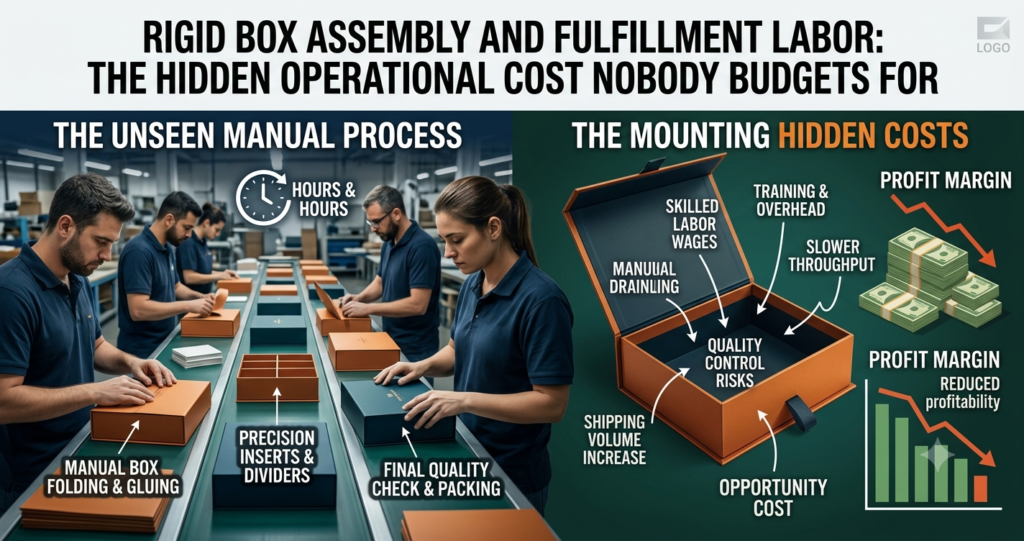
Brands investing in rigid boxes budget meticulously for packaging material costs while overlooking fulfillment labor expenses that frequently exceed the boxes themselves. A cosmetics company switching from folding cartons to rigid boxes discovers their fulfillment team processes 40% fewer orders daily, requiring additional staff and extending shipping timelines during peak periods. Meanwhile, a luxury candle brand launching rigid box packaging finds their per-unit fulfillment cost increased $1.85 beyond the packaging premium, eliminating margin improvements they expected from the premium positioning. Neither company anticipated labor implications because suppliers quote material costs while fulfillment complexity remains invisible until operations begin.
This guide explains actual labor requirements for rigid box fulfillment, hidden operational costs brands consistently underestimate, workflow optimization reducing labor impact, and honest total cost calculation enabling informed rigid box investment decisions.
Why Does Rigid Box Fulfillment Take Significantly Longer?
Physical Handling Complexity
Rigid boxes possess substantially greater weight than folding cartons. A typical rigid box weighing 180-350 grams requires more deliberate handling compared to folding cartons weighing 40-80 grams. Workers handle rigid boxes more carefully preventing damage to corners and surfaces.
Rigid box dimensions remain fixed unlike folding cartons collapsing for efficient storage and deployment. Workers retrieve rigid boxes from stacks, transport individually to packing stations, and handle throughout process without space-saving collapsibility.
Lid alignment requires precise positioning ensuring flush closure without gaps or misalignment. Rushing lid placement creates visible misalignment unacceptable for premium products. Workers develop rhythm but never achieve speed matching simple folding carton closures.
Surface sensitivity demands careful handling preventing fingerprints, scratches, and scuffs on premium finishes. Matte laminate, soft-touch finishes, and foil stamping all require clean hands and careful orientation throughout process.
Interior Presentation Requirements
Premium products in rigid boxes require elevated interior presentation standards. Products cannot simply drop into boxes requiring intentional placement creating appealing visual arrangement.
Tissue paper lining creates signature unwrapping experience contributing to unboxing theater brands invest in. Placing tissue requires unfolding, positioning, and tucking around product adding 15-25 seconds per box.
Insert cards, certificates of authenticity, and promotional materials need precise placement following brand standards. Random placement appears careless contradicting premium positioning.
Multiple product configurations (different SKUs sharing box design) require workers checking correct product placement. This verification adds 5-10 seconds preventing wrong-item errors.
Product orientation matters significantly. Cosmetic products need labels visible, jewelry requires arrangement within compartments, and food products need expiration dates accessible. Specific orientation requirements slow placement compared to generic packing.
Quality Inspection and Verification
Premium packaging commands premium appearance standards. Workers inspect each rigid box before and after packing ensuring no damage occurred during assembly or handling.
Inspection points include corner integrity (no crushing or deformation), surface condition (no scratches or marks), lid closure quality (flush alignment, proper magnetic closure), and interior presentation (product positioning, tissue arrangement, insert placement).
Inspection time ranges 15-30 seconds per box for thorough review. Abbreviated inspection risks shipping damaged boxes creating customer complaints and returns costing far more than inspection time.
Brand standards documentation requiring workers referencing packing guides adds time. Complex configurations with multiple products, inserts, and specific placement requirements need regular reference preventing errors.
Shipping Preparation Differences
Rigid boxes require outer protective packaging preventing shipping damage. Unlike folding cartons fitting neatly into mailers, rigid boxes often need additional outer boxes or protective wrapping.
Box-in-box configurations (rigid gift box inside shipping box) require selecting appropriate outer box size, adding void fill, and sealing outer packaging. This secondary packing step adds 45-90 seconds beyond primary packing.
Fragile sticker application and special handling instructions add labeling time. Premium products commanding careful handling need external communication to carriers.
Dimensional weight calculations often increase shipping costs for rigid boxes. Larger physical dimensions trigger dimensional weight pricing from carriers adding hidden shipping cost beyond labor.
What Are the True Hidden Costs Beyond Labor Time?
Training and Skill Development
Folding carton packing requires minimal training enabling rapid onboarding of temporary staff. Rigid box packing requires understanding brand standards, handling protocols, and quality inspection criteria demanding more extensive training.
Initial training investment ranges $150-400 per worker for rigid box packing including brand standard review, hands-on practice, and quality verification training. This overhead amortizes across workers over time but creates real cost.
Retraining frequency increases when brand standards change or new products launch. Each configuration change requires updated training adding ongoing costs.
Temporary staff during peak seasons require full training despite brief employment. Seasonal surge requiring 10 additional workers creates $1,500-4,000 training expense beyond normal costs.
Error rates during training period exceed experienced worker rates. New workers produce 5-15% error rates requiring rework or rejection. Premium boxes rejected from quality inspection become waste adding $2.50-6.00 per failed unit.
Quality Control and Rework
Rigid box quality standards generate higher rejection rates than folding carton packing. Damage rates averaging 3-8% for rigid boxes versus 1-3% for folding cartons create material waste and rework labor.
Rework involves reopening boxes, fixing interior presentation, and re-inspecting. Each rework event requires 60-120 seconds additional labor beyond original packing time.
Customer complaint rates from damaged or improperly packed rigid boxes generate resolution costs. Customer service handling rigid box complaints averages 8-15 minutes per incident including investigation, response, and resolution.
Return processing for damaged rigid boxes requires inspection, documentation, and restocking or disposal decisions. Returns from $30-100 retail products arriving in damaged rigid boxes create substantial loss including product, original packaging, and reverse logistics costs.
Storage and Warehouse Space
Pre-built rigid boxes require significantly more storage space than flat-packed folding cartons. A folding carton occupies 8-12% of its assembled volume while rigid boxes occupy 100% of assembled volume whether empty or full.
Warehouse space cost ($8-15 per square foot annually in major markets) applies to rigid box inventory. A business maintaining 5,000 rigid box inventory requires 200-400 square feet of dedicated storage costing $1,600-6,000 annually versus 30-50 square feet for equivalent folding carton inventory.
Packing station space requirements increase substantially with rigid boxes. Workers need larger station footprint accommodating box handling, tissue preparation, insert organization, and quality inspection compared to compact folding carton stations.
Damage rates during storage increase with rigid boxes. Stacking damage from improperly stacked rigid boxes creates losses not occurring with flat-packed folding cartons. Storage protocols preventing corner crushing add operational complexity.
Packing Material Costs
Rigid boxes require premium packing materials matching quality expectations. Tissue paper ($0.08-0.18 per sheet, 1-3 sheets per box), ribbon ($0.05-0.15 per unit), and decorative void fill ($0.10-0.25 per unit) add $0.23-0.58 per box.
Outer shipping boxes for box-in-box configurations cost $0.45-1.20 per unit. Custom-fit outer boxes reduce void fill needs while poorly fitted outer boxes require additional protective materials.
Void fill for outer shipping boxes costs $0.15-0.45 per unit. Premium protective materials preventing damage to rigid boxes during shipping command premium prices.
Tissue, ribbon, and decorative materials ordering complexity adds procurement overhead. Managing multiple SKUs of packing supplies creates additional inventory management requirements beyond box management alone.
Carrier and Shipping Cost Impact
Rigid boxes increase dimensional weight calculations triggering higher carrier pricing. A rigid box measuring 12″×8″×4″ creates dimensional weight of 2.7 lbs. Product weighing 0.8 lbs ships at dimensional weight adding 30-50% to shipping cost.
Fragile and special handling fees from carriers add $0.50-1.50 per shipment for premium products requiring careful handling. Not all brands apply these but appropriate use prevents damage.
Carrier damage rates affecting rigid boxes in transit create hidden costs from claims, replacements, and customer service. Adequate outer packaging prevents most damage but adds material and labor costs.
Insurance costs for high-value products in rigid boxes reflect elevated risk. Products over $100 retail value often warrant declared value shipping adding 1-3% of value per shipment.
How Do Different Business Models Experience These Costs?
Direct-to-Consumer E-Commerce
DTC brands shipping individual orders experience maximum rigid box fulfillment costs. Each order requires full individual handling multiplying per-unit labor impact.
Order velocity pressure during peak periods (holiday seasons, promotion launches) creates staffing surge requirements. Maintaining consistent quality while dramatically increasing throughput challenges operations.
Customer expectation for rapid shipping conflicts with careful rigid box packing time. Same-day or next-day shipping promises become difficult to maintain during high-volume periods without substantial additional staffing.
Returns processing for DTC requires full rigid box inspection and refurbishment. Reusable rigid boxes may return damaged requiring replacement before resale. Non-reusable configurations become waste on returns.
Retail Wholesale Fulfillment
Retail wholesale orders shipping cases to retail locations batch rigid box packing differently than individual orders. Case packing efficiency differs from individual order packing.
Retail compliance requirements add labeling, documentation, and palletization requirements beyond consumer packing. Retail-specific stickers, price tags, and compliance labels require application time.
EDI (electronic data interchange) documentation requirements add administrative overhead to retail wholesale fulfillment. Compliance failures create chargebacks potentially eliminating margin.
Retail damage expectations differ from consumer shipping. Products surviving retail supply chain typically experience more handling than direct consumer shipments requiring more robust outer packaging.
Subscription Box Services
Monthly subscription fulfillment creates predictable volume enabling optimization but requiring consistent quality across all shipments. Process standardization reduces individual handling time.
New subscriber growth creates scaling challenges. Adding 100 subscribers monthly requires proportional staffing increases maintaining quality and timing.
Seasonal subscriber churn requires adjusting production quantities. Over-packing creates waste while under-packing creates stockouts. Rigid box waste from cancelled subscriptions adds material cost.
Personalization requirements in subscription boxes add time beyond standard packing. Variable data, individual cards, and customized contents slow throughput compared to standardized packing.
Workflow Optimization Reducing Labor Impact
Packing Station Design and Ergonomics
Dedicated rigid box packing stations designed specifically for process efficiency reduce handling time 15-25%. Proper height, material placement, and workflow orientation minimize unnecessary movement.
Pre-positioned materials (tissue pre-cut, inserts stacked, boxes accessible) eliminate reaching and searching during packing. Workers maintain flow without interruption for material retrieval.
Lighting optimization ensuring quality inspection effectiveness prevents missed defects requiring rework. Inadequate lighting causes inspection failures increasing downstream problems.
Ergonomic considerations preventing worker fatigue maintain consistent performance throughout shifts. Tired workers make errors and work slower. Ergonomic investment pays through sustained productivity.
Batch Processing and Line Balancing
Batch processing similar orders together enables workflow specialization. Workers performing single repeated tasks achieve higher speed than workers performing complete assembly.
Assembly line approaches dividing packing into specialized stations (tissue placement, product placement, closure, quality inspection) enable specialization improving individual step speed 20-30%.
Station timing balance ensures no bottlenecks slow entire line. Unbalanced stations create waiting and bunching reducing overall throughput despite individual station efficiency.
Volume batching accumulating orders before packing initiation enables efficient production runs. Starting and stopping packing for individual orders creates setup overhead eliminated by batching.
Technology and Automation Options
Automated tissue folding and placement machines reduce tissue-related labor $0.08-0.15 per unit at $15,000-45,000 capital investment. Payback periods at 5,000+ monthly units reasonable.
Conveyor systems moving rigid boxes through packing stages eliminate box transport time reducing handling between stations.
Barcode scanning verification confirming correct product placement reduces error rates without adding significant time. $800-2,500 scanning station investment pays through reduced rework and customer complaints.
Quality camera inspection systems for high-volume operations detect defects automatically. $8,000-25,000 investment justifies for operations processing 10,000+ units monthly.
Process Documentation and Standardization
Detailed packing instructions with photographs reducing ambiguity and training time. Clear visual standards enable workers performing correctly without supervision.
Video training materials enabling self-paced learning accelerate onboarding. Workers reference videos when uncertain preventing errors during training period.
Quality checkpoint documentation creating accountability and traceability. Signed-off checkpoints enable identifying where quality problems originate.
Continuous improvement tracking where time is spent enables targeted optimization. Detailed time studies revealing highest-impact improvement opportunities.
How to Budget Rigid Box Fulfillment Costs Accurately
Complete Cost Calculation Framework
Material costs: Rigid box ($2.50-6.00) + tissue ($0.15-0.45) + inserts ($0.10-0.30) + ribbon ($0.05-0.15) + outer box ($0.45-1.20) + void fill ($0.15-0.45) = $3.40-8.55 total materials
Labor costs: Packing time (120-180 seconds × labor rate) + quality inspection (15-30 seconds) + shipping prep (30-60 seconds) = $0.85-2.50 total labor at $16/hour
Overhead allocation: Storage space + equipment + supervision + training amortization = $0.20-0.75 per unit depending on volume
Shipping premium: Dimensional weight increase + fragile handling + insurance = $0.50-2.50 per shipment depending on product value
Total fulfillment cost: $5.00-14.30 per unit beyond product cost
Volume Impact on Per-Unit Costs
Low volume (100-500 monthly units): High overhead allocation creates $8-15 per unit fulfillment costs. Fixed costs divide across fewer units. Limited automation justification.
Medium volume (500-2,000 monthly): Moderate overhead allocation ($5-8 per unit). Some automation justifiable. Process standardization improving efficiency.
High volume (2,000-10,000 monthly): Optimized overhead allocation ($3-5 per unit). Automation justified. Specialized staffing enabling efficiency.
Enterprise volume (10,000+ monthly): Minimum overhead allocation ($2-3.50 per unit). Full automation viable. Dedicated facilities and specialized teams.
Comparing Total Costs Before Switching Packaging
Brands switching from folding cartons to rigid boxes should calculate not just box price difference but complete fulfillment comparison including all hidden costs.
Folding carton complete cost ($0.45-1.20 box + $0.35-0.85 labor + $0.10-0.30 overhead) = $0.90-2.35 per unit
Rigid box complete cost ($2.50-6.00 box + $0.85-2.50 labor + $0.20-0.75 overhead) = $3.55-9.25 per unit
Total cost differential: $2.65-6.90 per unit higher for rigid boxes
This differential must justify through premium pricing, increased conversion, customer retention, or brand value creation.
When Rigid Box Economics Work
Product retail price above $35-40 typically justifies rigid box premium positioning. Below this threshold, rigid box costs compress margins preventing profitability.
Gift product applications where presentation drives purchase decision justify rigid box premium. Gift buyers pay for packaging experience directly.
Subscription services where unboxing experience drives retention justify rigid box costs through lifetime value improvement.
Luxury goods and premium brands where packaging signals product quality justify rigid box investment through brand positioning.
Retail environments where shelf presence creates competitive advantage justify rigid box investment through velocity improvement.
Common Budgeting Mistakes Causing Financial Surprises
Using Material Cost as Total Packaging Cost
Treating box purchase price as complete packaging cost ignores labor, materials, overhead, and shipping premium representing 40-120% of material cost. Full cost accounting prevents financial surprises.
Comparing rigid box material cost to folding carton material cost without accounting for labor differential fundamentally misrepresents true economics.
Underestimating Training Investment
Assuming workers immediately achieve efficient packing speed ignores learning curve. New workers typically achieve 40-60% of experienced worker speed during first two weeks.
Not budgeting for peak season training costs creates surprise expenses when temporary workers require full training investment despite short tenure.
Ignoring Seasonal Volume Impact
Average volume calculations underestimate peak period costs. Holiday seasons creating 3-5x normal volume require proportional staffing with associated training, overtime, and coordination costs.
Not building peak season fulfillment plan before rigid box launch creates operational crisis during highest-stakes periods.
Treating Storage as Free
Not allocating storage costs to rigid box inventory treats warehouse space as free. Actual storage costs $1-3 per box per month for typical warehouse space.
Ignoring storage space differential (rigid boxes requiring 8-10x space of flat-packed alternatives) underestimates total occupancy costs.
Practical Recommendations for Rigid Box Fulfillment Planning
Pilot Before Scaling
Process 100-500 units before committing to large rigid box inventory. Pilot reveals actual labor times, error rates, and workflow requirements enabling accurate scaling projections.
Measure actual packing times during pilot documenting realistic performance rather than theoretical estimates. Real measurements prevent planning errors.
Identify specific bottlenecks during pilot enabling targeted investment before full-scale launch.
Invest in Packing Station Design Early
Proper workstation design costs $500-2,000 per station but pays through sustained productivity improvements. Investing before launch prevents inefficiency becoming established practice.
Worker input during station design identifies practical improvements specialists miss. Workers performing tasks daily identify optimization opportunities.
Maintain Realistic Quality Standards
Establish clear quality standards before launch defining acceptable versus unacceptable conditions. Ambiguous standards create inconsistent inspection and rework decisions.
Quality standards should be achievable at realistic production speeds. Impossible standards create either chronic failure or pressure to skip inspection.
Build Fulfillment Costs Into Product Pricing
Complete cost accounting before setting retail prices prevents discovering margin compression after launch. Pricing decisions must reflect true fulfillment costs not just material costs.
Revisit pricing if fulfillment costs significantly exceed projections. Sustainable operations require adequate margins covering actual not theoretical costs.
Final Thoughts
Rigid box fulfillment adds $0.85-2.50 per unit in hidden labor costs beyond material pricing creating total fulfillment expenses of $3.55-9.25 per unit when accounting for all components. Brands switching from folding cartons to rigid boxes without budgeting fulfillment implications discover margin compression eliminating expected premium positioning benefits.
Labor costs stem from longer packing times (2.7-3x multiplier), elevated quality inspection standards, premium interior presentation requirements, and shipping preparation complexity. Additional hidden costs include training investment ($150-400 per worker), higher rework rates (3-8% vs. 1-3% for folding cartons), increased storage space requirements, packing material expenses ($0.23-0.58 per unit), and dimensional weight shipping premiums.
Budget complete fulfillment costs before rigid box investment decisions. Calculate material costs plus labor at realistic production rates plus overhead allocation plus shipping premium. Compare true total costs against expected benefits from premium positioning, conversion improvement, and retention enhancement.
Pilot 100-500 units before full-scale launch measuring actual labor times, error rates, and workflow requirements. Real data prevents planning errors based on theoretical estimates. Invest in proper packing station design, process documentation, and training infrastructure enabling sustainable operations at intended quality standards.
Rigid boxes justify premium fulfillment investment for products retailing above $35-40, gift applications where presentation drives purchase, subscription services where unboxing creates retention, and luxury brands where quality signals matter. Outside these scenarios, evaluate whether total fulfillment cost differential creates sustainable economics before committing to rigid box investment.