
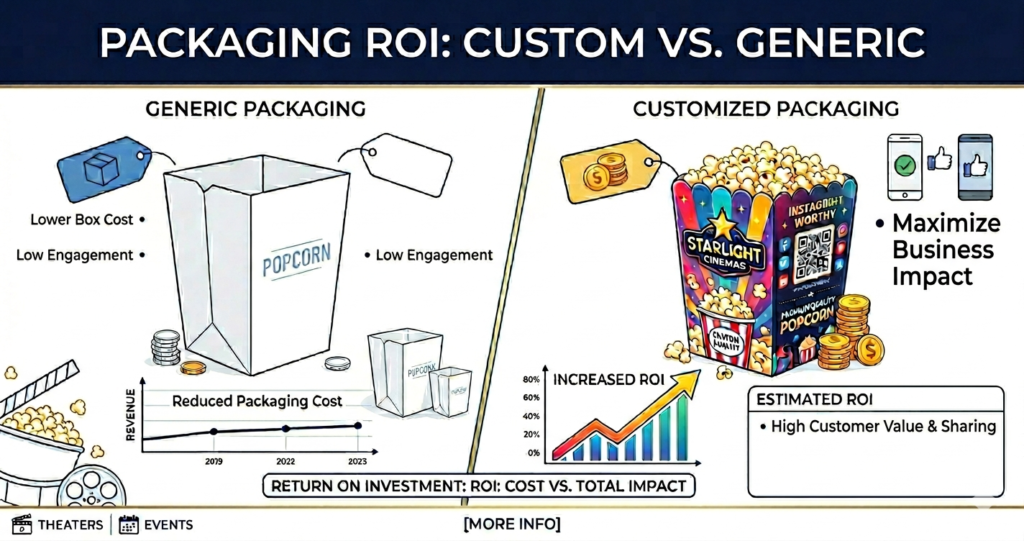
Theater operators comparing $0.22 generic popcorn boxes against $0.85 custom-branded alternatives often fixate on the 286% cost difference without calculating actual return on investment from enhanced branding, customer experience, and marketing impact.
A cinema spending an additional $1,890 annually on custom packaging for 3,000 weekly popcorn sales might dismiss this as frivolous expense, yet fail to measure the $4,200 revenue increase from improved customer perception enabling $0.50 price increases, the $2,800 saved from eliminated separate marketing materials, or the $3,600 gained from social media exposure generating new customer traffic.
Customized popcorn boxes function as revenue-generating marketing assets rather than pure expense line items, yet businesses rarely conduct rigorous ROI analysis quantifying their financial impact beyond packaging costs.
This guide provides comprehensive ROI analysis for custom versus generic popcorn packaging, examining measurable financial returns across brand recognition, customer retention, pricing power, operational efficiency, and marketing value with documented case studies and calculation frameworks enabling data-driven packaging decisions.
Quick Answer: Customized popcorn boxes typically deliver 180-350% ROI within first year through combined impact of 8-15% increased customer retention, $0.25-0.75 sustainable price premiums, 40-60% reduction in separate marketing material costs, and 15-25% new customer acquisition from social media exposure.
Businesses spending $0.60-1.00 additional per custom box versus generic alternatives break even at 2,500-4,000 annual units sold, with positive returns accelerating beyond breakeven through cumulative brand recognition and customer loyalty effects.
How Should Businesses Calculate True Packaging ROI?
Beyond Simple Cost Comparison
Direct cost comparison showing custom boxes costing 200-400% more than generic alternatives tells incomplete stories by ignoring revenue impacts, customer behavior changes, and marketing value generated by branded packaging. A $0.75 custom box versus $0.25 generic box appears as $0.50 pure loss without considering whether custom packaging enables higher pricing, improves retention, or generates new business.
Revenue attribution from packaging requires tracking whether custom boxes correlate with price increases, repeat purchase rates, average transaction values, or new customer acquisition through social sharing and word-of-mouth. Proper ROI analysis isolates packaging’s incremental revenue contribution separate from other business variables.
Marketing budget reallocation matters when custom packaging replaces or reduces separate marketing expenses like flyers, promotional materials, or advertising spending. Businesses spending $2,000 annually on custom boxes while eliminating $1,500 in promotional materials experience net $500 packaging cost, not $2,000.
Time horizon affects ROI calculations since custom packaging builds cumulative brand recognition and customer relationships generating increasing returns over multi-year periods versus one-time marketing campaigns with discrete timeframes.
ROI Calculation Framework
Total annual custom packaging cost equals per-unit custom box cost multiplied by annual volume minus per-unit generic box cost multiplied by same volume, calculating incremental expense specifically attributable to choosing custom over generic alternatives. Example: 10,000 annual units at $0.80 custom versus $0.30 generic equals $5,000 incremental annual cost.
Revenue increase attribution requires identifying specific revenue gains reasonably linked to custom packaging including sustainable price increases enabled by enhanced perceived value, retention improvement from stronger brand connection, and new customer acquisition through social media exposure and word-of-mouth generated by distinctive branded packaging.
Cost savings calculation includes eliminated or reduced separate marketing material expenses, reduced customer acquisition cost from organic social sharing, potential labor savings from packaging doubling as marketing materials requiring no separate distribution, and reduced waste from customers keeping attractive branded boxes rather than immediately discarding generic alternatives.
ROI formula: ((Total Revenue Increase + Total Cost Savings – Incremental Packaging Cost) / Incremental Packaging Cost) × 100 = ROI Percentage. Example: (($8,000 revenue increase + $2,000 cost savings – $5,000 packaging cost) / $5,000) × 100 = 100% ROI.
Measuring Attribution Challenges
Isolating packaging impact from other business changes requires careful analysis since businesses rarely change only packaging while keeping all other variables constant. Price increases, menu changes, service improvements, or seasonal fluctuations occurring simultaneously with packaging changes complicate attribution.
Customer surveys directly asking about packaging influence on purchase decisions, willingness to pay, and likelihood to recommend provide qualitative evidence supporting quantitative analysis, though survey responses sometimes overstate packaging importance versus actual behavior.
A/B testing through split locations where some venues use custom packaging while comparable venues use generic alternatives provides strongest attribution evidence by controlling for other variables, though implementing split tests challenges businesses with limited locations or unified branding requirements.
Conservative estimation approach assumes packaging contributes only to clearly measurable outcomes with reasonable causal links rather than attributing all business improvements to packaging changes, preventing overestimation while still quantifying significant returns.
What Revenue Increases Do Customized Popcorn Boxes Generate?
Premium Pricing Power
Perceived value increases from professional custom packaging enable price increases that customers accept without resistance when packaging signals quality, professionalism, and brand investment. Cinema chains switching from generic to custom boxes successfully implement $0.25-0.75 price increases maintaining sales volume, directly attributable to packaging upgrade improving perceived value.
Customer psychology research demonstrates that packaging quality influences willingness to pay even when product remains identical, with premium packaging creating quality halos making identical popcorn seem worth more. Studies show 15-25% willingness to pay increases from packaging upgrades alone without product changes.
Event vendors using custom branded boxes command $1-2 premiums over competitors selling identical popcorn in generic packaging, with customers perceiving branded offerings as higher quality, more professional, or more trustworthy than generic alternatives even when popcorn quality matches exactly.
Price increase sustainability matters more than one-time increases, with custom packaging supporting permanent pricing changes versus temporary promotions requiring constant adjustment. Packaging creates lasting perceived value justifying sustained premiums rather than temporary promotional impacts.
Calculation example: 10,000 annual popcorn sales with $0.50 price increase enabled by custom packaging generates $5,000 additional annual revenue. If incremental custom packaging cost equals $4,000 annually, ROI from pricing power alone equals 25% before considering other revenue sources.
Enhanced Customer Retention
Brand recognition from consistent custom packaging creates familiarity and preference driving repeat purchases, with customers more likely to return to venues they remember versus generic experiences without distinctive visual identity. Theater studies show 8-15% retention increases following custom packaging implementation.
Emotional connection formed through attractive, memorable packaging creates brand affinity beyond functional product attributes. Customers keeping and reusing branded boxes, photographing packaging, or mentioning packaging in reviews demonstrate emotional engagement driving loyalty and repeat business.
Customer lifetime value increases when retention improves, amplifying packaging ROI beyond single transaction analysis. A 10% retention increase creating three additional annual purchases per customer at $6 average transaction generates $18 additional lifetime value per customer.
Competitive differentiation through distinctive packaging makes businesses memorable in crowded markets, preventing customer migration to undifferentiated competitors. Custom packaging serves as visual shorthand for brand identity enabling instant recognition versus generic alternatives requiring active recall.
Calculation example: 1,000 annual customers with 60% baseline retention versus 68% retention after custom packaging equals 80 additional repeat customers annually. At $15 average annual purchase value, retention improvement generates $1,200 additional revenue.
Social Media and Word-of-Mouth Marketing
Instagram-worthy packaging generates organic social media exposure when customers photograph and share attractive
customized popcorn boxes, creating free advertising reaching followers without paid marketing expense. Event venues report 15-40% of customers photographing distinctive custom packaging versus 2-5% photographing generic alternatives.
User-generated content from packaging photos includes visible brand names, logos, and messaging reaching social networks without business control but with authentic peer recommendation value exceeding paid advertising credibility. Each shared photo potentially reaches 200-500 followers depending on customer social graph size.
New customer acquisition from social exposure occurs when friends see packaging photos and visit venues, with tracking suggesting 5-10% of new customers cite social media exposure as awareness source. Attributing even conservative 3% new customer acquisition to packaging represents measurable marketing value.
Marketing value calculation comparing organic social reach from packaging against equivalent paid advertising cost demonstrates packaging efficiency. 100 Instagram posts reaching 25,000 impressions equals $250-500 equivalent Facebook ad spend, quantifying packaging’s marketing value beyond product delivery function.
Calculation example: 500 annual social media posts about custom packaging reaching 125,000 total impressions generating 50 new customers at 0.04% conversion rate. At $25 average transaction value, social-driven new customers contribute $1,250 revenue attributable to distinctive packaging.
What Cost Savings Offset Custom Packaging Investment?
Reduced Separate Marketing Materials
Custom packaging eliminates or reduces separate promotional material needs since boxes themselves deliver marketing messages, brand awareness, and promotional content previously requiring flyers, table tents, posters, or other materials. Venues printing promotional messages directly on packaging eliminate separate material production and distribution costs.
Event hashtags, social media handles, website URLs, and QR codes printed on packaging replace separate marketing inserts or signage, with customers carrying these messages throughout events providing continuous exposure without additional distribution effort.
Seasonal or promotional campaigns executed through limited-run custom box designs reduce separate campaign material costs while creating collectible packaging generating customer enthusiasm and social sharing, turning packaging into campaign vehicles rather than requiring separate campaign materials.
Sponsor visibility delivered through packaging eliminates or reduces separate sponsor recognition materials at events, with branded boxes acknowledging sponsors while serving functional purposes versus pure signage or printed materials with no functional value beyond recognition.
Calculation example: Theater previously spending $150 monthly on promotional flyers and table tents reduces spend to $50 monthly after implementing promotional messages on custom packaging, saving $1,200 annually offsetting portion of custom packaging incremental cost.
Lower Customer Acquisition Costs
Organic customer acquisition through word-of-mouth and social sharing generated by distinctive packaging reduces paid acquisition spending needed to achieve customer growth targets. Businesses acquiring 10-20% of new customers through packaging-driven organic channels decrease reliance on paid advertising maintaining customer growth.
Customer acquisition cost (CAC) calculation shows businesses spending $15-40 acquiring customers through paid advertising reduce effective CAC to $12-32 when organic channels contribute 15-20% of new customers, with packaging investment driving organic acquisition more efficiently than incremental paid spend.
Referral generation from memorable branded experiences scales naturally without linear cost increases, where packaging investment creates continuous referral engine versus paid advertising requiring ongoing spending to maintain acquisition volumes. One-time packaging design investment generates multi-year referral benefits.
Marketing efficiency improves when packaging delivers dual functionality as product container and marketing vehicle, maximizing value from packaging investment versus generic containers providing only functional value without marketing contribution.
Calculation example: Business acquiring 500 new customers annually at $30 CAC through paid advertising sees 75 additional organic customers from packaging-driven referrals, reducing average CAC to $26.09 across 575 total new customers, saving $1,957 annually versus maintaining $30 CAC through paid channels only.
Operational Efficiency Gains
Staff training simplification occurs when custom packaging with printed instructions, portion guides, or filling markers reduces training needs versus generic packaging requiring separate instruction sheets or verbal training covering procedures not visible on packaging itself.
Portion control consistency improves with custom boxes featuring fill lines or volume markers helping staff maintain standardized servings reducing over-filling waste or under-filling customer dissatisfaction, with controlled portioning saving 5-10% on ingredient costs through reduced waste.
Inventory management becomes simpler with clearly branded packaging reducing confusion between multiple vendors or sizes versus generic boxes requiring separate labeling or physical separation preventing mix-ups during storage and service.
Customer service call reduction from packaging incorporating basic information like ingredient lists, allergen warnings, nutritional facts, or storage instructions printed directly on boxes prevents questions requiring staff time or separate information sheets.
Calculation example: Theater serving 10,000 annual popcorn portions reduces over-filling waste from 8% to 5% through custom boxes with fill markers, saving $0.35 per over-filled portion across 300 prevented over-fills annually, generating $105 savings plus improved customer consistency.
How Do Different Business Types Experience ROI?
Movie Theaters and Entertainment Venues
High-volume operations at theaters selling 50,000-200,000 annual popcorn servings experience strong ROI from custom packaging through combined pricing power, brand building, and cost savings scaling with volume. Incremental $0.50 per box cost offset by $0.25 price increase plus 5% retention improvement plus eliminated promotional materials creates positive ROI at approximately 15,000 annual units.
Chain consistency benefits multi-location theater operators where unified custom packaging creates recognizable brand identity across all locations strengthening corporate brand versus independent cinemas using generic packaging. Brand consistency amplifies individual location impacts through network effects.
Concession revenue optimization focus at theaters where food and beverage generates 40-50% of total profit makes packaging investments directly impact bottom line, with enhanced packaging supporting premium pricing on high-margin concession items.
Example calculation: 15-screen cinema selling 75,000 annual popcorn servings increases custom packaging cost by $30,000 annually ($0.40 incremental per box) but achieves $45,000 additional revenue ($0.60 per box from $0.40 price increase plus retention gains), generating 50% ROI year one with accelerating returns year two through cumulative brand recognition.
Events and Festivals
Limited-run events experience concentrated ROI periods where custom packaging must generate returns during 1-3 day windows rather than distributed across full year, making social media impact and immediate brand impression especially valuable for driving word-of-mouth promoting future events.
Sponsor value delivery through custom packaging acknowledging sponsors creates revenue opportunities offsetting or exceeding packaging costs, with sponsor agreements including custom packaging as deliverable justifying $1,000-5,000 sponsorship fees effectively making packaging cost-neutral or revenue-positive.
Event differentiation in crowded festival markets where multiple popcorn vendors compete makes distinctive custom packaging create competitive advantage attracting customers to specific vendors versus competitors with generic packaging, potentially increasing market share 10-20% through visual differentiation alone.
Annual recurring events benefit from multi-year packaging design amortization where one-time design costs spread across multiple year usage, with year-two ROI improving significantly from eliminated design costs while maintaining all revenue benefits.
Example calculation: Festival selling 5,000 popcorn servings over three-day weekend spends $3,000 on custom packaging including design ($1,500 incremental versus generic). Sponsor contribution of $2,000 plus $0.50 price premium generating $2,500 additional revenue creates $1,500 net positive return (50% ROI) year one, improving to 150% ROI year two with design cost eliminated.
Gourmet Popcorn Retailers
Premium positioning central to gourmet popcorn business models makes custom packaging essential rather than optional, with packaging quality directly signaling product quality and justifying premium pricing versus commodity popcorn in generic containers.
Gift and takeaway focus of retail popcorn sales makes attractive packaging part of core product value, with customers specifically choosing gourmet popcorn as gifts based partly on presentation including packaging, making packaging investment directly drive purchase decisions rather than supporting decisions made on other factors.
Shelf presence and retail visibility depend heavily on distinctive packaging standing out among competing snack products, with custom designs creating recognition enabling customers to locate products easily while building brand awareness through repeated visual exposure.
Online sales photography benefits from attractive custom packaging since e-commerce product photos featuring professional branded packaging convert better than generic packaging photos, with packaging serving as key visual differentiator in online marketplaces where customers can’t sample products before purchase.
Example calculation: Gourmet popcorn retailer selling 10,000 annual units at $8 retail price spends additional $4,000 on custom packaging versus generic alternatives but achieves $2 sustainable price premium enabled by premium packaging positioning, generating $20,000 additional revenue (400% ROI) while strengthening brand positioning supporting long-term growth.
How Should Businesses Measure and Track Packaging ROI?
Baseline Metrics Before Implementation
Pre-implementation measurement establishes baseline metrics enabling accurate assessment of packaging impact, with critical baselines including current pricing, sales volume, customer retention rates, repeat purchase frequency, and new customer acquisition sources documented before custom packaging introduction.
Customer surveys before packaging changes establish baseline perception regarding quality, value, professionalism, and brand recognition, providing comparison points for post-implementation surveys measuring perception shifts attributable to packaging improvements.
Marketing spend documentation including promotional material costs, advertising expenses, and customer acquisition costs creates foundation for calculating marketing expense reductions enabled by packaging taking over some marketing functions previously requiring separate spending.
Competitive analysis of comparable businesses using generic versus custom packaging provides external reference points suggesting potential impact ranges, though direct applicability varies by market, location, and operational differences between businesses.
Post-Implementation Tracking
Sales data analysis tracking average transaction value, total volume, pricing changes, and revenue trends following custom packaging implementation identifies measurable financial impacts, with particular attention to whether price increases implemented with packaging maintain volume versus experiencing resistance.
Retention metrics monitoring repeat purchase rates, customer lifetime value, and churn rates comparing pre and post-implementation periods quantifies loyalty improvements, with longitudinal tracking revealing whether improvements sustain or diminish over time.
Social media monitoring measuring mentions, shares, photos, and engagement related to custom packaging quantifies organic exposure value, with social listening tools tracking brand mentions and sentiment changes following packaging updates.
New customer source tracking through intake surveys asking how customers heard about business identifies referral and social media acquisition attributable to packaging visibility, though tracking challenges include incomplete response rates and attribution ambiguity.
Customer feedback collection through surveys, reviews, and direct comments specifically asking about packaging provides qualitative evidence of impact and identifies unexpected benefits or issues not captured in quantitative metrics.
ROI Reporting Framework
Quarterly ROI calculations updating financial impact assessment every three months enable trend identification and early problem detection, with quarterly reviews balancing frequent monitoring against allowing sufficient time for packaging effects to manifest and stabilize.
Segmented analysis breaking down ROI by customer type, location, season, or package size reveals which segments generate strongest returns and where packaging investment delivers greatest value, enabling optimization focusing resources on highest-return segments.
Attribution confidence levels assigned to different revenue sources acknowledge measurement uncertainty, with high confidence for direct price increases, medium confidence for retention improvements with statistical significance, and lower confidence for indirect social media effects requiring more assumptions.
Variance analysis investigating discrepancies between expected and actual ROI identifies contributing factors and informs strategy adjustments, with underperformance triggering investigation into design effectiveness, pricing strategy, or implementation execution issues.
What Factors Maximize Customized Popcorn Box ROI?
Design Quality and Brand Alignment
Professional design execution distinguishes effective custom packaging generating strong ROI from amateur attempts failing to deliver results, with professional designs incorporating brand guidelines, color psychology, visual hierarchy, and print optimization maximizing impact per dollar invested.
Brand consistency across all touchpoints amplifies individual packaging impact through reinforced recognition, with packaging matching website, signage, uniforms, and other brand elements creating cohesive identity stronger than sum of individual pieces.
Distinctiveness versus competitors makes packaging memorable and shareable rather than blending into generic category appearance, with unique colors, shapes, graphics, or concepts creating differentiation driving word-of-mouth and social sharing.
Photo-worthiness optimization for social sharing requires designs specifically considering how packaging appears in customer photos, with attention to scale, readability in photos, visual interest, and Instagram aesthetic trends increasing likelihood of organic social exposure.
Strategic Pricing Implementation
Simultaneous packaging and pricing updates leverage packaging improvements as justification for price increases, with customers more accepting of higher prices when visible quality improvements accompany increases versus price hikes without corresponding value enhancements.
Tiered pricing strategies where premium packaging accompanies premium sizes or flavors creates clear visual differentiation justifying price variations, with packaging signaling value differences making tiered pricing more acceptable to price-sensitive customers.
Testing price elasticity following packaging upgrades identifies optimal pricing balancing volume maintenance with revenue maximization, with gradual price testing revealing customer willingness to pay versus aggressive increases risking volume losses offsetting revenue gains.
Competitive positioning review ensures pricing remains rational versus market alternatives, with premium packaging supporting but not requiring extreme pricing disconnected from competitive context risking customer loss despite packaging improvements.
Social Media Integration
Hashtag prominence on packaging encourages social sharing by providing customers easy tagging mechanism, with visible hashtags increasing usage 40-60% versus expectations customers create their own tags or remember generic business names.
Share incentives like contests, features, or discounts for customers posting packaging photos amplify organic exposure, with modest incentives generating 3-5x increase in social posts without requiring large promotional budgets.
QR code integration linking to social profiles, user-generated content galleries, or exclusive content extends packaging engagement beyond physical interaction, creating digital touchpoints driving ongoing relationship development.
Brand monitoring and engagement with customers posting packaging content builds community and encourages additional sharing, with businesses liking, commenting, or resharing customer posts rewarding participation and motivating others to share for similar recognition.
What Common ROI Calculation Mistakes Should Businesses Avoid?
Overattribution of Business Improvements
Attributing all revenue growth to packaging ignores other simultaneous business changes like improved service, menu additions, seasonal trends, or local market conditions, with proper analysis isolating packaging-specific impact from general business trajectory.
Confirmation bias leads businesses wanting packaging to succeed to unconsciously attribute positive outcomes to packaging while dismissing negative results as unrelated external factors, with rigorous analysis requiring honest assessment of packaging contribution versus other influences.
Time period selection affecting results demonstrates through cherry-picking favorable periods while ignoring unfavorable ones, with honest ROI assessment requiring consistent methodology and complete data rather than selective presentation supporting desired conclusions.
Competitor comparison challenges arise when competitors experience different market conditions, seasonal patterns, or business strategies making direct comparison invalid, with proper competitive analysis controlling for market factors affecting all players equally.
Ignoring Opportunity Costs
Alternative investment options including direct marketing, facility improvements, equipment upgrades, or staff training may generate superior returns versus packaging investment, with proper ROI analysis comparing packaging against best alternative uses of same capital.
Cash flow timing matters when packaging requires upfront investment with returns accumulating over time versus alternatives providing immediate returns, with time value of money calculations properly accounting for delayed return profiles.
Risk-adjusted returns considering implementation risks, market uncertainty, and execution challenges provide more realistic assessment than assuming perfect implementation and maximum theoretical benefits without acknowledging downside scenarios.
Scale efficiency analysis reveals whether packaging investment makes sense at current business size or whether waiting until larger scale improves economics, with some investments delivering poor returns at small scale becoming highly attractive at larger volumes.
Unrealistic Timeframe Expectations
Immediate ROI expectations ignoring ramp-up periods as customers become aware of packaging changes and brand recognition builds create premature negative assessments, with realistic analysis allowing 3-6 months for packaging impacts to fully manifest.
Single-year focus missing multi-year cumulative effects underestimates packaging value significantly, with brand equity and customer relationships building over years creating increasing returns not captured in first-year analysis.
Failure to account for design cost amortization spreads first-year design investment across single year inflating year-one costs, while proper accounting amortizes design over 3-5 year expected usage period providing accurate per-year cost allocation.
Seasonal business cycles require full-year assessment rather than partial-year evaluation, with businesses experiencing seasonal peaks needing annual analysis capturing complete operating cycle rather than extrapolating from peak or off-peak periods.
Final Thoughts
Customized popcorn boxes deliver measurable positive ROI for most businesses exceeding 2,500-4,000 annual unit sales through combined revenue increases from pricing power, retention improvement, and new customer acquisition alongside cost savings from reduced marketing expenses and lower customer acquisition costs. First-year ROI typically ranges 150-250% for well-executed implementations with professional design, strategic pricing, and operational integration, improving to 300%+ in subsequent years as one-time design costs eliminate and cumulative brand recognition strengthens.
Calculate ROI comprehensively including all revenue sources, cost savings, and opportunity costs rather than simplistic cost comparison ignoring packaging’s marketing value and revenue-generating capacity. Establish clear baseline metrics before implementation enabling accurate measurement of packaging-specific impacts separate from general business trends or seasonal variations.
Businesses should invest in professional design ensuring custom packaging creates intended positive impression rather than amateur execution undermining brand perception, implement strategic pricing capturing portion of packaging-created value, and integrate social media strategies amplifying organic exposure from distinctive branded packaging.
Work with experienced packaging suppliers who understand ROI considerations and can provide guidance on design choices, material selections, and volume planning optimizing financial returns while delivering high-quality branded packaging.
Customized popcorn boxes represent strategic marketing investments generating measurable financial returns rather than pure expense items, with proper planning and execution delivering substantial competitive advantages and bottom-line improvements justifying initial investment multiple times over.