
Theater operators placing $8,000 orders for 15,000 custom popcorn boxes discover supplier reliability problems only after receiving shipments three weeks late with 20% defect rates and mismatched colors requiring expensive rush reorders from alternative suppliers. A festival organizer commits to 5,000-unit order based on attractive pricing discovers too late the supplier lacks grease-resistant coating capability, delivering boxes that leak butter oil within minutes and create guest complaints plus liability concerns.
Popcorn box suppliers vary dramatically in quality standards, production capabilities, and service reliability, yet businesses often select suppliers based primarily on pricing without systematic vetting of critical operational factors affecting order success.
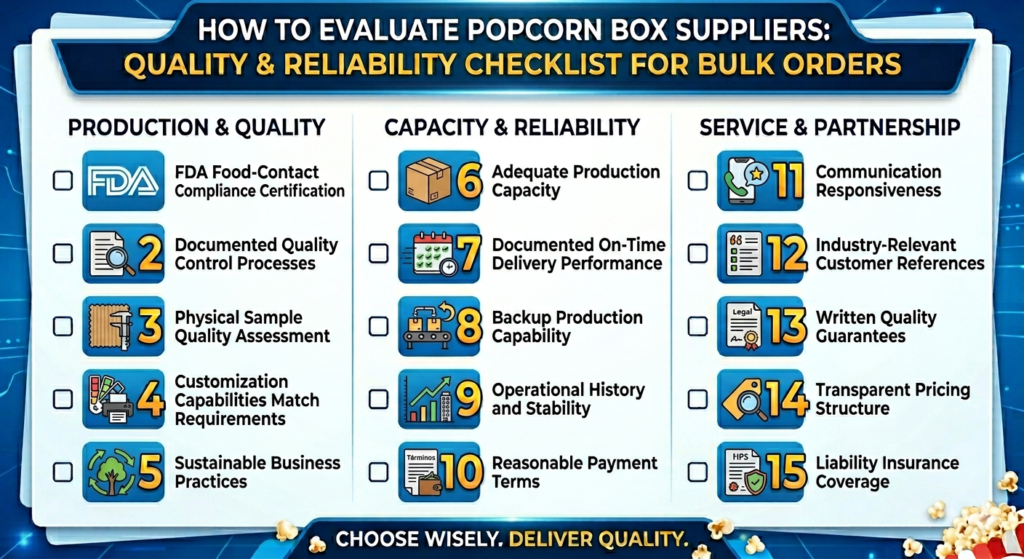
This guide provides a comprehensive 15-point evaluation checklist for assessing
popcorn box suppliers before placing bulk orders, covering quality certifications, production capacity, delivery performance, customer service standards, and financial stability indicators enabling data-driven supplier selection minimizing operational risks.
Why Does Systematic Supplier Evaluation Matter?
Financial Risk from Poor Supplier Selection
Defective shipments create immediate financial losses through wasted packaging costs, rush reorder expenses at premium pricing, and potential revenue losses from delayed operations or cancelled events unable to proceed without proper packaging. A $5,000 defective order can generate $12,000 total loss including replacement costs, expedited shipping, and lost revenue.
Late deliveries force expensive emergency alternatives like local print shops charging 3-5x normal rates for rush production, overnight shipping costs adding 40-60% to order values, or temporary generic packaging undermining brand positioning and marketing investments.
Quality inconsistencies between orders create operational chaos when staff must compensate for varying box strength, different sizes affecting portion control, or color variations confusing customers and diluting brand recognition built through previous consistent packaging.
Operational Disruption Consequences
Event cancellations or postponements from missing packaging create cascading problems including guest disappointment, refund requests, damaged reputation, and lost future bookings from attendees forming negative associations with unreliable operations regardless of packaging supplier fault.
Staff time wasted managing supplier problems, coordinating emergency alternatives, explaining issues to customers, and processing returns or replacements diverts valuable resources from revenue-generating activities to damage control and problem resolution.
Customer experience degradation from substitute packaging, delayed service, or visible operational stress damages brand perception and customer satisfaction even when businesses ultimately resolve supplier-created problems.
The 15-Point Supplier Evaluation Checklist
1. FDA Food-Contact Compliance Certification
Verify suppliers provide documentation proving materials meet FDA regulations under 21 CFR for food-contact substances, ensuring packaging materials won’t contaminate food or create health risks. Request copies of FDA compliance certificates or material safety data sheets.
Grease-resistant coatings must specifically comply with food-contact standards since some industrial coatings meeting general safety standards aren’t approved for direct food contact. Ask suppliers to specify coating types and provide compliance documentation.
2. Adequate Production Capacity
Confirm supplier’s total production capacity exceeds your order size by at least 25% ensuring they can fulfill your order without straining capacity or delaying other customers. Suppliers running at 100% capacity face higher defect rates and schedule delays from lack of buffer.
Ask about equipment specifications including number of presses, maximum daily output, and whether your order requires dedicated press time or shares production runs with other customers affecting scheduling flexibility and priority.
3. Documented On-Time Delivery Performance
Request on-time delivery metrics from past 12 months showing percentage of orders delivered by promised dates. Reliable popcorn box suppliers maintain 95%+ on-time delivery rates while problematic suppliers show 85% or lower performance indicating systematic scheduling or production problems.
Review how suppliers define “on-time” ensuring they measure actual delivery date versus shipment date, since shipping delays outside their control shouldn’t obscure production reliability within their control.
4. Physical Sample Quality Assessment
Order physical samples before committing to bulk orders, evaluating structural integrity by filling with popcorn and handling normally, checking grease resistance by adding butter and monitoring for leakage over 30 minutes, and assessing print quality for color accuracy and sharpness.
Compare samples against specifications measuring dimensions, material weight, and coating performance rather than relying solely on visual inspection, since subtle quality differences invisible in casual review become significant problems across thousands of units.
5. Operational History and Stability
Verify suppliers have minimum 2-year operational history demonstrating business stability and experience, though longer histories provide additional confidence. Newly established suppliers lack track records for assessing reliability and may struggle with growing pains affecting service quality.
Research ownership changes, bankruptcies, or major operational disruptions in supplier history indicating potential instability or management problems that could resurface affecting your orders.
6. Liability Insurance Coverage
Confirm suppliers maintain product liability insurance protecting against contamination, injury, or property damage claims arising from defective packaging. Request certificate of insurance showing coverage limits of at least $1-2 million for adequate protection.
General liability insurance demonstrates professional business practices and financial stability while providing recourse if packaging defects cause customer injuries, product contamination, or property damage at your facilities.
7. Communication Responsiveness
Test communication responsiveness during evaluation phase by submitting questions through different channels and timing response speed. Suppliers responding within 24 hours to email and phone inquiries demonstrate customer service commitment while slow responders often provide poor ongoing support.
Evaluate communication quality beyond just speed, assessing whether responses directly answer questions with specific information versus vague generalities, demonstrating supplier’s technical knowledge and attention to customer needs.
8. Transparent Pricing Structure
Request itemized quotes breaking down per-unit costs, setup fees, die charges, shipping costs, and any additional fees rather than single total-cost figures obscuring pricing structure. Hidden fees revealed after commitment create budget problems and erode trust.
Clarify what changes trigger additional charges including minor design revisions, rush production, split shipments, or special materials ensuring complete understanding of potential cost variations preventing unexpected invoices.
9. Documented Quality Control Processes
Ask suppliers to describe quality control procedures including inspection frequency, acceptance criteria, and defect handling protocols. Professional suppliers implement systematic quality checks at multiple production stages rather than final inspection only.
Request defect rate statistics from recent production runs showing percentage of units failing quality standards, with acceptable suppliers maintaining defect rates below 2-3% and excellent suppliers below 1%.
10. Backup Production Capability
Inquire about contingency plans if primary production equipment fails, orders exceed capacity, or unforeseen disruptions occur. Reliable suppliers maintain backup equipment, relationships with partner facilities, or overflow production arrangements preventing single points of failure.
Understand geographic risk from suppliers operating single facilities vulnerable to local disasters, labor disputes, or utility interruptions versus multi-facility suppliers with geographic diversification reducing risk concentration.
11. Industry-Relevant Customer References
Request 3-5 customer references specifically from your industry segment—theaters if you operate theaters, event companies if you run events—since requirements and priorities vary across applications making general references less valuable than industry-specific feedback.
Contact references asking specific questions about delivery reliability, quality consistency, problem resolution responsiveness, and whether they would reorder from supplier. Generic positive comments provide less insight than specific experiences with measurable outcomes.
12. Customization Capabilities Match Requirements
Verify suppliers offer customization options you need including custom sizes if standard dimensions don’t fit requirements, specialized coatings for specific applications, printing capabilities matching your design complexity, and material options supporting sustainability goals or functional requirements.
Confirm minimum order quantities align with your volume needs avoiding suppliers requiring 10,000-unit minimums when you need 2,000 units, or accepting suppliers with no minimums potentially indicating lack of efficiency affecting quality or pricing.
13. Reasonable Payment Terms
Evaluate payment terms ensuring they align with industry standards and your cash flow capabilities. Standard terms require 50% deposit with balance due on delivery, while requiring 100% upfront payment signals potential financial instability or lack of confidence in delivery capability.
Negotiate payment timing for large orders considering whether suppliers offer net-30 or net-60 terms after establishing relationship, providing cash flow benefits and demonstrating supplier confidence in customer satisfaction and repeat business.
14. Written Quality Guarantees
Obtain written guarantees specifying acceptable defect rates, replacement policies for defective units, and resolution timelines rather than verbal assurances lacking enforceability. Professional suppliers confidently provide written commitments while problematic suppliers avoid documentation.
Clarify warranty coverage including whether suppliers replace defective goods at their expense, who pays return shipping, and timeframe for replacement delivery ensuring clear understanding of recourse if problems occur.
15. Sustainable Business Practices
Assess environmental practices including recyclable material usage, waste reduction programs, and energy efficiency initiatives both for operational sustainability and meeting customer expectations for environmentally responsible sourcing.
Verify certifications like FSC for sustainable forestry, compostability certifications if relevant, or carbon neutral commitments demonstrating genuine environmental commitment versus greenwashing marketing claims without substantiation.
How Should You Score and Compare Suppliers?
Weighted Scoring Approach
Assign weights to each evaluation criterion based on your priorities, with critical factors like food safety compliance and delivery reliability weighted higher than nice-to-have elements like sustainability practices. Weight critical criteria 3x, important criteria 2x, and desirable criteria 1x.
Score each supplier on each criterion using consistent 1-5 scale where 1 = fails requirement, 2 = barely meets minimum, 3 = meets requirement adequately, 4 = exceeds requirement, 5 = exceptional performance. Multiply criterion scores by weights calculating weighted total scores.
Compare weighted scores across suppliers identifying clear leaders, though recognize highest score doesn’t automatically determine selection since specific weaknesses in critical areas may outweigh overall score advantages.
Red Flag Identification
Automatic disqualification should apply to suppliers lacking food safety compliance, refusing to provide references, unable to meet basic delivery timelines, or showing signs of financial instability regardless of strengths in other areas.
Multiple moderate concerns accumulating across several criteria often indicate systematic problems more serious than isolated weaknesses, with 5+ criteria scoring below 3 suggesting fundamental operational or quality issues warranting supplier elimination.
Trust your instincts when suppliers feel unprofessional, unresponsive, or evasive during evaluation since these interpersonal warning signs often predict future service problems regardless of checklist scores.
What Questions Should You Ask Potential Suppliers?
Production and Capacity Questions
What is your total monthly production capacity? How much capacity is currently committed? Where would my order fit in your production schedule? This reveals whether supplier can comfortably accommodate your order or would be stretched thin.
What is your average lead time for orders similar to mine? What factors could extend that timeline? How much advance notice do you need for rush orders? Understanding realistic timelines prevents scheduling problems.
Do you manufacture in-house or subcontract production? If subcontracted, who are your production partners and what quality control do you maintain over their work? Subcontracting isn’t inherently problematic but requires understanding oversight processes.
Quality and Compliance Questions
What quality control inspections do you perform and at what production stages? What are your typical defect rates? How do you handle defective products? This reveals commitment to quality beyond just claims.
Can you provide FDA compliance documentation for your materials and coatings? What food-safety certifications do you maintain? Do your materials meet FDA 21 CFR requirements for food contact?
What is your warranty or guarantee policy? Under what conditions do you replace defective products? Who pays shipping for returns and replacements? Clear policies protect your investment.
Service and Support Questions
Who will be my main contact? What is your typical response time for customer inquiries? How do you handle urgent issues or rush situations? Understanding support structure prevents communication frustrations.
Can you provide 3-5 customer references from businesses similar to mine? May I contact them to discuss their experience with your service? References provide real-world performance evidence.
What happens if you cannot fulfill my order due to equipment failure or other problems? Do you have backup production capacity or partner facilities? Contingency plans demonstrate operational maturity.
Common Supplier Evaluation Mistakes to Avoid
Choosing Based Solely on Price
Lowest-price suppliers often cut costs through inferior materials, rushed production, poor quality control, or understaffing creating defect rates and service problems costing more than initial savings. Calculate total cost of ownership including defect risk rather than just per-unit price.
Price outliers significantly below market rates signal potential quality compromises, financial instability, or unsustainable business practices likely to fail or force price increases after establishing relationship. Be skeptical of too-good-to-be-true pricing.
Skipping Physical Sample Review
Digital proofs and photos don’t reveal structural integrity, material quality, coating effectiveness, or handling characteristics only discovered through physical examination. Always order samples before bulk orders.
Sample costs of $50-100 represent trivial insurance against $5,000-10,000 order mistakes, yet many businesses skip sampling to save minimal expense then discover fundamental problems after committing to large purchases.
Not Verifying References
Accepting supplier claims without reference verification misses opportunity to learn from other customers’ experiences with delivery reliability, quality consistency, problem resolution, and hidden issues not obvious during evaluation.
References provided by suppliers naturally represent best customers, so listen for subtle concerns or hesitations even in generally positive feedback indicating areas requiring attention or additional investigation.
Ignoring Communication Quality During Evaluation
Poor communication during sales process when suppliers should be maximally responsive predicts worse communication after securing order when attention shifts to new prospects. How suppliers communicate during evaluation reveals future service quality.
Vague, evasive, or inconsistent responses to straightforward questions indicate potential problems with transparency, competence, or integrity that will resurface during order fulfillment creating frustration and disputes.
Final Thoughts
Systematic evaluation of popcorn box suppliers using this 15-point checklist prevents costly mistakes from defective products, late deliveries, or unreliable service disrupting operations and damaging customer relationships. Suppliers meeting 12 or more criteria represent reliable partners capable of supporting your business growth while those meeting fewer than 10 criteria require careful consideration of specific weaknesses and whether risks justify potential cost savings.
Prioritize food safety compliance, production capacity, delivery reliability, and quality control as non-negotiable requirements since failures in these areas create operational crises regardless of supplier strengths in other dimensions. Secondary considerations like sustainability, payment terms, and customization flexibility enhance partnerships but shouldn’t override fundamental operational requirements.
Invest time in thorough supplier evaluation before initial orders rather than learning supplier limitations through expensive mistakes. Request physical samples, verify references, test communication responsiveness, and review documentation establishing clear performance expectations and accountability mechanisms protecting your business interests.
Work with experienced popcorn box suppliers demonstrating proven track records, transparent operations, and customer-focused service philosophies. Quality packaging partnerships built on mutual trust and clear communication support business success through reliable supply chains enabling consistent customer experiences and operational efficiency.